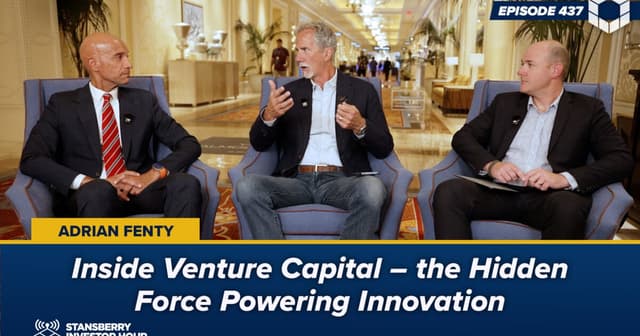

Inside Venture Capital – the Hidden Force Powering Innovation
In This Episode
On this week's Stansberry Investor Hour, Dan and Corey welcome Adrian Fenty to the show. Adrian is the founding managing partner of MaC Venture Capital, an early-stage venture-capital ("VC") firm investing in visionary founders. Before breaking into VC, Adrian was the mayor of Washington, D.C. from 2007 to 2011.
Adrian kicks off the show by discussing how he transitioned from politics to VC, starting with investing in education-technology companies and working at established firm Andreessen Horowitz. As he explains, VC is still the Wild West of investing, so he searches to find "technical" founders with big ideas. Adrian also covers which sorts of companies MaC is invested in right now and how he helps them grow...
Where we can be very helpful is on strategy – particularly fundraising strategy. Because that is something that a venture capitalist sees all the time. We've got much better pattern recognition than them. So we'll say, "OK, no, don't do that. Don't just reach out to one potential investor. Reach out to 10."... [We're helping them by] giving all of them different advice for what they need at different times.
Next, Adrian talks about AI investing in the VC space – what conversations are happening and how companies are keeping up in this new and rapidly evolving ecosystem. He says that the U.S. is "building the future through technology," and it's drawing talent from all over the world. Adrian then discusses why he doesn't encourage early exits, the pattern of larger companies "acqui-hiring" AI engineers and founders from smaller companies, and how he finds promising startups to invest in...
Venture capital is a little more of an art... It's not just about the amount of hours that you put in, although that's important. It's about making sure you're top of mind with really great entrepreneurs who know other great entrepreneurs and that they think highly of you, too.
Finally, Adrian talks politics. Once D.C.'s youngest mayor, he shares his thoughts on city governments and politicians not doing enough for their people, especially in terms of trying to reduce crime and improve public education. His solution for this problem involves putting someone ambitious and qualified in charge of the efforts. Adrian says that, similar to management at successful companies, city officials need to tackle problems head on and not let them fester. He then finishes with a discussion about Americans "letting politicians off too easy," gives his opinion on the upcoming New York City mayoral election, and argues that the government needs to be held to higher standards...
If someone came in to me and said, "OK, we're going to rebuild these three schools in two and a half years," I would just tell them, "No, that's not good enough." It seems like a very simple thing, and it sounds like I'm someone who doesn't know construction – both things are true. I don't know construction, and it is a very simple thing. But I know that that's too long. And so give me a date that's shorter... Government would change so much [if officials did this].
Click on the image below to watch the video interview with Adrian right now. For the audio version, click "Listen" above.

(Additional past episodes are located here.)
This Week's Guest
Adrian Fenty is the founding managing partner at MaC Venture Capital. The firm has more than $500 million under management and 120-plus companies in its portfolio. Prior to MaC's founding in 2019, Adrian was co-founder and managing partner at M. Ventures, special adviser at Andreessen Horowitz, and a consultant for Rosetta Stone, EverFi, and several software startups.
Adrian is also a former two-term city councilmember and was mayor of Washington, D.C. from 2007 to 2011. After leaving office, he initially worked at two different law firms (Klores and Associates and Perkins Coie) before getting involved in the VC space.
Dan Ferris: Hello, and welcome to the Stansberry Investor Hour. I'm Dan Ferris. I'm the editor of Extreme Value and The Ferris Report, both published by Stansberry Research.
Corey McLaughlin: And I'm Corey McLaughlin, editor of the Stansberry Daily Digest. We're here in Las Vegas at our annual conference talking with Adrian Fenty, former D.C. mayor and managing partner at MaC Ventures.
Dan Ferris: Adrian, welcome to the show.
Adrian Fenty: Thank you so much.
Dan Ferris: Yeah, glad to have you.
Adrian Fenty: Excited to be here.
Dan Ferris: So, just before we hit the record button, Adrian and I were talking and I was trying to remember in the few hundred podcasts that we've done since we started doing this, since I started doing it seven years ago, I don't think we've ever had a venture capitalist on the show.
Adrian Fenty: Amazing.
Dan Ferris: I think you are the – I think you are it. You are the first.
Adrian Fenty: I'm going to try and do well.
Dan Ferris: Right. So, of course, as a firm, we're focused more on publicly traded securities, so that sort of explains it. But not really. I mean, you guys are out there.
Adrian Fenty: Yeah, I mean, it takes a while but startups become great public companies, as you can look at the top of the Nasdaq.
Dan Ferris: Exactly. Exactly. This is where it all starts. Now, before we get into exactly what you do, the portfolio and everything, since you're a new guest to our audience, maybe tell them a little bit about – I was particularly interested in what you did with EverFi, Rosetta Stone. They were earlier in the career.
Adrian Fenty: Yeah.
Dan Ferris: All right. Maybe –
Corey McLaughlin: In the investing career.
Adrian Fenty: Yeah, so –
Dan Ferris: The investing career. The political thing, yeah, that's a whole other thing.
Adrian Fenty: Yeah. So, I spent 10 years in politics and my greatest – your greatest thing that you did wrong can be your greatest thing that you did right. And that was education. It wasn't the most popular thing but a lot of people appreciated it. And one sector that appreciated it was education technology companies because education technology companies usually have really bright innovative founders and engineers who have a great product that can usually help kids do better in school. But schools are so slow in buying. They mismanage their money, so they don't have money readily available.
So, long story short, when I left politics, a couple of education technology companies, EverFi and Rosetta Stone, hired me to just help them talk to school systems so that their product could be more widely received. And that was the first step for me in becoming a Silicon Valley venture capitalist because I got the bug; I started working with all different variety of startups. I made my first trip to Silicon Valley, kind of fell in love with how excited people were to shake things up. That's kind of my mantra. And it just seemed like, wow, the future was really being painted – this was 2011, 2012 and people had no fear of failing. More than anything else, that was the one thing that I just felt so excited about. And the rest is history. For the last 14 years, I've made so many trips to Silicon Valley. I'm now a resident of Menlo Park. I have a house there. And as you said, I cofounded a venture capital fund after I worked for a pretty established one for four years.
Dan Ferris: A pretty established one called...
Adrian Fenty: Andreessen Horowitz.
Corey McLaughlin: Slightly established, yeah.
Dan Ferris: A pretty established one. That might be an understatement.
Adrian Fenty: Yeah. Yeah. And what was amazing. I joined September 2012, and they were pretty well known then, but we had less than 50 people, just six general partners.
Dan Ferris: That's cool.
Adrian Fenty: It's quite – just like so many other venture capital firms on Sand Hill Road, it's quite amazing to see the organizations they built, but more importantly, the founders they back. When I was at Andreessen Horowitz we looked at very early stages of Lyft, GitHub, Oculus, so many other companies that have gone on to not just be unicorns, but decacorns. And that's just awesome to believe in a founder, believe in a team before they've actually made it. I don't think in business there's really anything that could be more rewarding.
Dan Ferris: Wow. Yeah, that is pretty cool. In the VC business, you kiss a lot of frogs to get to those few unicorns and decacorns though, don't you?
Adrian Fenty: Well, yes. But I will say sometimes, sometimes I find myself saying, "I can't believe we just passed on that company because that company is like – all the engineers are brilliant. They're going to do well. We know they're going to do well." But venture capital, like we were saying before, we've got to – it's really kind of a wild, wild west. We can't just invest in companies that we think are going to do well. My parents had a running shoe store that's still around 41 years later. That's obviously a business that's done well. But that's not – it's not a venture capital-backed business. And so many of the ones we look at, as you say, we have to pass on because even if they do well, they won't become billion-dollar or multibillion-dollar companies. So, you end up backing these incredible founders who have only the biggest ideas. And often, whenever a company doesn't work out, it's usually because the idea wasn't big enough. So, it's okay if they fail, but just if it works, it's going to be incredible.
Dan Ferris: Right. So, the analog for me here is exploration mining. I've known plenty of people in Toronto and Vancouver and they'll run a portfolio of 100 names. And maybe some significant number of them just will never hit that big deposit. They just never quite get there. And then, of course, a handful of absolutely enormous winners amortizes all loss and provides sometimes breathtaking return.
Adrian Fenty: Precisely.
Dan Ferris: Sounds like what you do.
Adrian Fenty: No, that's exactly what we do. And it's a rewarding job because it's both an art and a science. You can really de-risk it up to a point. And up to that point, then you really just have to go with your gut, which I love. I love going with my gut, especially when it's betting on people.
Corey McLaughlin: Yeah, I've talked to other venture people before and they say a lot of it is betting on the people.
Adrian Fenty: Yeah.
Corey McLaughlin: In addition to, I guess, if it's a big enough idea, that goes for you.
Adrian Fenty: It really is betting on people, particularly in software, because almost invariably, whether it's consumer, like a Facebook or whatever, or enterprise, there's going to be some pivots. So, you want to invest in a founder that is so amazing that they will figure out, like water, what the right path is and then jump over every obstacle. Hardware can actually be a little bit different. Most of our hardware pitches, still amazing founders. They still have to get over obstacles, but usually with our hardware companies, particularly deep tech like aerospace and defense, what they say in the pitch is pretty much what they're going to be doing five to 10 years later. They're going to have to stay – so, that one's a little bit more of a science.
Dan Ferris: Science, yeah. They would never hire me.
Corey McLaughlin: What's the scope of subjects' businesses that you're interested in? I mean, is it – what are you – yeah, what are you most interested in?
Adrian Fenty: Yeah. No, I mean, I try not to go into any pitch with any preconceived notion about what vertical I like, what needs to happen to a vertical or anything. If I thought that, I would just found the company myself. I think there are people out there who are born founders who are really smart, who have ideas. My job as a venture capitalist is to find those people. One of the things that Andreessen Horowitz teaches anybody who works there is you really have to invest in technical founders. And that is because usually the problem is so difficult that you have to be technical to solve it. Two, to build a defensible moat, it helps also to have a great engineering product. And three, to scale fast. To scale fast, you really need something that is a technical engineering challenge.
That being said, just to name a few of the things that we've been investing over the years, certainly obvious things like health tech and fintech, and that includes blockchain and cryptocurrencies. But quantum computing. The last 18 months have been, for – at least for me, a majority of the deals have been AI and machine learning.
But we took an early interest on aerospace and defense and deep tech. Our most valuable company in our portfolio right now is an aerospace company out of Seattle called Stoke. And I mean, just quite frankly, I worked in government, I worked in Washington D.C., I'm a fan of aerospace, but we didn't really know anything about aerospace. But we were introduced to this team who had been at Blue Origin under Jeff Bezos and they had this idea that they were going to build a company with reusable rockets, full reusability, both first and second stages that could go up into orbit, taking satellites on a daily basis. Maybe even a couple of times a day.
And so, remember what we said earlier, that you have to have a really big idea. Well, that's a really big idea because if you're taking satellites up to space, not only are you changing the future of the world but you're also probably going to make a really big lucrative business out of it. And so, we invested in them, like 2020. Actually, the first company when the pandemic hit that we invested in. And now they just raised $500 million in their latest round and are doing very well. And so, you become an expert over time. And now we've had – now we've got lots of aerospace and defense investments because we were successful with that first one.
Dan Ferris: So, you don't write $500 million checks, though, right?
Adrian Fenty: Right.
Dan Ferris: Okay. Yeah. That's – I just want to make that clear. The $500 million round, did you guys participate in that or –?
Adrian Fenty: No. So, these are great, great questions. So, we participated in the first three rounds. So, that would have been seed A and B. I think that – I don't know, that maybe got us to – that probably got us to nine figures. But no, these are much bigger funds. The latest one was actually Thomas Tull's fund. I think he's got a billion-dollar fund. Yeah. And there's a number of people in it. But yeah, that's what happens in venture capital. You participate as long as you can, as long as it makes sense. But we really don't write checks. I think our biggest check is about $4 million and we normally write a check between $1 million and $3 million. Going forward, maybe we'll raise bigger funds and write bigger checks. But right now we're pretty much seed stage investors.
Dan Ferris: And how many names are you in right now?
Adrian Fenty: How many portfolios?
Dan Ferris: Portfolios?
Adrian Fenty: Companies?
Dan Ferris: Companies.
Adrian Fenty: Over a hundred by now because we're on our third fund. Each fund averages about $150 million and we – so, yeah, we're over a hundred companies now. Yeah.
Dan Ferris: That's what it takes, huh?
Adrian Fenty: Yeah, I mean, it's funny, we've been around since early 2019 for this fund. I started investing on my own in 2017. But look at how many cycles we've seen. I mean, we've seen San Francisco go from being way up to way down. Now it's way back up again with AI and lots of other stuff. We've seen cryptocurrency go – I mean, it was probably – it's been $5,000 since we had it in our fund and now it's gotten up to $125,000. You know what I mean?
Dan Ferris: Cool.
Adrian Fenty: Yeah, so it's amazing.
Dan Ferris: So, let's do this. Okay, so we've seen – we're talking about getting into the fund. The size checks you write, the kind of companies you look for. And then we'll talk about exits later. What about when it's a portfolio company of your firm? What do you do? You write a check and say, "Good luck"?
Adrian Fenty: No. I mean, I'm going to be in New York Wednesday and I'm arranging meetings with all of our New York-based portfolio companies and so that I can touch base with them, maybe do a walk with them, have coffee with them. And in those – and then we have conversations every month, every quarter with them. And in those conversations what you're looking to do is you're looking to figure out how you can be helpful. And sometimes you already know and you're ongoing introducing them to potential customers or people who can work at their company. A lot of times – like, we did a catch-up with a portfolio company that's raising their next round this morning. We were just – we were looking over their data room because we're like family. So, they don't have a whole big team that they can show their data room or other things too. So, we're looking over it to say, "Hey, change this, change this, give them advice." A lot of giving advice. A lot of being a sounding board. And then key introductions to different parts of their go-to market as needed.
Dan Ferris: The sounding board function is interesting to me. I can just – you've got a lot of young people probably with huge ideas and lots of energy and intelligence and skills. And I mean, with 100 portfolio companies, I mean, there has to be some probability that you're going to be the sounding board for some of the worst ideas you've heard. Do you ever panic? Do you ever – well, you just wrote a $3 million check and then somebody says, "Hey, what do you think of this?" And you say, "Oh my goodness"? I mean, in other words, what I'm getting at in a comical way there is how interactive is that? Do you push back and say, "No, you're not doing that" or would it be "Hmm, let's see"? How would that conversation go if you heard something you thought was a troubling direction, let's say, just hypothetically?
Adrian Fenty: We would very rarely do that, particularly on things that are really core to the founders' knowledge base, whether that's – usually the engineering but sometimes they're earned secrets. They stay in venture capital they need to have an earned secret. So, again, I'll use the aerospace example. So, someone who's worked at Blue Origin for almost 10 years, it would be silly for me to say, "Don't use this type of thing." That wouldn't make any sense. But where we can be very helpful is on strategy, particularly fundraising strategy, because that is something that a venture capitalist sees all the time. We see – so, we've got much better pattern recognition than them, so we could say, "Okay, no, don't do that. Don't just reach out to one potential investor. Reach out to 10." You know what I mean? And you want to be talking to different people who can be interesting to you and be helpful to you.
Dan Ferris: Right.
Adrian Fenty: But yeah, but the sounding board thing is really – like I was telling you, my parents had a small business – which my brother now owns too – and it's a franchise. And it's really – my dad was – I think he was 44 years old when he started the business and my mom was 40. You know what I mean? So, they're seasoned. And they've had a long professional life. Even then in their seasoned – they had – they made a lot of mistakes. And it was great for them to be able to go and talk to the franchise, other people's stores, and just say, "Hey, what do you think of this? What do you think of this mistake?" And they very frequently would tell them, "You better do this right away or something bad's going to happen," like over inventory stuff.
So, in some ways, I kind of see venture capitalists a little bit – we have that kind of franchisee role where we're helping all the stores within the franchise by giving them different advice for what they need in different times.
Dan Ferris: Right. And they're – and you are hiring people who, as you say, are very technical. So, like in the aerospace example, you're not going to tell them how to do aerospace engineering but you're going to tell them how to do aerospace business, aerospace fundraising, and aerospace maybe even management or whatever it is.
Adrian Fenty: Yeah. And then when you get – I'm 54. I've served in all these different capacities in life. I mean, I know a lot of people, a lot of companies. There's so many random ways that I end up being helpful to companies. You can't even predict it. I can't put it in our prospectus when we go out to invest. It's just things pop up and we can be helpful and you just never know. And that's what makes it really fun.
Corey McLaughlin: So, I'm curious, right now with the AI space what are you – what are the conversations like with founders there? What are the – I mean, because that's new for everybody, even if you're technical in it. What are the conversations like there? And what's the actual – we're at the point now where we're like, "Okay, what's the actual value?"
Adrian Fenty: Yeah. So, it's been amazing because the ecosystem is changing so fast. The companies that our companies are doing business with are changing so fast. The amount of money being spent is changing so fast. So, most of them, as I said earlier, are pivoting. But not pivoting like they were doing this and they're doing that, more like they were doing this and then they found, "Okay, wow. I didn't know that was a potential way that I could be a part of the ecosystem. I'm going to add that as well. And then I'm going to add that." And they just become bigger and better and stronger. And it's probably happening every three months for every one of our AI investments.
Dan Ferris: So, they're finding their way –
Adrian Fenty: They're finding their way; that's a great way to say it.
Dan Ferris: – because it's new to everybody.
Adrian Fenty: And it's changing so much.
Dan Ferris: Yep.
Adrian Fenty: Yeah. So, most of the AI companies we invest in are – they're helping to build the AI layer, if you will. They either serve other AI companies or they serve other technology companies that are using AI. And –
Corey McLaughlin: What's an example of one? Just –
Adrian Fenty: Sure. So, I'll tell you about a company called Koval. So, this is a woman who worked at Waymo, the famous self-driving company that Google owns. She has created a software platform to help other companies review their LLM, to look at their – to evaluate their LLM, to make sure that it's as accurate as possible. So, I don't want to give any examples, but there's huge numbers of them. OpenAI, Anthropic, etc., etc., but – and there's a lot more. So, that's what her company does.
And then we have other companies that help to do the data labeling for really big AI infrastructure companies. And in every aspect of AI right now there's a potential – in many, not everybody, but in many, there's an opportunity to build a really big business. So, hopefully a lot of these will be really big businesses. But it's just exciting to be on the frontier of building the future. I just find it so fascinating and I feel very lucky to be working in Silicon Valley in this ecosystem at this point in time. It's really a business and economic revolution.
Dan Ferris: It really is. It's like the Internet, but it's not 1999 or 2000. It's like 1993 or something. It's sort of –
Adrian Fenty: I think you're right. But now, I mean, and Silicon Valley still is a very small place. It's still pretty niche but a lot bigger than it was in 1993. A lot more resources available. A lot more people who are excited. Maybe even to the point where there's overexcitement, if you will. But I will take that any day.
Dan Ferris: When you think about your whole portfolio, you say you have three funds now, a hundred portfolio companies, more than a hundred, is there an attempt to sort of – to weight it so it's not too much in one industry and make sure you sort of – are you diversified in the traditional kind of way that we tend to think of a portfolio of stocks, let's just say?
Adrian Fenty: Well, we consider ourselves generalists. So, that means that we should be looking at whatever the best opportunities that come through our network. But like I said, there tends to be – right now, if you – all the best engineers – or, not all but a majority, a lot of the best engineers are working on AI because it's just so exciting and there's so much possibility and opportunity. A few years ago, the same would have been true with cryptocurrency, and maybe in a few years, that'll be true of quantum computing.
I do have one of my partners – there's three general partners who founded the fund – who definitely specializes more in hard tech, which can be software, but it's manufacturing, robotics, aerospace and defense, these types of things. He likes it a little bit more scientific, as we talked about earlier, where these are – what they say they're going to do is pretty much what they're going to be doing in five to 10 years.
Dan Ferris: What do you like? What do you –?
Adrian Fenty: Honestly, I really just want to be blown away by a founder. And I tend to fall in love with a founder being so prescient about the future and having the ability to execute on it, that if they come in talking about something that I hadn't even been thinking about before, but their intelligence, passion, energy, and aptitude, that wins me over every single time. And honestly, it's kind of similar to when I was – my only real big management job when I was mayor. I got really excited in whatever agency someone who was fantastic was talking to me about. So, you know what I mean? If they were talking about street paving but we were going to do it in a different way, or bike lanes, or certainly parks – if we were going to renovate parks and recreation buildings, whatever it was – policing. You know what I mean? If the chief was coming in saying, "We're hiring these new detectives and we're going to reduce our closed cases and –" I just got so excited about it because you just like to be around people who – as I said in my speech, if someone's amazing, it's just so great to be around them.
Corey McLaughlin: Silicon Valley is probably a little more fun than politics, right? And lucrative?
Adrian Fenty: Both are fun. And I mean that – it's so serious. Yeah, I mean, I really enjoyed politics. I'm a political junkie. I find it fascinating and I do feel that the connection between paying taxes and getting some results out of it from elected officials, we need to tighten that connection because it doesn't seem that – the accountability or the elasticity seems to be off.
Dan Ferris: Yeah, there's a lot of slack in that connection. I think we need to tighten that way up.
Adrian Fenty: But – so, I've always liked that and I've always obviously loved Washington, D.C., where I got to serve in politics. But I feel very lucky to have found another profession that I think is just as interesting and really super important and that's future-based. And, well, another thing we don't talk enough about, I think, in terms of Silicon Valley, and you can mean that to mean the greater ecosystem, is how people come from all over the world to be there. That's just amazing to me. In our country, in the United States of America, in this year, we have become so good at this particular thing, building the future through technology, that people from Asia and Africa and Europe and South America, if they can pick one place they want to do it, they come to our country and they come to this one little narrow place. And I happen to be lucky enough to work there. So, I do find that as super exciting.
Dan Ferris: It must be. It must be. It's the center of that universe. Right? It's the force of gravity. It must feel electric to walk around Silicon Valley every day at this time.
Adrian Fenty: I tell you, when I first moved there, I've got to be honest with you, I mean, there's brilliant people in politics. Rhodes Scholars, you name it. I remember thinking to myself, "Wow, I didn't know human beings were this smart." And it's a very – it's a different type of smart. It's very technical, you know what I mean? And then they get really good at building companies too. And the venture capitalists help them. So, it is fun and it's exciting.
Dan Ferris: Let's talk about exits. What is a typical exit look like for your – if there is a typical one?
Adrian Fenty: There almost is no typical one but – so, one thing we were taught at Andreessen early on was you don't want to encourage early exits. You don't want to be that venture capitalist who is encouraging your company to sell. And you don't even want to invest in a company – this is one of the first things I learned. You don't want to invest in companies if someone's coming in to pitch you and part of their pitch is "I think I can exit this company really soon."
And that is not intuitive. I would have thought that good business principles are "Okay, that's great. They're going to tell you how they're going to make money." No, the Silicon Valley way, which was made even better at the firm I worked for, was you want that founder to stay with the company all the way through going public. Now, the truth of the matter is that they don't always do that. If they're really good, someone tries to acquire them and then just like The Godfather, if they make them an offer they can't refuse, then they're going to sell. And that happens. It's happened very interestingly in some of these "acquihires" with some of the AI companies in the last six months, but that's the goal.
Corey McLaughlin: Can you just explain that? Because you mentioned that during the speech too, those hires.
Adrian Fenty: Yeah, well, I mean, Meta in particular hired – acquihired. So, they didn't actually buy the whole company. They acquired part of it. And they acquired certain founders from the company.
Corey McLaughlin: Talent, yeah.
Adrian Fenty: And so, it's like half acquisition, half acquihire. But it shows you, one, how hot the market is, two, that the legacy players like a Meta are not relaxing, that they very much don't want these younger companies to grow up and be bigger than them, and that they don't feel like they can compete with their peers if they don't hire some of the best and brightest. So, that's what I meant.
Corey McLaughlin: Okay. Thanks.
Dan Ferris: Yeah. I've never heard that term, but –
Corey McLaughlin: I know, I hadn't heard it either, but –
Dan Ferris: It makes a lot of sense.
Adrian Fenty: Yeah, usually –
Corey McLaughlin: Maybe that's why I'm not in Silicon Valley right now.
Adrian Fenty: Well, usually an acquihire, if you think about it, it's not really like a great outcome. It's usually like you get hired just for the hiring of the people. But in some of these cases recently, it's been for many billions of dollars. So – and all the investors who invested in the companies very early on have done very well.
Corey McLaughlin: Yeah, that hit me as almost like free agency in sports when you're signing a player for –
Dan Ferris: Yeah, exactly.
Corey McLaughlin: – $50 million or whatever it was.
Adrian Fenty: Yeah, no, it's become like that. I haven't – I don't have all the facts and figures but there's definitely been many reports of really talented AI engineers getting recruited by big firms for millions of dollars, like in sports.
Dan Ferris: So, this is actually – the more you talk about this, the more it fascinates me because you're telling me that, for example, let's say there's two or three founders or something and someone like Meta comes along, and what if they only want one of them? That's got to be an awkward outcome. Does it? No? The first left behind? I mean –
Adrian Fenty: It could be. But I think what's ended up happening is they do that Godfather offer. They make and offer that everybody can't refuse. So, they may take one of the founders into the company and that founder is going to work with Meta and do – but the other ones, they buy them out.
Dan Ferris: I see. Okay. All right.
Corey McLaughlin: Yeah, that's one of the things, you look back at the – all the –
Adrian Fenty: And they're buying the investors out too.
Dan Ferris: I see.
Adrian Fenty: So, the investors – the investor would have wanted the company to go on for a long time, but I mean, they're sitting on probably something equivalent to 20x, 30x, 50x their investment. That makes – venture capitalists have investors also, so that makes our investors happy.
Dan Ferris: Yeah, I mean, I guess if my feelings were hurt and I had tens of millions of dollars in my pocket, it would probably just about level it out. It would probably just about be okay.
Adrian Fenty: Yeah.
Dan Ferris: I see. So, I just want to be clear on this because it's nothing we've ever discussed on the show. Effectively, it sounds like you're telling me that the whole company is effectively acquired. But –
Adrian Fenty: It's different every time. And a lot of this has to do with, I think, regulation. I mean, mergers and acquisitions are regulated. So, if you just acquire part of the company, maybe it's not so regulated. I'm not an M&A lawyer, I'm a lawyer but not an M&A lawyer. So, it's probably as far as I can help you to understand it. But it's very obvious that that's a part of it as well.
Dan Ferris: I see.
Adrian Fenty: And – good. If they can figure out a way to make everybody happy and the companies get better and stronger and the ecosystem gets stronger and the technology gets stronger, it does seem like a win-win.
Dan Ferris: I'm going to try to ask a question without using a certain word, and I'll tell you what the word is after.
Adrian Fenty: Okay.
Dan Ferris: How frenzied is this race in AI? Are you guys working 60, 70 hours a week or seven days a week because you have got to get the best before somebody else gets there? Or – and the word I'm trying not to use is "bubble" because that word gets thrown around with AI all the time, but I don't want to use it because it's just a whole – there's baggage with it that I don't want to get into.
Adrian Fenty: Well, certainly there's no company that is even – in AI that's even moderately successful and growing moderately fast where the founders are – and the employees are not working 70 hours a week. That's for sure. Yeah, I mean –
Dan Ferris: But what about – I'm thinking about you as a firm, though. Is there a real sense that you better get your ass out there because all the other VCs are looking for that unicorn, that AI unicorn too?
Adrian Fenty: Yes, but there's a difference in an operator and a venture capitalist. It's almost like the difference when I was in politics, in an executive and a legislator. The only way to make your company successful is you have to work 80, 90 hours a week. That's the minimum you have to do. You have to work smart. You have to hire great people. You have to have good ideas but you're not going to not work great hours. Venture capital, like I was saying before, is a little bit more of an art. Sometimes, and this has happened before, someone will shoot me a text message that says, "Hey, there's this incredible founder who you have to meet." And that company that – and I mean, that's how I met the aerospace company, is someone sent me a text message – and I just have to be – and the way I – you really just have to be top of mind with a lot of people who know great companies.
But the way to be top of mind with a lot of people that know great companies, there's a lot of different ways to do it. When – again, when I'm in New York this week, I'm going to go talk to a lot of people, and every one of them, when I leave there, they may meet somebody and they'll say, "Hey, I was just with my friend – with friend Adrian and he's a great investor. You should meet him." And it's not just the amount of hours you put in, although that's important, and because you have to read and know what you're doing, but it's also about making sure you're top of mind with really great entrepreneurs who know other great entrepreneurs, and that they think highly of you too, and that they will forward them to you if they hear about a great company.
Dan Ferris: I just realized my question is just so typical of me as a typical sort of public markets guy. I'm just like, "Where's the sentiment indicator? I want to hear you – give me the sentiment indicator." Well –
Corey McLaughlin: Oh yeah, I was just going to say it's different in the public – we're not – you're really betting on the people and the promise of it too, more so than earnings or, I mean, whatever it may be.
Adrian Fenty: And it's like any other kind of relationship type of thing. I mean, all of us have been in – you never know where you're going to meet your next great best friend. You may run into them at a sports game. Or someone who you're romantically involved with. In a funny way, that's kind of how companies – if you take 10 of my best companies, I bet I met all 10 of them in very different ways. I certainly met all 10 of them from very different people. So, it's hard to make that into a science. And if you try too hard, you're going to end up missing out on good deals. So, you just have to be very nimble and on your toes.
Dan Ferris: It just reminds me of stories I've heard of iBankers too, always on the phone, always making connections day after day after day.
Adrian Fenty: It's also like sports, I think, in a way. I remember hearing about these famous recruiters, you know what I mean? Like famous college basketball, like a Rick Patino. You know what I mean? He would go – who knows? You've just got to go – you're never going to know where your next great prospect is going to come from. So, you've got to work really hard and be on your toes, but you've also got to be nimble enough to fly to New York or fly to Las Vegas, wherever that next great talent's going to come from.
Corey McLaughlin: Right. Yeah, and now sports is turning into the venture world too with paying college players and –
Adrian Fenty: Oh, that's amazing.
Corey McLaughlin: – when recruiting and all that.
Adrian Fenty: Yeah, NIL.
Corey McLaughlin: I mean, so – you were D.C.'s youngest mayor and I think you said that you were the – America's youngest mayor for a year?
Adrian Fenty: I was the youngest mayor in a big city for one year and then the mayor of Pittsburgh died and [Luke] Ravenstahl became the mayor and he was way younger than me.
Corey McLaughlin: Okay. But now, obviously, there's so much going on in American cities now for all – I could name off a list of five, 10 huge national topics. What is your view on what is the biggest challenges that our cities face and what needs to be done to just, I don't even know, fix it or build it or develop the cities?
Dan Ferris: Fix it, yeah.
Adrian Fenty: Okay, so here's the dialogue that I do like and I won't to attribute it to anybody. I do like dialogue that says that the cities aren't doing enough, that the cities aren't good enough. I do like that dialogue because they're not. And the bar for how good a city is is way too low. I really don't like when people just think there's always going to be crime in a city or the schools in the city are always going to be bad. Or there's always going to be trash. There's always going to be homelessness. And to be honest with you, there aren't many cities where the people who run those cities don't have that embedded into their mind and they've had it for a while. And so, a dialogue that says that cities are not good enough, I associate myself with that dialogue.
Now, I think that what you do is you hire the best person in your city to come in and make really tough decisions and put that city on a rocket, and everyone else supports that person and gets out of the way. You know what I mean? And to be honest with you, I think that's how you start to bring crime down, increase the performance of schools, have services for people who need them, everything that's important in a city. And then, that's how you get great restaurants and great theaters and great hotels and the streets are clean. I don't think that these are too lofty of a goal. And I do think that the bar is too low.
Corey McLaughlin: The bar is too low. Why is –?
Adrian Fenty: And in some places the bar is so low –
Corey McLaughlin: Why is the bar so low?
Dan Ferris: It sounds like there is – and there is an embedded mentality of the low bar, it sounds like.
Adrian Fenty: Yeah, there is an embedded mentality. I'll talk about San Francisco. I have no problem with that. I think Daniel Lurie is doing a terrific job. And he's only been in office for less than a year. And so, I think he's got their city on the right trajectory. And if he goes for another couple terms and someone really great comes in behind him, I think San Francisco is going to be an incredible city. But for the better part of the whole time I have lived in Menlo Park, not San Francisco, but have gone there to work, the management of the city has been really, really bad. They haven't hired the best people. They haven't used technology and innovation well. There's something called a "broken windows" theory and it became popular around Giuliani. And it means – in New York – if something is not working, you can't let it fester. You have to get at it right away. So, if there's homelessness on the street or people on the street or trash on the street or tents or anything, you have to get it up immediately because if you don't, then some other problem will come in right behind it.
And to be honest with you, if you talk to any great Silicon Valley CEO tech person, they will tell you that's how they run their company. I mean, take Jensen Huang, who runs Nvidia. That's absolutely how he runs his company. That's how cities should be run. And I think I don't – there's so many reasons why we have lowered our standards, but a lot of it is because – honestly, because we're letting politicians off too easy. And they're letting themselves off too easy. And so, when people hold politicians more accountable, I'm first in line to be excited about it.
Corey McLaughlin: Yeah, I guess – and that speaks to what you were talking about during your speech, recounting your D.C. days with trying to reform the school system and then that ultimately being held against you by the teachers union.
Adrian Fenty: Which is fine. Yeah, there should be no person –
Corey McLaughlin: But that's politics, right? That's what –
Adrian Fenty: There should be no person who has higher standards than the city, than the person who is elected to mayor. There should be no person who has higher standards for that state than the governor. And there should be no excuses, and the performance should be to beat everybody else not only in the country but in the world. You should have better performance than anywhere else in the world. And if you're not up to that job, then you should not take the job or run for it. And also, we shouldn't elect those people. So, I have really, really no patience for politicians who mail in it.
Dan Ferris: Do I dare broach the topic of New York City with you?
Adrian Fenty: Gladly. Yeah.
Dan Ferris: Okay. We all know what's happening there, and this election is frankly scaring the daylights out of a lot of people. How do you feel about it?
Adrian Fenty: I don't know either of the people running. You know what I mean? I don't know them personally. Maybe I've met Andrew Cuomo before. Here's the thing. The only way New York is going to continue to be as great a city as I think Giuliani and Bloomberg made it is for great management. Those were two really great managers. You may not like what they did. I never lived in New York. So, people – but without any question, they were hands-on. They had high standards. They held people accountable and they got things done.
So, since then, at least to date, there hasn't been that high level of management. So, the next mayor in New York has to have that high level of management. It doesn't appear right now that either of the people running are the kind of manager that Giuliani and Bloomberg were, but I know that most people in New York hope that they will be. Maybe they'll just completely be different when they get elected than they are. Stranger things have happened.
Corey McLaughlin: It's happened before.
Adrian Fenty: But you will not make the city great if you are not a great manager. All this talk about ideas –
Dan Ferris: Ideology. Yeah.
Adrian Fenty: – ideology, and politics, that's not what makes a city run great. What makes a city run great is great management. And the first rule of great management is hiring amazing people. If you look at the people who work – I don't know the Giuliani administration. That was a little bit before my time. But I know the Bloomberg administration. The people who he hired were just as good, if not better, than people you would find in similar private sector roles. So, whoever the next mayor is of New York or any other city, they have to come in and hire people who are just as good as the private sector, if not better, and then the city will do terrific. That's the only standard we should be thinking about for these politicians. And then they have to make tough decisions because there will be tough decisions. But without having great people, nothing matters.
Dan Ferris: To hear you talk about it, you talk about being the mayor of a big city like it's a real job and that it's not about ideology and it's not about wanting to make all the bodegas public or whatever Mamdani wants to do. It sounds like it's like a job and if you have experience being a very good manager, well, hey, you're probably more likely to succeed.
Adrian Fenty: Well, one thing I would say –
Dan Ferris: Which is so different than the narrative of politics in America.
Adrian Fenty: No, I couldn't agree more. Most people are –
Dan Ferris: Nobody's talking like you.
Adrian Fenty: Most people are – most people pander. They pander to get in office and they pander to stay in office.
Dan Ferris: While in office, yeah.
Adrian Fenty: The one thing I will say is I don't know if you have to be a manager to be a great manager. And I know some people who are great managers who are not great public managers also. You just have to do two things. I always talk about Kennedy and how he was adamant about hiring the best and the brightest to come to Washington because – and two, you have to be impatient. You have to measure three times and cut once. You have to set the highest standards.
What I know about Silicon Valley, great tech companies is that the people who made them great, they set really high bars. And so, for instance, if we had – if someone came in to me and said, "Okay, we're going to rebuild these three schools in two and a half years," I would just tell them "No, that's not good enough." And it seems like a very simple thing. And it sounds like I'm someone who doesn't know construction. Both things are true. I don't know construction. And I don't – and it is a very simple thing. But I know that that's too long. And so, come give me a date that's shorter. And honestly, that was half of what I did as mayor. I would just tell them "No, that's not good enough. You have to do it faster."
And that's – and government would change so much if we had – and that's how the private sector is. That's how all these tech CEOs that we read about – Elon Musk or – I mean, they really demand a lot of out of their people. And you know what's really funny? People really like it. My cabinet, when I tell that story, my cabinet was really upset to be leaving. And I drove them hard. Michelle Rhee, who was our school chancellor, she was one of the toughest managers you could ever imagine. We had a waiting list of 7,000 people who wanted to be teachers in the D.C. public schools because for the first time, they felt like they would actually be held accountable. Who wants to go to a job where it doesn't really matter how good of a job you do? And that's what most governments are. Most people want to go to a job where they – people expect them and demand them to do terrific.
Dan Ferris: Yeah, nobody is demanding people in government to be terrific these days. They're demanding – they seem to be demanding something quite other. But wow, you've had quite a career. Politics, youngest mayor, venture capital. It's pretty exciting to be Adrian Fenty.
Adrian Fenty: It's just great to be around great people. I mean, honestly, it's great to be around – when I was in my campaigns, I mean, the level of how hard people worked, we would knock on doors when it was like 25 degrees and raining outside and people would show up. And it's just as amazing investing in these young founders, because to be honest with you, I mean, they're risking it all. You know what I mean? I'm not just talking about the Stanford kid who drops out and his parents go really – get really mad at him and – because they feel like they're throwing their life – although, we have a lot of those and they're incredible. But all of them. I mean, I've got I've got one new founder. She actually had a baby while we were investing in her company. I mean, so, she's working 80-, 90-hour weeks and she's raising two small kids and her husband – and she's unflappable. I mean, it's unbelievable what she does. And so, they're risking everything to bet on themselves. And it's just fun to be around them.
Dan Ferris: That's super exciting. It really is. So, we're – I think we're just about at time for our final question.
Adrian Fenty: Okay.
Dan Ferris: It is the same for every guest, no matter what the topic.
Adrian Fenty: Oh, wow.
Dan Ferris: Identical question, even if sometimes – every now and then we've had a non-financial guest over the years, same identical question. And it really is just for our viewers, our listeners. If you could just leave our listeners with a thought – like, a typical – the traders that we talk to, they like to say "Let your winners run and cut your losers short." And it could be anything. A core principle.
Corey McLaughlin: Philosophical. Something.
Dan Ferris: Yeah, something philosophical. Some people, they get outside and touch grass. It could be just about anything.
Adrian Fenty: I'll just – I'll say something I said before, but I'll connect it in my world. I'm not from Silicon Valley. I'm not a Silicon Valley insider. I'm not from tech. It's not how I made my first career. I come to this as something of a transplant. But it just makes me super proud that Silicon Valley and all of the associated places, whether it be some other places where people are building great technological products are here in the United States. That we're taking a lead. If I could think of one thing that we would want to be the best at out of all the things we do, besides education, but one thing, it would be that we would be the best in technology and innovation. And at least right now, in October of 2025, we are the best in that. And I think too often, we take it for granted. We don't celebrate it enough. And unfortunately, I think this has changed a little bit recently, but unfortunately, over the last 12 years, I have been going back and forth between D.C. and Silicon Valley, too many Washington politicians really overly critique Silicon Valley and make it hard for these business people to do business, a business that is transforming the world. And I think I'm glad to see that starting to change, and I hope that that's part of the future, that politicians and government, particularly those in Washington, will really celebrate this great thing that America is doing and find every way that we can continue to make it grow faster and go as long as possible.
Dan Ferris: Well, thanks again for being here, Adrian. It was great to talk with you.
Adrian Fenty: Yeah, thank you guys. I really enjoyed it.
Dan Ferris: Yeah, you bet.
Corey McLaughlin: Thanks again.
Adrian Fenty: Thank you so much.
Dan Ferris: All right. Well, that's another interview, and that's another episode of the Stansberry Investor Hour. I hope you enjoyed it as much as we really, truly did.
Announcer: Opinions expressed on this program are solely those of the contributor and do not necessarily reflect the opinions of Stansberry Research, its parent company, or affiliates.
The 2-to-1 Rule That Makes You Profitable
From Tweets to Trades: This Trader Scrapes Social Media for Trading Setups... It BEATS Wall Street
10:1 Risk/Reward: 3 Drug Monopolies Built for Massive Upside

Key Strategies for Reduced-Risk Options Trading