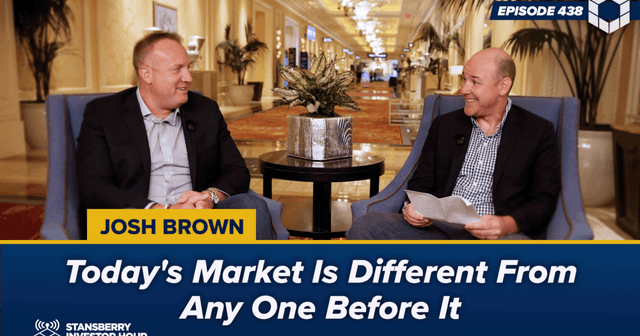

Today's Market Is Different From Any One Before It
In This Episode
On this week's Stansberry Investor Hour, Corey welcomes Josh Brown to the show. Josh is the CEO and co-founder of investment advisory firm Ritholtz Wealth Management, as well as an author and co-host of The Compound and Friends podcast.
Josh kicks things off by discussing how his lack of formal education in economics sets him apart in the world of financial media, the importance of relying on your own instincts, and what it was like interviewing legendary investor Peter Lynch. He also talks a bit about how he got to where he is today, including falling in love with the stock market from a young age and the "anti-mentors" he had growing up who showed him firsthand what not to do. Plus, he shares his thoughts on financial media...
There are people that are vocally displeased with financial TV [or] financial articles. They yell and scream at the Wall Street Journal or Bloomberg or CNBC. I don't [care]. I'm trying to build a business, and I'm trying to help my clients. I don't have any other causes... My job, I feel, is to communicate with the audience that cares about my opinion. And I do the best I can.
Next, Josh explores what's happening with today's bull market – why it's not 1999 all over again, how folks are underestimating the power of earnings, and AI being in a bubble that will inevitably end. After that, he discusses how he helps his clients, why investors should take on risk earlier in life rather than later, and how Ritholtz withstood losing its biggest client a week before launch to grow to where it is today, with more than $6 billion in assets under management. He notes that being able to scale the business responsibly is a balancing act...
We're 80 people. How do I go to 100 people without the firm feeling like it's a totally different place and people saying things like, "Ah man, this has changed"?... I spend a lot of time thinking about that, and not just for the employees' sake but the clients' sake... I don't want my clients to start feeling like it's McDonald's and we're serving 85 billion hamburgers and nobody really cares very much about what's coming out of the kitchen.
Finally, Josh explains an important lesson he learned from Shake Shack founder Daniel Meyer about putting your employees first, why he wrote his latest book (You Weren't Supposed to See That), and what's different about today's market versus past markets. He points out that even when the Federal Reserve was hiking rates aggressively, the economy was just fine, so clearly our current market doesn't adhere to previous norms. And Josh closes things out with a discussion about why we might never again get a cyclical recession and what worries him about today's market. Speaking broadly, he says...
Just recognizing that it is different this time [is crucial]. It's always different. This idea that every environment you're in has to somehow rhyme with a previous environment from the past is just not how it works in real life.
Click on the image below to watch the video interview with Josh right now. For the audio version, click "Listen" above.

(Additional past episodes are located here.)
This Week's Guest
Josh Brown co-founded investment advisory firm Ritholtz Wealth Management in 2013, where he serves as the CEO. He is also co-host on The Compound and Friends podcast, a prominent contributor on CNBC, and the author of four books, including You Weren't Supposed to See That and Backstage Wall Street. Josh is known for his sharp market insights and actionable investing strategies.
Corey McLaughlin: Welcome to the Stansberry Investor Hour. I'm Corey McLaughlin, editor of the Stansberry Daily Digest. Dan is actually on stage, we're at our Las Vegas conference, so I'm riding solo here. But lucky me, we have a fantastic guest, Josh Brown, who just got done doing a presentation on stage and signing copies of his book. You weren't supposed to see that.
Josh Brown: The mood is electric in this place. I don't know if you can feel – from the moment I walked offstage.
Corey McLaughlin: Yeah, yeah, it was a great presentation.
Josh Brown: Yeah, I feel like I really brought it and I'm feeling good.
Corey McLaughlin: Yeah, cool.
Josh Brown: So –
Corey McLaughlin: We're happy for you to be here. You're, of course, CEO of Ritholtz Wealth Management.
Josh Brown: Yes.
Corey McLaughlin: Which now has almost $7 billion of assets under management, you said, and you've likely seen him on CNBC and the great Compound and Friends podcast on YouTube Channel. And perhaps most importantly, you're a Long Islander like myself.
Josh Brown: I am.
Corey McLaughlin: And we're very proud of it.
Josh Brown: But I never left, unlike you. Well, I'm sticking it out.
Corey McLaughlin: It was a little too expensive for me at the time.
Josh Brown: I'm going to ride it out.
Corey McLaughlin: And that's how I ended up here learning about money and whatnot, and listening to cool people like you,
Josh Brown: All right.
Corey McLaughlin: So, we could go a lot of directions here. But maybe – and we'll get into what you talked about in your presentation a little bit. But I just want to start by reading something back to you that you wrote in a blog post last year that I think we'll kind of set the stage for our listeners and viewers pretty well.
Josh Brown: I will not confirm or deny that I actually said this.
Corey McLaughlin: If that's OK.
Josh Brown: OK. Until I hear it.
Corey McLaughlin: June 2024 on your website.
Josh Brown: OK.
Corey McLaughlin: "I'm a former stock broker with no formal education in economics or econometrics," which the latter word, I couldn't tell you what it means with a dictionary in my hand –
Josh Brown: That's true.
Corey McLaughlin: – which incidentally is very funny because our director of research, Matt Weinschank, great guy, has a master's degree in econometrics.
Josh Brown: Well, holy sh**. That's the man I need to talk to.
Corey McLaughlin: He's around. You can talk to him next. You went on, "I don't know anything. I started in this business cold calling Dun & Bradstreet index cards with the names and phone numbers of business owners. I'm an alumni of the speculative fever swamps of stockbroker land in Syosset, Long Island. No pedigree. Classically trained with a plastic black telephone, a headset, and an Acer monitor running Quotron."
Josh Brown: Yeah.
Corey McLaughlin: "But like most of you, I have my own two eyes and two ears and try to understand what's going on. These have been valuable if we've learned how to use them." I think that that says a lot about what you do, I think.
Josh Brown: Yeah. Look, I get to meet a lot of really brilliant people and a lot of people that do have a substantial, impressive pedigree where they went to school, what degrees they have, PhDs, where they worked, what their first job was, who their mentors were. I get to meet very impressive people. I think what I bring to the table as not being one of those people, I think I am both the go-between between those people and the audience and I'm also in the audience, too. So, that's the way I see myself and my place in the financial media. And I'm very comfortable with that. I think I'm smart. It's not that I think I'm like an idiot. But I don't put on airs and I don't come from a place of "I know everything, therefore listen to me." I have opinions. I fight for them, change them. I think that comes through. I think that's what my audience appreciates about what I do. And it's still sort of unique. I think most people in the financial media, they only want you to know how smart they are and how great they are. And I guess I've never really come from that place. And hopefully people appreciate that.
Corey McLaughlin: That's kind of what I was going to ask you, was why do you think it's so hard for so many other people to learn to trust their eyes and ears?
Josh Brown: Oh, that's easy. Oh, wait, I thought you were going to ask me a different question. I jumped the gun.
Corey McLaughlin: Which –?
Josh Brown: Why is it so hard for people to not act that way?
Corey McLaughlin: No, why is it so hard for people to trust their own eyes and ears in investing in general?
Josh Brown: Oh. Well, a lot of people shouldn't, because if you don't have a lot of experience and you haven't been around that long, you should be in search of other people's opinions. And I don't trust my own eyes and ears when something's wrong and I go to a doctor. I kind of want to defer to the doctor. So, I do think that there is a place for putting trust in professionals and listening to people who know what they're talking about. But I also think people should have some confidence once they've been in the investing business or the investing game for long enough. They should sort of be able to rely a little bit on their own instincts. And it's a process like everything else.
Corey McLaughlin: What question did you think I was going to ask you?
Josh Brown: I have no idea.
Corey McLaughlin: OK.
Josh Brown: No, but you know what? I – so not to brag. I interviewed the greatest investor of all time 10 days ago.
Corey McLaughlin: Peter Lynch.
Josh Brown: Peter Lynch.
Corey McLaughlin: I watched it.
Josh Brown: OK. So, I asked him, I said – so, he wrote the definitive book for individual investors, one of – maybe the bestselling investment book of all time, One Up on Wall Street. Still a classic. And I asked him after all these years later – he wrote it, I don't know, 30, 40 years ago, ish, late '80s – what is that, 36 years ago?
Corey McLaughlin: Yeah.
Josh Brown: So, I asked him, "Do you still think after all these years, now we have institutional investors who are armed to the teeth with data, Bloomberg's, and charts, and statistics, and high frequency trading tools, do you still think that the regular investor can do it themselves and can be one up on Wall Street?" And he said, "Yes. The names change, stocks change, the market's sped up. There's a lot of things that are different, but if you have common sense and you're willing to do research, you can still do this." So, I think that's a good message. And I appreciated hearing Peter say that after all these years.
Corey McLaughlin: Yeah, well, what was that like sitting there interviewing him?
Josh Brown: Oh, nuts.
Corey McLaughlin: Hhe had to – he was one of your idols, right?
Josh Brown: The craziest thing I ever – so, you have to understand when I started in the business I was 19 years old. It was in between my freshman and sophomore year of college. I was a cold caller one summer. And the first book they gave me – this is 1996. I was 19. They say, "Read this." I had no idea what – I read it. I had no idea what any of the words in the book meant. I just listened to them.
Corey McLaughlin: This is very familiar to me, by the way. Yeah.
Josh Brown: But I read it. And I revisited it since, once I knew what the hell I was doing, but that's foundational for me. So, to get to sit next to him and interview him for a live audience, it's like the most insane thing – it's probably one of the top highlights of my career. So – this is great, too. I don't want to give you the impression that that this is not – no, this is cool.
Corey McLaughlin: Oh, me and Peter Lynch? Yeah, OK. All right. OK. OK.
Josh Brown: This is cool, though .
Corey McLaughlin: Well, just so you know, this is up there for me as well –
Josh Brown: All right. All right. I appreciate it.
Corey McLaughlin: – because you've established yourself clearly as a – probably one of the most prominent market commentators out there, right? People know you from –
Josh Brown: For better or for worse.
Corey McLaughlin: For better or for worse. People know you from CNBC.
Josh Brown: Prominent is a good way of putting it. Yes, people do have to hear –
Corey McLaughlin: Well, I'm a writer by nature, so I'm better with words than talking.
Josh Brown: So, I don't know if this comes – I hope this comes across. I love the stock market. I fell in love with it at that age and –
Corey McLaughlin: Why did you fall in love with it?
Josh Brown: I just – so, I watched the senior brokers. I was not licensed, so I could not pitch stocks. I was a cold caller, just connecting people. I was like, "Hey, do you want to hear a stock idea? Hang on." Like that. But I got to watch these guys do what they did. And of course, it's silly now. Nobody does this anymore. But for a very long time, that's how people bought stocks. They were pitched an idea. And so, in that summer, I watched Callaway Golf, Snapple Iced Tea, Boston Chicken, they all came public. And I watched these guys pitching these stocks and telling the story of why people should buy them. Boston Chicken didn't work out so well. I don't know if you heard. But –
Corey McLaughlin: Snapple is good, though.
Josh Brown: – I was captivated by the idea that anyone could learn the story of a company, put money, invest directly into it, and have that grow and become more money. I don't gamble. We're in Vegas. I didn't even look at a table or – I don't have that gene. I don't have the gambling gene. It's not exciting for me. I don't get much out of it when I win, so I don't even bother. But I have the investing gene, and I get really turned on by that idea of "Wait a minute, these are publicly traded companies. Anybody can buy in. All you have to do is learn the story and be right eventually and you can make more money. That is the coolest thing on earth." And I still feel that way all these years later.
Corey McLaughlin: Yeah, no –
Josh Brown: Twenty-eight, 29 years, I still feel that way.
Corey McLaughlin: Yeah, no, it definitely comes through it, right? So, did you have any influences, mentors, like from your family – before you got into the business, who were interested in businesses and stocks, from your family or anybody? How'd you get into that interest –?
Josh Brown: So, the last chapter of my book actually tells the whole story, but I'll give you the abbreviated version. I had anti-mentors. I had people that I was only able to learn what not to do from.
Corey McLaughlin: Yeah, which is valuable.
Josh Brown: It doesn't feel that way in the moment. I worked for pirates, gangsters. These were guys that were running some of the most notorious boiler-room brokerages in the history of – I wouldn't even call it Wall Street because all of this was Long Island, Brooklyn, Staten Island, New Jersey, Boca. These firms –
Corey McLaughlin: An extension of –
Josh Brown: These were firms that – it was before it was called FINRA. It was called the NASD. The NASD had all of these firms on a list of "Companies we need to close down." That's where I learned the business. Not on purpose. I didn't know any better. All the guys were in suits. They all drove Porsches. I just assumed these were successful people. But they were anti-mentors. And I guess that's not the worst thing. But I watched what they did with their clients, to their clients. And I just – all the lessons were "All right, never do that." And I accumulated a lot of that. And that, I guess, is what enabled me to figure out "OK, what – so, if I don't want to be that, what do I want to be?" So, that's the sort of mentor. For better or for us, it all worked out OK. I'm not complaining. But I didn't – I never had a role model in the early days of "This is who I want to grow up to be in this business."
Corey McLaughlin: This is – might be a tough question to answer, but do you feel financial media is – how close is it to the ideal of what you would want it to be? In general.
Josh Brown: I don't care. I don't get upset. There are people that are vocally displeased with financial TV, financial articles. They yell and scream at the Wall Street Journal or Bloomberg or CNBC. I don't give a sh**, honestly. I'm trying to build a business and I'm trying to help my clients. I don't have any other causes. I don't – I'm not looking for revolutions. It doesn't faze me, to be honest. I show up. I do financial media. I'm a guest. I'm a host. I'm a contributor. I am what I am. And my job, I feel, is to communicate with the audience that cares about my opinion. And I do the best I can.
Corey McLaughlin: Can we talk about – maybe a little bit about what we're seeing right now in the market? A little bit maybe about what you talked about on stage? We're in this bull market that just keeps on going.
Josh Brown: Yeah, I think it's a bull market.
Corey McLaughlin: And the AI trends and –
Josh Brown: I think it's a bull market with some bubbles within the bull market. And some of them are small enough that they are no need for concern. And some of them are maybe in the foothills of becoming really big bubbles. And I wouldn't say we're in a full-fledged mania. I don't think this market is as reminiscent of 2021 as a lot of people do. I don't think it's 1999. And I was there, so this is not something I read about in a history book. I lived it. I really don't think it's that carried away. I just think it's a regular bull market, and yeah, there are some people acting extremely speculatively. And what would you expect? They've made a lot of money doing so.
Corey McLaughlin: One of the things you talked about was just how underestimated the earnings, the power of American companies, the potential of American companies to just keep increasing their earnings over the last –
Josh Brown: I think it's the whole thing.
Corey McLaughlin: – 40 years. Yeah.
Josh Brown: The two things that actually matter for stock prices are earnings and interest rates. There's other factors. There's regulation. There's economics. There's demographics. There's geopolitics. Of course, there are a lot of things. But when you boil down what fueled bull and bear markets historically, were earnings growing or not, and were – was the cost of money rising or falling? So, here's what we have right now: sustained earnings growth and falling interest rates. I don't really think it's more complicated than that.
Corey McLaughlin: Everybody wants to know if –
Josh Brown: Everybody wants – you talked to everybody?
Corey McLaughlin: Everybody.
Josh Brown: OK.
Corey McLaughlin: A lot of people want to know about is this AI going to end up – is the AI trend going to turn into a bubble? Is the boom going to turn into a bubble?
Josh Brown: Yeah.
Corey McLaughlin: It is?
Josh Brown: It's going.
Corey McLaughlin: OK. Do you think we're in, like, '97-ish?
Josh Brown: Oh, man, I wish I could be the person that could tell you that definitively.
Corey McLaughlin: But you do think it'll end up in a bubble?
Josh Brown: Yeah, it always does, though. It's not a profound statement. People are like "This isn't going to end well." Well, it never ends well. There's a great – one of my favorite lines from the movie Cocktail. How old are you?
Corey McLaughlin: Thirty-nine.
Josh Brown: Remember Cocktail?
Corey McLaughlin: No.
Josh Brown: No. All right, Tom Cruise at his apex. Peak Tom Cruise. It's got to be '89, '90.
Corey McLaughlin: OK. Yeah. I was young. So...
Josh Brown: Anyway, Elizabeth Shue is his girlfriend, and they're dating and then they start fighting. And she – her family doesn't approve of him because he's just a bartender and she's like a rich girl. And they have this fight and she says something to the effect of "I don't want this to end badly." And he says, "Everything ends badly. Otherwise, it wouldn't end." It sounds so simple but it's so profound. Of course this ends badly. We – the only question is when and to what extent, like how bad? But it's OK. Other bull markets have ended badly, too, and here we are. So, I – I'm not good at that game, like what inning are we in.
Corey McLaughlin: Yeah. OK. Fair enough. So, how do you translate kind of the way you think about the market and about all these things we're talking about into advising clients? That's a whole nother thing. You can have your view, but then your relationship with clients, managing – a lot of times what you would want to do might not match up with their goals or their personalities or whatever.
Josh Brown: Yeah, so I'm of the belief that my client base, they're going to live way longer than they think and they're going to live way longer than the actuarial tables tell you because we work primarily with high net worth. And so, it's one thing to know that the average life expectancy in the United States for men is 74 and for women it's 78 or whatever it is. Amongst the top 10% of wealthy household it's definitely not that. It's way longer. So, people that think they're going to retire at 65 and be dead at 75, it's really not going to go that way. The reality is they could have decades of life long after their earning income, which means they're going to need a lot more money later in life than they think they will, which necessitates risk-taking today.
You can't not have risk. The only decision that you can make is when do you want it? So, we prefer to have people take their risk now while they're still earning money and while they're able to. That means equity-heavy portfolios and the emotional necessity of living through drawdowns and accepting that's part of the deal. You can't have the upside if you're not willing to endure the temporary downside. And the reason that becomes so important is you may have a portfolio – you may have a lifespan that requires a portfolio to grow for a way longer period of time than prior generations. So, our investment philosophy is to just be very aware of that as we build financial plans and then build portfolios that will satisfy those parameters.
And the other alternative is, OK, you don't want to take a lot of risk today. Well, your portfolio will not grow as much as it could have. And then you have risk on the back end of your life. You didn't make enough money with your investments, and now what are you going to do? Now you're out of the most precious resource, which is time. You need time to be able to compound. So, if you are not compounding now, you ain't going to be able to do it later. So, I think we're very frank about the expectations people need to have about taking risk. And I think overall we've done a pretty good job given the growth of the firm and its organic growth. We've given people that message. The market has done very well, so have they, and it's been right.
Corey McLaughlin: How has your firm changed since from the earliest kind of days to now where you've got billions under management?
Josh Brown: Oh, we were cavemen. We started our firm 2013. There were four of us and an assistant. The assistant was right out of college, her first job. One day, she said, "I'm going to go take a SoulCycle class" and never came back. It was like – it was four of us and we all wore 10 different hats. My partner Barry was the – was handling payroll. It was hilarious. He was on the phone with health insurance providers.
Corey McLaughlin: HR, yeah. All right.
Josh Brown: I was licking FedEx envelopes. This is – you start a firm, it's a guerrilla campaign. It's just like –
Corey McLaughlin: Who was your first client? Do you remember?
Josh Brown: We started the firm with $65 million in assets.
Corey McLaughlin: $65 million. OK.
Josh Brown: We lost our biggest client the week before we launched. It's a true story. Our biggest client was $10 million.
Corey McLaughlin: Wow.
Josh Brown: So, we thought we were launching with $75 million. And he called us up. He says, "I know you guys are about to leave and start your new firm. And I feel really bad telling you this, but I just bought a vacation home on the Jersey Shore and I need to borrow money to close the transaction. I'm not – I can't get out of my company stock to do this, so I kind of have to do a securities loan." And I'm like "Well, I don't know what that is." He's like, "Yeah, no, I know you guys can't do that. But Goldman's going to do it for me." So, he's like, "I love you. I love you guys. You've done a great job. But I literally have to borrow $5 million against my portfolio right now."
So, that was scary. So, we launched the firm minus our biggest client. And the universe kind of conspired to make it work. We put it on our blogs. I still have the link to the blog post I wrote. Barry wrote a blog post, like "Hey, we are now Ritholtz Wealth Management. We launched our own firm." And people just came pouring in. It was the coolest thing ever. Not only did people call us to open an account, they were sending gifts. Somebody sent a case of beer and opened an account. It was just – it was a really special thing. And we realized very quickly "Holy sh**, we actually don't know what we're doing in a lot of areas." The good news is not only did clients come pouring in but potential hires. So, we just got inundated by people that wanted to work with us. And that enabled us to actually build something that has obviously grown. But we needed a lot of help. We didn't even know what we needed until we found it.
Corey McLaughlin: And I guess that there was so much interest right off the bat probably speaks to the –
Josh Brown: Well, so that's the part we didn't know what we were doing. We were very good communicators and we had built up this really great track record saying smart things and sticking to our guns and not panicking people for clicks. And when others were writing these hyperbolic headlines about double dip recession and it's 1937 and all this sh**, we would debunk that stuff. And people over time really grew to appreciate our message.
Corey McLaughlin: Build trust. Yeah.
Josh Brown: And so, we had that trust with the audience. So, that part wasn't terribly surprising. I just didn't imagine the extent. I didn't know that we were going to be able to – we've grown at a [compound annual growth rate] of, like, 37% organically over the last 12 years. We're still at that same growth rate and I never could have imagined it. So, fingers crossed, things have gone pretty, pretty good. And we hope it'll continue.
Corey McLaughlin: What are your goals now for the firm overall? You just keep attracting more and more clients? Or –?
Josh Brown: So, what's changed now is we have a lot of employees who are counting on us for this place to last forever. We have a lot of young, hungry, hard-working, dedicated people who love the firm. They fight for the culture. They really care about what happens. And I have to figure out as the CEO – and I've never owned a business before so I'm learning on the job, but I have to figure out how do I scale and continue to grow so that we can do more things for clients and we can provide backups and backups to the backups for our employees so people can be on vacation and the wheels don't fall off? How do I scale but not lose the thing that made us special in the first place? How do you – so, we're at 80 people. How do I go to 100 people without the firm feeling like it's a totally different place and people start saying things like, "Oh, man, this has changed. This used to be great. I don't know what happened." That's the thing that I view as my primary responsibility, is to scale responsibly. And I'll let you know how it goes. But that's –
Corey McLaughlin: We'll watch how it goes for sure.
Josh Brown: No, people are like, "What do you think –" not "What keeps you up at night?" but "What's on your mind? What do you think about?" That's what I spend a lot of time thinking about. And not just for the employees' sake, for the client's sake. I don't want the clients –
Corey McLaughlin: That kind of your DNA goes through the whole thing.
Josh Brown: We think of ourselves like Peter Luger. Best steakhouse in the world. That's what we think of ourselves. That's our opinion of our own service. I don't want my clients to start feeling like it's McDonald's and we're serving 85 billion hamburgers and nobody really cares very much about what's coming out of the kitchen. So, I use a lot of restaurant analogies because I'm a big restaurant connoisseur.
Corey McLaughlin: You like food.
Josh Brown: No, but that's how – can the firm 2x and 3x from here, but still feel the way it's always felt?
Corey McLaughlin: You talked about on stage that you have, what, four meetings with families before you even put the money to work. Is that essentially right?
Josh Brown: Yeah. So, this is our – this is one of our natural advantages over other [registered investment advisers]. And we don't really see other firms as competitors. I know they are. But we're very collaborative within the industry. We throw an event called Future Proof every year. We had it last month in Huntington Beach, California. Five thousand financial advisers came from all over the country, all over the world. So, we don't – they wouldn't come to our event if they thought we were ruthlessly competing against them. But – what was the question? Oh.
Corey McLaughlin: About the families, bringing in families.
Josh Brown: Our natural advantage is that when we talk to a family who wants to become a client, if what they're looking for out of a financial advisory firm is reasonable, we're very certain we're going to win the business. It doesn't matter who else they're talking to because we've built up a trust with those people way before they ever reached out to us. They didn't – we didn't randomly find them. We weren't assigned them at a Schwab or a Fidelity branch like a referral. These are people that listen to us religiously.
Corey McLaughlin: They found you at some point.
Josh Brown: Yeah, they believe in what we're saying. So, it's like we're going to win that business. So, as a result, we're able to do three and four meetings before we get paid a dollar. We're able to do all this upfront legwork. We can commit to doing that because there's a very high likelihood that that person is going to become a client. Most firms can't afford to do that level of work prior to onboarding a family. So, that's one of our natural advantages of having built a fan base that becomes a client base.
Corey McLaughlin: Cool. All right. You mentioned Peter – the Peter Lynch interview before. It's the highlight of your career, not this. That's OK.
Josh Brown: No, you're like – this is like top 50.
Corey McLaughlin: OK. [Laughs] You – and the lessons that you learned from Peter Lynch, are there any – maybe one or two or three things that – lessons that you've taken from interviews that you've done? Or what not – from the last 10 to 20 years that you've kind of directly applied to how you manage the firm or how you manage money?
Josh Brown: Yeah, I think – so, I think I've learned little – large things and small things from people, even if what we do looks nothing like what they do. So, one of the first really established super successful people on Wall Street that actually took an interest in me is Jim Chanos. Chanos is obviously brilliant and one of the most successful people on Wall Street. We don't – nothing that we do is apples to apples with what he – he's a short-biased hedge fund manager. It looks nothing like us. But I learn things from listening to people like that.
And you don't always realize what you're absorbing. It's not always some direct piece of advice, like, "Never do this on Tuesdays." "All right, I won't do that on Tuesdays." Sometimes you're just watching the way people carry themselves or how they think about the market. Or how – you watch people, how they're building their enterprise. So, I've met amazing business people who don't even work on Wall Street and I've picked up things about how they've built what they've built. My idols are people like Danny Meyer, Union Square Hospitality Group, founder of obviously Shake Shack but some of the best restaurants in Manhattan. He's got a book called Setting the Table. And it's just about hospitality. And his philosophy is people say they put their customers first – he actually puts his employees first, because if you put your employees first, they're going to put your customers first. Like that – those types of things, I absorb stuff like that that's maybe not directly related to money management or investing but it's like "Oh, yeah, that makes perfect sense to me as an entrepreneur." So, there's a lot of stuff like that. And I'm still learning every day.
Corey McLaughlin: Why did you write the book, your latest book?
Josh Brown: The short answer is the publisher told me I should. You don't write books for money.
Corey McLaughlin: Yeah, you do not. Yeah.
Josh Brown: I made a little bit of money, but it's like if you were to take the amount of hours and divide that by how much money you made, it's less than a minimum wage job. So, that's not really the thing. The thing with the last book is I wanted to put a capper on an era of time in my life and in the markets and just put a punctuation mark after it. So, this is a collection of everything that I wrote from the start of my blog, my first blog in 2008 to the end in '23. And I put an end to the blog in '23 and this was all of the best lessons and ideas and takeaways and insights from that period. So, I think it's a really great way to learn all the things – or, for people to get this panoramic view of everything that went on in the markets and in the economy. And then also, there's a lot of personal stuff in there. And I thought it was just a nice way to send off that era and begin a new chapter. So, that's the real answer.
Corey McLaughlin: Cool. All right. Let's back to the market for a little bit. You've seen a lot of the market – a lot of market cycles. Is there anything different – and you talked about it a little bit. Anything different about this market now? Or is it the same stuff just dressed up in a different way with –?
Josh Brown: No, it's really different. The market has blown through so many things that used to be norms that just don't apply anymore. There's an open question about whether or not the type of economy that we're in could ever even have a cyclical recession again. I think we'll have recessions. They'll be driven by exogenous events. But in the '70s and the '80s if you raised interest rates, you would basically halt bank lending and that halted bank lending would freeze financing throughout the economy. And then you would have companies dumping inventory and then you would have layoffs and it would be this very predictable thing. We just had the most aggressive rate hike cycle, one of the most aggressive rate hike cycles outside of the early '80s in history and the market – the economy didn't budge. Nothing happened. It's like this extraordinary thing.
So, just recognizing that it is different this time. It's always different. It's – this idea that every environment you're in has to somehow rhyme with a previous environment from the past is just not how it works in real life. So, there are so many things – we used to take it as gospel that a yield curve inversion was an automatic recession. You're on the clock.
Corey McLaughlin: We are still waiting.
Josh Brown: We had one three years ago. Where is it? There's so many things like that. So, I think that's the big takeaway, is how much things can change. And permanently change.
Corey McLaughlin: And I guess that speaks to your idea of just the importance of staying humble and not trying to be right.
Josh Brown: There's this really great story where from the turn of the century, 1900 to 1957 – you could set your watch by this – anytime the Treasury yield and the stock market dividend yield reached parity – you understand? It used to be that stocks yielded more than bonds. That was the norm. Whenever stocks went up so much that their yield dipped below the Treasury bond yield, that was a sell signal for the stock market. And it worked all the time. Instance after instance, every decade. When the stock market rallied, the dividend yield fell, and if it fell below the rate of the Treasury – I think it was the 10-year – if it fell below the rate of the 10-year, that meant stocks were too expensive and you should sell them. And it worked, it worked, it worked, and you could just – you could calibrate, you could set your watch by it.
And then in 1957 for some reason, and no one knows what it is, dividend yield in the stock market went below the yield on the 10-year, and not only was that not a sell signal, the bull market ran into 1972. In 1957, not only was that a terrible time to sell, it actually never went back the other way again. The 10-year Treasury yield has been above the stock market dividend literally ever since. So, now in 1957 you're this f**king know-it-all waving the sheaf of papers around, "Look, look at the dividend yield. It's a sell." You don't know that the world has permanently changed. How can you know? No one knows. You look like you're the smartest man in the room, waving this stat around. "Guys, this is the cell signal. It always works." And then 75 – here we are, 70, almost 80 years later, and things were never that way ever again.
So, I collect these stories and I share them with clients and other investing professionals because they have to know that things do change. And sometimes they change permanently. And you don't know if you're in one of those times. You won't know until later.
Corey McLaughlin: Yeah. Why do you think the – why do you think we might not see these cyclical recessions again? I've heard a Fed official – I forgot who it was – say –
Josh Brown: Rick Rieder was saying that. So, he's probably in the running to be the next Fed chair. So, smarter people than me are of this opinion. I think because we have gone from a manufacture economy to a service economy, and a service economy that's very heavily equity-financed, meaning the stock market is a bigger driver than lending rates for a lot of that service economy. We have a lot of stock-based compensation in that service economy, I just think it reacts to different things than overnight lending rates. We just went through a very obvious period of that.
So, I think for that reason, if you don't have that same debt dynamic hanging over a manufacturing sector that dominates the economy – now it's a very different, it's a knowledge-based economy – I think that makes it a little bit harder to just have these cyclical run-of-the-mill recessions. I'm sure it could happen. I wouldn't say it can't. I just think it's less likely than a lot of people that focus on the past think it is. So, what will bring about the next recession? Probably something insane that none of us can think of right now.
Corey McLaughlin: Yeah, that's –
Josh Brown: Sorry, but that's just reality.
Corey McLaughlin: It is. Yeah. No, it is. Anything concern you – anything really worry you about this market right now?
Josh Brown: There's always things to be worried about, no matter what the market environment is. So, I do think there's a ton of speculative activity. I think, unfortunately, a lot of that is concentrated amongst young people. I think a lot of young people don't really care for the investing process. I think they prefer the gambling. Maybe they'll grow up. But for right now, I think a lot of people are taking a lot of risk that they don't understand. Some of it is paying off and they're learning all the wrong lessons. You don't learn anything from your success. You learn from failure. There hasn't been a ton of failure. There will be. And so, a lot of lessons will get learned. Maybe that's the silver lining but that's one of the things I worry about.
Corey McLaughlin: OK. Do you worry about stock –?
Josh Brown: Can't do anything about it but –
Corey McLaughlin: Do you worry about stock valuations?
Josh Brown: No.
Corey McLaughlin: No? All right. Fair enough.
Josh Brown: Well, they could come down.
Corey McLaughlin: Right. Right.
Josh Brown: I worry about stock prices.
Corey McLaughlin: Prices, yeah.
Josh Brown: Yeah. Not so much valuations. Prices. I like them where they are.
Corey McLaughlin: Cool. So do a lot of people. All right, I think we're wrapping up here, but we'll get to our last question that we do for every guest. Same for every guest.
Josh Brown: What is the fastest land mammal? Cheetah.
Corey McLaughlin: OK. [Laughs]
Josh Brown: Did I win? All right.
Corey McLaughlin: That is not the question.
Josh Brown: All right. What's the final question?
Corey McLaughlin: Simple. If you need to leave our listeners or viewers with one thought, what would it be?
Josh Brown: Oh, man. I don't know if this is off message for Stansberry but this is my honest opinion. People probably spend too much time focused on what the market's going to do, what stocks to buy. I think people are spending too little time away from the computer, away from the phone these days. I think people sort of take their time for granted. And I end up – in my profession, I end up talking to a lot of people toward the end of their lives, not like the day before, but none of them are like, "I wish I had spent more time researching stocks. I wish I had spent more time reading economic reports. I wish I had spent more time listening to company conference calls." None of them. They don't – I think the No. 1 thing is what people never regret are the experiences they've had, even the ones that weren't great in the moment.
And so, what we try to instill in our clientele, and they don't need us to tell them this, but sometimes people need to hear things from someone else to validate it, right? We have people that spent 50 years of their lives saving. Everyone said, "Save, save, save, save, save." They listened. And now at 65, at 70, now we're telling them "Flip the switch. Spend." It's hard. They don't want to hear it. But we have to explain to people, we have people with millions of dollars, "One day I'm going to get that car." When? You think this sh**'s going to be more fun when you're 80? Do it now. A lot of the job of a financial planner these days – look, people's portfolios –
Corey McLaughlin: Kind of like a psychologist. Yeah, yeah.
Josh Brown: People's portfolios have way outperformed what the financial planning software said would happen. We're doing 15% a year in the S&P over 15 years. People have way overshot their goals. So, now it's more important than ever. It's like "You've got to live. Spend the money. Buy the vacation home with enough bedrooms for your children and grandchildren. Do the thing. Do it right now." That's a lot of what my planners do these days. And it's fascinating. People would say, "Oh, it's a good problem to have. You don't spend enough money." Yeah, fine. But it's still a problem. So, if I could leave people with anything, it's don't wait. Don't wait. Do the thing. You'll – one day you'll be glad you did it. You won't regret that you did it.
Corey McLaughlin: Yeah, no, I think that message will resonate with our audience. And thank you so much for your time, man. This was awesome.
Josh Brown: My pleasure. Thanks for having me.
Corey McLaughlin: All right. And that's another episode of the Stansberry Investor Hour here in Las Vegas. We hope you enjoyed that conversation with Josh Brown as I truly did. And Dan will be back with us next week.
Announcer: Opinions expressed on this program are solely those of the contributor and do not necessarily reflect the opinions of Stansberry Research, its parent company, or affiliates.
Rob Spivey: He Found Six Small Defense Stocks Positioned for the Coming Spending Boom
Joel Litman: We Are NOT in an AI Bubble
Bryan Beach: He Never Would Have Bought These Stocks – Until Now
Ramin Nakisa: The 90/10 Portfolio Strategy Every Investor Should Know