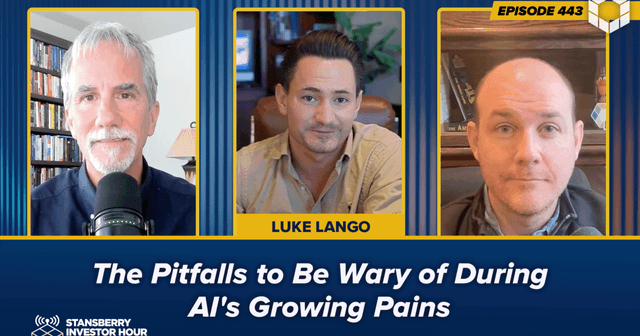

The Pitfalls to Be Wary of During AI's Growing Pains
In This Episode
In this week's Stansberry Investor Hour, Dan and Corey welcome Luke Lango to the show. Luke is the senior investment analyst at our corporate affiliate InvestorPlace. He has built a reputation for spotting tech stocks on the verge of major market breakouts.
Luke kicks things off by sharing his thoughts on what many consider to be the current "AI bubble." He follows that up with how the jobs market is going to transition as AI continues to develop and how the economy will fare during that period. And he provides data for how the AI data-center epicenter has impacted the housing market...
The housing market everywhere is frozen solid. Existing home sales are near record lows... [But] the Bay area/San Francisco housing market is on fire. Absolutely on fire. Home sales in the San Francisco area are up 40% year over year. Average time on market's only 17 days... Everywhere else the housing market is frozen, but at the epicenter of AI, the housing market is absolutely on fire. That's a microcosm of the split that is already happening in society due to artificial intelligence.
Next, Luke discusses the shift from companies using graphics processing units ("GPUs") to tensor processing units ("TPUs") for their data centers and why this is taking place. He then gives his thoughts on whether Intel can become a viable competitor again in this market. And he highlights the risks around the AI companies being interconnected and feeding into each other...
There's something fishy about the ostensible desperation involved in a lot of these massively stated circular financing deals. There's something that just smells funny about that. Nvidia's pouring $100 billion into OpenAI. That's almost too big of a number to fathom... But then OpenAI's going to take that money and use it to buy Nvidia chips, and so it's just money going in a circle. And then AMD gets involved there. There's something there that's not right about that, not fundamentally sound about that.
Finally, Luke expresses why he's pleased that Alphabet has begun to act as a competitor to Nvidia with its own TPUs. He also covers AI being used in ads and how companies like Meta Platforms have seen success with utilizing it in that area. The three all share how they're all using AI in their personal use cases. And Luke gives his thoughts on what the big investment themes are going to be for 2026...
There are six industries in [President Donald Trump's Genesis playbook]. And by January 23, the Department of Energy Secretary Chris Wright is supposed to submit 20 specific challenges within those six industries that they're going to go after in 2026... A lot of it right now is focused on energy: nuclear energy, nuclear fission, next-gen reactors.
Click on the image below to watch the video interview with Ben right now. For the audio version, click "Listen" above.

(Additional past episodes are located here.)
This Week's Guest
Luke Lango is the senior investment analyst at our corporate affiliate InvestorPlace. Prior to InvestorPlace, Luke studied economics at the California Institute of Technology – one of the world's top technology universities – and used the knowledge he gained there with his passion for math and sports to later cofound fintech startup Scoutables. He went on to help launch several other Silicon Valley startups.
Today, as the lead technology and cryptocurrency analyst at InvestorPlace, Luke oversees several premium research services – including Innovation Investor, Early Stage Investor, and Breakout Trader – where he continues to merge advanced data modeling with firsthand venture experience.
Dan Ferris: Hello,
and welcome to the Stansberry Investor Hour. I'm Dan Ferris. I'm the editor of Extreme Value and The Ferris Report, both published by Stansberry Research.
Corey McLaughlin: And I'm Corey McLaughlin, editor of the Stansberry Daily Digest. Today we talk with Luke Lango, the lead technology and cryptocurrency analyst at our corporate affiliate InvestorPlace.
Dan Ferris: I can't wait to talk to Luke because he knows a whole bunch of stuff that I know nothing about. And so, get out your pens and pencils and I think he's going to have a lot of ticker symbols and good information for us. So, let's do it. Let's talk with Luke Lango. Let's do it right now.
Luke, welcome to the show. Good to see you.
Luke Lango: It's great to be here. Thanks for having me.
Dan Ferris: Yeah, you bet. I like talking to people like you because you know a whole lot of stuff that I have no idea. No idea. But people say, yeah, I'm a technology guy and I'm into cryptocurrencies. I'm like "Well, I've heard of bitcoin and Ethereum, but that's pretty much it. The rest of my knowledge is about things like Dogecoin and other bad jokes on the world. So, let's talk. Since you're a new guest, our listeners don't know you. Maybe we'll talk about how you got here – where you started and how you got here, because I was reading a few very interesting things in your past, so I'd like to hear about some of these.
Luke Lango: Yeah, sure thing. Just the long story short is I went to school thinking I was going to be an engineer. I went to a tech school in Pasadena, California called Caltech and quickly learned that I was not smart enough to become one of the best engineers in the world. I was surrounded by people that were truly brilliant and in fact, have gone on to develop AI models at places like Meta Platforms, Alphabet, Palantir, etc., etc. So, I developed just a really good network of people in college that have gone on to become really not the execs, not the C-suite people at these companies, but the actual legwork at these companies, the people that are actually making the models. Elon Musk doesn't actually make the model, Mark Zuckerberg doesn't actually make the model, but my friends actually do.
So, I developed a really robust network of connections through my time at Caltech and also through that time developed some connections in the venture-capital ("VC") world. And that's where I kind of jumped into while in school, and immediately after school was getting into VC investing, both on the startup side and on the investment side. I experimented around with a few startups in there. Sports analytics was always a passion of mine. Eventually got into the finance side of things. And then, while doing all this started writing about some of the investments that I was seeing in the VC space, things that were exciting, how they translated to public markets. And one thing led to the next, and all of a sudden I became a stock picker. And then 10 years later, here we are, focusing on tech stocks, cryptocurrencies, up-and-coming stuff, kind of big idea tech growth trends, because that's sort of where my experience and expertise allows me to have a bit of an edge on the rest of the market, if you will.
Dan Ferris: Good. Sounds great. So, just for our listeners benefit, because I know we're pretty good at knowing what's on everybody's mind and what they're obsessed with at any given moment, and there's been a lot of – there's a lot of talk about whether AI is a bubble or where it is in the bubble, etc., etc. And I'm just curious about your take on that. Don't worry, we'll get to some, we'll get to some meatier stuff but we've got to do this first.
Luke Lango: Yeah, is AI a bubble? I think a bubble is being formed in the stock market. I think that as all manias develop, there is the boom phase and then the bust phase and then the durable growth phase. So, I think we're obviously in the boom phase right now. I think obviously what comes after that is some sort of bust phase. So, I do think that there is an AI stock bubble that is forming. But I think any bubble that does pop, it'll pop and it'll create pain in the market for a year or two. And then it'll recover and then we'll enter the durable growth phase for artificial intelligence in 2027, 2028 and beyond. And so, I think if you're really looking at markets, Everyone's worried about the AI stock-bubble risk. I think that's a really small risk to be worried about.
The risk that I would be worried about is the existential threat that AI poses to the labor market, that when I look at what AI apps can do today – and they're in their infancy. When you really think about it, AI is three years old. Public AI is three years old. ChatGPT launched three years ago, almost three years ago to this day. So, public AI is really three years old. It's still in its infancy. And the things that it can do right now – I just downloaded this new app on my phone called Suno, which is an AI musicmaking app. It's essentially text prompt-to-music song. So, you type in "Make me a song, a country folk song about being thankful for my kids and how being a dad is the best job ever" for Thanksgiving, and within seconds it whips up a minute and a half, two-minute song that's pretty good – actually really good in some instances, if you know how to prompt engineer it. And you can do this for anything. So, it's like, OK, well, what's the value of musicians in that world?
And that's just a small vertical, small facet of this whole revolution. I think that's happening everywhere. And I think if we're already at this point while AI is still in its infancy, then where is AI going to be in five to 10 years? [The Massachusetts Institute of Technology ("MIT")] just came out with a study saying 12% of jobs can be done with AI. AI is only three years old. How many jobs will be done by AI within five years? So, when I look at it from that perspective, I think AI bubble stock risks are very legitimate, very real. But actually, if we're talking about in terms of the Titanic, that's the tip of the iceberg. Underneath the water is a massive existential risk to labor that I think is going to create much bigger impacts on people's everyday lives over the next 10 years than whether or not Nvidia stock goes up 10% or down 10%.
Dan Ferris: And smarter folks than probably all of us have said the same and express the same. What's his name? Gregory Hinton, I want to say, the godfather of AI, expressed almost the exact same thing, an absolute existential crisis to labor. And several others. [Anthropic CEO Dario Amodei]. And even Zuck said we're going to get rid of – Zuckerberg said, "We're getting rid of the midlevel engineer. We're replacing midlevel engineers with AI." Could you imagine being one of those people? Oof, that's got to hurt. But overall, though, this narrative has accompanied every transformative technology in history. And even accompanied the Internet, to a degree. I remember people saying it would put lots of people out of work, but of course, it really created vast new industries that just couldn't exist any other way. So, what do you think about the prospects for just massive new industries that we can't even fathom right now? They're building all this infrastructure and we really – if we're being honest, I think, but I'm not you. I don't have the knowledge you have, I would guess we don't even know what's going to be built on top of that.
Luke Lango: Yeah, entirely. But I think Corey brought up a good point there, is there's pain until you get there. That yes, I don't think the Internet's all that comparable here. I think we're talking about things like the Industrial Revolution. We got through that, but getting through it was really painful. There was a lot of unemployment in the transition period, and it was a long transition period. It was not easy. It was not easy on the labor class. It was very tough on the labor class for a very long time.
And so, I think that's – I'm hopeful that this time is not different, that there will be a utopia on the other side with more jobs, more industries that, to your point, we cannot even fathom right now. I'm hopeful that we do get there, but I'm almost sure that in order to get there we're going to have to go through a very painful – arguably the most painful technological transformation period in the history of – at least in the modern history of humanity. And I think that does lead to – if you kind of take 4% unemployment, where we are today, MIT is a 12% with AI. That's – the 12% number goes up over time. The 4% number goes up when you get a downturn in the economy. So, you could be looking at a 20% unemployment in this transition period. And –
Dan Ferris: By when? Amodei said within a year to five years it was –
Luke Lango: Yeah, I would say that it's going to depend on the cycle, that – I think that if push came to shove and companies were in a really tough position right now, I think they could fire that many people and still operate. It's not a matter of do we have – do they have the capabilities to replace labor. They do. It's a matter of do they have the want to replace labor? And right now there's not a strong want to replace labor because the revenues are growing. The economy is challenged but GDP is positive. Unemployment's still pretty low. Then once that turns – I think once the cycle turns, once the macro cycle does turn, and I think it will within probably the next one to two years, then the capability becomes a want.
And when that happens is when you're going to start to see mass layoffs to defend shareholder profits, because we have a shareholder capitalist society in America, and shareholders, once the revenue growth starts to dry up a little bit or slow down, they're going to demand cost cuts to keep those profit margins fat. And when that happens is when Meta comes through and does replace midlevel engineers across the board with AI. That is when Alphabet comes through and replaces coders with AI across the board. That is when Lululemon and Costco Wholesale and Walmart, even the retailers get in there. And you know how Zara, one of the big retail stores, they have this AI-powered checkout thing where you essentially just drop your clothes into a basket and it tallies up what you have and then you just swipe and pay. There's one person in an entire Zara store. Every other store will do that when push comes to shove, when the capabilities become want. So, I think we're probably one to two years away from a pretty widespread mass unemployment scare. That would be my guess based on the macro cycle.
Dan Ferris: One to two years is not a lot. And 12%, that would be a disaster. That's like we're deep in a recession. That's really bad.
Luke Lango: Yeah, that's – see, that's the very confusing thing about this paradigm, I think, is a lot of economic models out there suggest that – and this is going to sound maybe somewhat insensitive, but if you fire the right 20% and the other 80% make way more money because they're defending shareholder profits, then the economy still turns. And so, what you get more so than an economic malaise is a societal rupturing. And so, I think that's really –
Dan Ferris: I'm so glad it's only that.
[Laughter]
Luke Lango: Yeah, right. Well, that's why I think this time is a little bit characteristically different, is we are – it's not going to look like '08 or the early 2000s. It's going to look different and it's going to feel a lot worse for most people, I think, but I think the market can actually do kind of OK. I think the economic numbers outside of unemployment can be kind of OK because I think it's just going to be this aggregation and concentration of wealth. We talk about the "K-shaped economy." Everyone's talking about it these days. I think when this hit does happen, it's just going to accelerate that divide meaningfully and is going to force – well, it's going to force in some policy changes and some societal changes. I don't know what those look like. I'm not a politician. I'm not a social scientist. But I do think that it's going to force some pretty big changes over there that'll go against this all-out blitz of capitalism that we've seen since, I guess, post-World War II.
Dan Ferris: Yeah, I don't know. We could probably agree to disagree on some of this stuff because I don't think the Industrial Revolution was terrible for the labor class, but – and I don't think that – I would not call it an all-out blitz in capitalism since World War II. In fact, World War II launched the modern new era of massive big government, massive interference in economics, and it started in the '30s, in the Progressive Era before that. And got worse. War always makes that stuff worse. But overall, the market economy can take a hell of a beating in that way and still do what you're saying, which has happened since World War II. So, it's – life has gotten better for most people, etc., etc. And all over the world, too. So, that's really what we're talking about, I think. Now, maybe it will be more fun to talk about some technologies that excite you for other reasons rather than concern you because it's the end of society and civilization as we know it. Maybe we should do that. Just the top of my head, just spitballing what we might like to do now.
Luke Lango: Yeah, I don't mean to sound like a "doom and gloom" guy. I'm not at all. I'm actually – I remember I spoke at the Stansberry Conference a couple months ago, and somebody came up to me afterwards and was like "You know what, Luke, I never really trusted you all that much even though you were right because you were always optimistic. You were always seeing the glass as half full and never seeing it as half empty." And that's naturally how I am. I am a very, very optimistic and positive guy. I love to see the bright side of things. And so, I do think – and from that perspective, I do think there's a utopia on the other side of this rough transition period. But I think just the realist in me says that we are going to have a rough transition period. So, while I do have this – you called it a doom-and-gloom outlook for the next maybe five years. I think the next one to two years could be really, really good in the stock market, followed by a really painful three- to five-year transition, and then some utopia after that where we have an abundance of energy, an abundance of supplies, an abundance of goods and resources, and then we do create new labor classes, we do create new jobs, new industries, and then everything works out. So, I am optimistic about this stuff in the long term and in the short term. I just think in the medium term, we're due for a rough transition.
Dan Ferris: OK, noted. What – is there –?
Corey McLaughlin: Yeah, that makes a lot of sense. That's – it's – I think we're already starting to see the – I don't want to belabor the point too much, but we're already seeing kind of the societal impacts, I feel like, from just even the – literally almost every person I meet now, if they find out what I – kind of what I do, the first thing is AI. "Oh, AI is going to take this job. AI is going to take that job." It's really – in the last six months, it's really picked up a lot, just anecdotally, I think. But anyway, that's the – the pain to get there, I feel like, is real. And it's probably already starting. But that said, the market can do what it does – the stock market can do what it does separately.
Luke Lango: Yeah, I would agree that it's already starting. I just read a report this morning. This is weird to talk about the housing market as being a microcosm of this, but the housing market everywhere is frozen solid. Existing home sales are near record lows. I know here in Phoenix, nothing's moving. My hometown of San Diego, nothing's moving. But I just read a report this morning that the Bay Area, San Francisco housing market's on fire. Absolutely on fire. Like, listings – or, home sales in the San Francisco area are up 40% year over year. Average time on markets, only 17 days. Medium sales price, $1.85 million, the highest since June of 2022. So, it's like everywhere else the housing market is frozen, but at the epicenter of AI the housing market is absolutely on fire. That is – that's a microcosm of the split that is already happening in society driven by artificial intelligence. So, yeah, to your point, Corey, I agree that it is already playing out in the real world.
Dan Ferris: Right. Now, if somebody told me that the housing market in the city where there's more fecal matter on the street than anywhere else was going to be on fire, I wouldn't have believed them. But I live right up the street from there. I live in southern Oregon. And we get a lot of transplants in southern Oregon, a lot of them.
Luke Lango: Yeah, it's where the money's at. And interestingly enough, the – it was the over $5 million listings where the – that's where the market is the hottest, I guess, when you look at kind of the data. It's homes that are over $5 million. So, it's the C-suites. It's the execs moving in there and making all this money off stock comp, the Nvidia people that are retiring early. That's what's going on right there right now.
Dan Ferris: Make sense when you put it – when you frame it that way. And I wonder – I always wonder when I hear something like that, especially in a coastal city, if foreign buyers are a factor.
Luke Lango: Yeah.
Dan Ferris: Did the report you read say anything about that?
Luke Lango: It did not get into from the origin, the country of origin of the buyers. It may have but I didn't get to that part if it was in there. But I wouldn't be surprised if that is the case as well.
Dan Ferris: Right. But your guess is a good one, right? There's a huge AI boom going on. They're buying houses while their shares are still high. So, that makes sense.
Let's talk about – AI is such a broad topic, and I feel like when I ask someone like you what technologies excite you the most, nobody can avoid it. Every now and then, somebody will be like, "Well there's this company –" like, Whiteny Tilson is talking about Joby Aviation. They make basically flying cars, is what they are. Which is pretty exciting. And I'm sure they use AI somehow, but it's not like the first thing on the tip of your tongue when people start talking about AI. Is there something other than AI – or maybe we'll go the other way. Which do you want to do? Other than AI or a specific use case of AI that you're most excited about? That's what I really want to know.
Luke Lango: Yeah, I would say that everything relates back to AI in some way, shape, or form these days in terms of technological trends and breakthroughs. Even talking about Joby, a big part of that story is their autonomy. A big part of that story is not – it's cool that you're putting these flying cars in the air, but with pilots in them it's not that cool. You make them autonomous and all of a sudden it's really cool. So, that's – when you look at their conference calls and you dig through their transcripts, a lot of it now is dedicated towards [Federal Aviation Administration] certification, obviously, and then autonomy. The other half's autonomy. So, everything in some way, shape, or form in the tech world relates back to AI.
So, I would say within the AI umbrella, I think the theme that's going to be one of the most defining themes of 2026 is going to be the shift to custom silicon, that I think the – Nvidia has been the poster boy of the AI boom for the past, what, three years, ever since ChatGPT launched. Their [graphics processing units ("GPUs")] have been the epicenter of all the spending. That is starting to shift. We are starting to see a shift away from Nvidia GPUs towards custom AI chips, towards custom silicon. Google's TPUs – tensor processing units – have really started to have a moment. First it was their Gemini 3.0 breakthrough. The Gemini 3.0 model is fantastic. It's so good that the leader in AI, OpenAI, their CEO, Sam Altman, has issued a code red to their company saying, "Hey, you know what? Gemini 3.0 is so good, we need to go all hands on trying to make ChatGPT better." And Gemini 3.0 is built on top of TPUs, so that is validation of the "TPU over GPU" argument.
And then you have Meta ordering purportedly several billions of dollars' worth of TPUs instead of Nvidia GPUs starting in 2027 and tapping into Google Cloud's TPU services in 2026. Then Amazon just launched their Trainium3, which is their own custom chip, their version of TPU. So, you're seeing – Meta has their own chips as well. Microsoft's working on their own chips as well. So, Big Tech is – they've been working on these custom silicon efforts for two years now, I would say, in earnest two years, but they're accelerating them now that Google has kind of shown a proof point validation of "Hey, this is – if you really get the custom chip stuff down, this is what's possible." Meta sees that. Amazon sees that. And now I think they're going all in. I think '26 is going to be the year of custom silicon.
Dan Ferris: Who's building all this stuff?
Luke Lango: Yeah, so that's the question. It's – there's – I think there are four companies to play this. Broadcom is No. 1, AVGO. They're the ones developing Google's TPUs. So, Google's – and Meta as well. Google and Meta have their own chip efforts. Those are built with Broadcom. Amazon and Microsoft are building their own chips. Those are built with Marvell, Marvell, MRVL, and Arm, ARM. So, I think Broadcom, Marvell, and Arm are the three kind of designer developer ways to go. And then all of them are still being fabricated with – or, by TSMC, TSM. So, I think that's the four-horse way to play the custom silicon effort is AVGO, MRVL, ARM, and TSM. Those are the four ways to play it, and it's away from the Nvidia complex, if you will.
Now, an interesting sub narrative here is that Nvidia, when you stand up a giant Nvidia GPU data center with these GPU clusters, Nvidia has its own proprietary in-house networking called InfiniBand. So, networking is how you get these GPUs to talk to one another. Very important for operating a full-scale data center. Nvidia has their own in-house architecture for that: InfiniBand. If all of a sudden these GPU data centers turn into custom silicon data centers, TPUs or Trainiums, or whatever it may be – or Inferentia – that's what Microsoft's working on – you don't use the in-house Nvidia networking solution. Instead, you use a custom networking solution. And that's where a company like Lumentum, LITE, or Coherent, COHR, these are networking plays that will stand to benefit if indeed the market shifts away from Nvidia GPU, shifts away from in-house InfiniBand networking towards more custom networking. So, you kind of have your four big courses to play it, and there's definitely sub-narratives in here to play this shift away from Nvidia GPUs and towards custom silicon, which I think is just starting.
Dan Ferris: You mentioned, of course, Taiwan Semi, the fabricator. Do you think that – of course, the government owns 10% of Intel now. Does that mean anything to you? Do you think putting money in – whether it comes from the government or anywhere else, that Intel has a prayer of becoming competitive again?
Luke Lango: So, I think another one of the defining themes of 2026 is going to be the White House putting money to work in this – in the AI complex. Intel is – I think stands a chance to be a good player in this space, but as of the most recent news, they're still going to make their chips on TSM's technology. Intel is just going to be part of the design. They're not going to be the actual fabricator. The actual fabricator of Intel's chips is still going to be TSM with all the foundries they're building actually out here in Arizona. They're wild. They're literally the size of small – not small towns, medium towns, even large towns. And they're building four or five of them out here in the suburbs of Phoenix, or the outskirts of Phoenix.
So, it's very interesting that even though the White House has taken this stake in Intel and wants to make chips domestically, they're still using TSM to fabricate them. So, I don't see TSM as being competitively challenged by the White House and Intel's partnership or – I think the White House gets involved with some other chip designers as well. I don't see TSM as being challenged by that. Their chokehold on this industry is just too large Their technology is too good. They're too far ahead. Maybe 10 years down the line a competitor emerges, but not in the foreseeable future, not in a way that would impact the stock.
Dan Ferris: I see. It's just – I guess I have a bit of Intel on the brain because I read the – there are books about it and stuff and Andy Grove has a book and you – if you read that stuff years ago or whatever, you developed this sort of respect for what happened there, and at one time it was this great repository of engineering talent. It was this amazing thing. And then now there's just no – just gone. That's just gone. And we could probably name other things that – other situations that are similar, but that's the one that just constantly – and I heard a pitch for Intel. I don't know, it was probably three or four years ago, and it just about made sense to me. And since then it hasn't done any – it's just like – it's like it's done. Just forget about it.
Luke Lango: Yeah, there's been a massive brain drain. I'm a big believer in – talking about my backstory at the top of this podcast, I believe in people. I believe in talent, I believe in investing in people, investing in talents, because I think great people build great products, great products make great businesses, and great businesses make great stocks. So, I think it starts with people. Intel has had a massive brain drain. And the talent's going to Nvidia, the talent's going to AMD, the talent's going to startups. The talent's not sticking around in Intel. And so, I think that is a fundamental challenge for them. Now, the White House could change that with their investment and now maybe they're a bit sexier, so to speak, but I'm not seeing that really materialize or manifest yet. So, until I see that, I'm – I mean, I don't want to say I'm anti-Intel, but I'm just not all that excited about Intel because I just think the brain drain is a real big problem.
Dan Ferris: Yeah, I didn't want to – I don't want to spend too much time on Intel. It's just a personal thing more than anything else because it's just – I actually had a good run with it, too. Years ago I recommended it, I think maybe in 2009 or sometime like that when nobody wanted to buy anything, and it ran up pretty decently and then that was it. But anyway, getting past that. Getting past that.
Corey McLaughlin: Yeah, I just wanted to go back to the custom silicon story for a second. Let's – can we just explain to people what that – all this AI stuff is new for everybody – what that means specifically?
Luke Lango: Sure. Yeah. So, I think the best way to think of it is in terms of an analogy to cars. So, Nvidia's GPUs are like Ferraris. They are these super high-performance, very sexy chips that can do a lot. But you don't need to drive a Ferrari to the grocery store. You don't need to drive a Ferrari to pick up your kid from school unless you're trying to show off to your neighbors. Yeah, the Ferrari is – it's a great car to have. It's a fancy car. It can do a lot. But it's not really what you need. You're overpaying – if that is your daily driver, you're overpaying for insurance, you're overpaying for the car, you're overpaying for everything.
What Big Tech is doing is now shifting to Toyotas and Hyundais and more affordable cars, their custom silicon effort. So, they're making chips that are custom to their applications to do something very specifically. For Google it might be their TPUs are really good at advertising, really good at AI advertising, AI targeting, things like that. So, they're building custom chips that are specific to their use case applications. Head for head, these chips are not going to be able to compete with the Ferrari, to compete with Nvidia GPUs. The Nvidia GPUs are going to be able to do way more. But this chip, these chips are going to be able to do X or Y or Z way better than Nvidia GPUs can do X or Y or Z and do so at a fraction of the cost.
So, it's all about cost efficiency and compute deficiency using a fraction of the compute resources. So, whereas the first three years of the AI boom were all about this land grab for GPUs because that was the only chip out there that could really do this AI stuff over the – kind of behind the scenes over the last several years, the Big Tech dogs have started to develop their own custom chips specific for applications to their own AI models. And Google has had a breakthrough with that with TPUs. And now, all of a sudden you're seeing more investment from the big tech dogs go into these custom chips.
And I think that's sort of where the AI boom is evolving, where it will evolve in 2026, that as we move from these massive data centers and these massive clusters, I think we're going to go more towards the edge where you're going to have edge AI applications, where you're going to have inference, where you're going to have things that sort of "I need this AI to do this very specifically, or that very specifically." And when you do that, you're going to want these custom chips, not the Nvidia GPUs.
Dan Ferris: OK, so I want to be really clear about this because I want to understand it myself and I want our listeners to understand it. It sounds like the impetus – it sounds like it might be a combination of cost plus what you describe as a focus on particular functions. You said the Ferrari, if you think the Ferrari is almost – there's also like the Swiss Army knife, right? It's got everything in it. But I only need one or two of those tools inside there and I need them to be really good, so I'm going to put all my resource into that. And that costs less than building a GPU?
Luke Lango: That is correct. That is the impetus for it. And then, I would add a third impetus for it is, according to my contact to Silicon Valley that are buyers of Nvidia chips, Nvidia operates very arrogantly. And –
Dan Ferris: Of course. Yeah, of course.
Luke Lango: And they – there's no negotiating on price. There is no negotiating on – you try to get volume discounts and they don't offer that. It's just – they're very tough to work with because they think they're the only game in town. And that has rubbed a lot of the big – you don't do that to Meta. You don't do that to Microsoft. You don't do that to Alphabet. And I think that's an impetus for why these guys are like, "Hey, we're tired of forking over so much. If you were able to work with us on price, maybe we could come to a level where the cost makes sense for us and our own custom chip efforts would not be worth it." But because Nvidia is not coming down on price – one of the biggest line items in their earnings reports every single quarter is gross margins, and those keep going up. That's because they're not negotiating on price – that has caused these other guys to be like, "You know what? You're charging us so much for this that yes, even our custom chip efforts that are going to be expensive, they're going to be less expensive than buying a bulk volume of your overpriced GPUs."
Dan Ferris: OK. I want to – I think we'll circle back around to this very thing.
Luke Lango: OK.
Dan Ferris: But I'm going to get there by a big detour.
Luke Lango: OK.
Dan Ferris: And the detour is I've learned that while all these data centers that are being built with all these GPUs in them, while their load factors, their power usage is, like, 80%, 90%, the utilization of the servers inside them is very low, I'm told. And I've read. And I've heard. And for a while, people were saying, "No, there's so much demand." But the demand is by the builders of the data centers. The demand is not because data centers are so fully utilized. At some point, this smells a lot to me like a gazillion billion miles of dark fiber in the year 2001 or 2000 or whenever. And at some point someone has to – the Internet usage of for 20 years after 2000 was up a thousandfold and the telecom revenues were cut – the services revenues were cut in half. So, at some point there's a reckoning here and Nvidia is no longer what they are today and they're no longer the jerk at the end of the phone saying, "We don't give volume discounts" and all that. Right?
[Crosstalk]
Luke Lango: Yeah, I would say that's a massive risk that is building. Now, the counterpoint there, at least in the present time, would be you go through Amazon's conference call or Microsoft's conference call or Alphabet's conference call and they're saying they're sold out on capacity and demand is through the roof and AI bookings are up triple digits year over year. So, those guys are selling out servers and selling out cloud compute. So – and that's demand that's coming from a Palantir, that's coming from a Lemonade, the AI insurance operator, that's coming from these actual AI end applications. That's the demand that that you have to see.
What – where I think the reckoning is going to happen is – there are so many studies out there and it depends on which one you quote. But basically, 90% of these AI apps don't deliver any ROI. Ten percent of them deliver amazing ROI, absolutely tremendous, and 90% of them are just garbage and do nothing. That's where I think the reckoning is going to be. That's where the dark fiber is hiding, that the 10% is delivering; the 90% isn't. When people really realize we've spent the bunch of money on the 90%, that's the compute, that's the capacity that is – that's going to go dark and could create a reckoning in the market. So, I don't think we're there yet, but that is something, again, with the next year or two that I think could pop the bubble, cause a rough medium-term transition period before we get to some long-term durable growth.
Dan Ferris: Sure. And the long-term durable growth will involve much lower prices for the compute.
Luke Lango: I could not agree more with you on that. And then, there's something fishy about the ostensible desperation involved in a lot of these massively stated circular financing deals. There's something that just smells funny about that. It's like Nvidia's pouring $100 billion in OpenAI. That's just almost too big of a number to fathom: $100 billion. And then – but then OpenAI is going to take that money and use it to buy Nvidia chips. And so, it's just like money going on a circle. And then, AMD gets involved there. It's like there's just something really not right about that, not fundamentally sound about that. It feels desperate. It feels like a desperate act from [Nvidia CEO Jensen Huang]. It feels like a desperate act from [OpenAI CEO Sam Altman]. It feels like a desperate act from [AMD CEO Lisa Su]. It feels desperate.
Dan Ferris: Yeah, it feels – it has the vague feel of something in the accounting world like channel stuffing, or you're cranking up the demand, you're using your own finances to crank up the demand for your own – for your product sort of. You'll run out of money at some point to do it – doing that, won't you? It can't go on –
Luke Lango: That is – yeah, that's – I'm just saying there's just – they're – and they're also connected now. And that's something I also don't like about the ecosystem, which worries me in the medium term, is they're so connected, like the telecon buildouts of the '90s. It's all connected. There's no isolated player here. They're all so deeply – I guess Alphabet's a little bit more disconnected, but when you talk about the OpenAI, Nvidia, AMD, that ecosystem – Bloomberg had a chart recently that came out, it's like a bunch of circles just overlapping each other. They're all so deeply embedded with one another. So, yeah, once one thing pops, the whole thing kind of – it'll cascade.
Corey McLaughlin: Yeah, that's an interesting point that I was thinking about, too, with Alphabet, with Google a couple weeks ago, having their moment, as you say. To me, that's like – I was encouraged when I saw Google was coming out with their Gemini and now the TPUs because it kind of just – I was more worried before with all those relationships with OpenAI and Nvidia just going back and forth with each other and promising that they're going to work with each other five years in the future. And – but with Google, with Alphabet, there's a legitimate competitor now. There's an actual horse race here with Nvidia. And to me that's so much – it makes it less risky – I feel better about that than I did before, like two weeks ago.
Luke Lango: I could not agree more because, On top of that, it's cash-financed. It's self-financed. They are – they have a core business that sells ads and they have enough money from that to develop their own – they're not raising equity. They're not raising cash from equity. They're not going out to the venture-capital markets. They're not going to venture investors. They don't – they're not in debt. They're not burning money. They're in the black. They're not – there's no White House involvement. The White House is heavily involved with OpenAI. The White House is heavily involved with Nvidia. The White House and Alphabet – they have a friendly relationship, but there's been no money back and forth there. So, it's like its own self-sustaining cycle, which I think is – yeah, it's much healthier than what's going on with the OpenAI-Nvidia complex.
Dan Ferris: I'm glad you brought that up because I agree. It's not WorldCom. It's lots of excess free cash flow that you can do this. And they have – they've used a lot of balance sheet. In fact, the four big hyperscalers are now in a net debt position. They tipped into it when Meta – I think they issued $40 billion of notes?
Luke Lango: Right.
Dan Ferris: And so, so they just tipped over there, but they've still got tons of balance sheet and they can support that with all that cash flow. That alone is very different from what was happening in the dot com boom. That alone – are we – are people going to stop responding to internet ads? I don't know.
Luke Lango: Right. Well, especially when those internet ads are getting better, right? That's the thing that I liked about Meta was – I don't like their massive debt issuance recently, but the thing I liked about them before was they're showing meaningful ROI on their AI investments. Time spent on Facebook and Instagram was up 6% last quarter. To me, that's ridiculous. This is a ubiquity. This is something that everybody's already on. This is something that everybody is already spending half their day on. And you're telling me even that is seeing engagement growth? Time spent on video, Instagram video, Instagram reels, their new feature, was up, like, 30% in the last quarter. And that's all because of their AI algorithm. Their AI algorithm knows you better than you know you and it's giving you exactly what you want to watch when you want to watch it and for how long you want to watch it. And you just get addicted and you just keep scrolling that way. And so, it's like there is meaningful ROI for Meta in terms of their ad business. And then the targeting is a whole other thing. And then they're automating their ad business as well. So, it's like they're actually seeing really meaningful improvements in their core operating business because of their usage of AI. Alphabet is the same way. Microsoft is the same way. So, that's one thing – or one place you're seeing AI really deliver true financial results for people that are using it smartly. "Smartly" is the key word there.
Dan Ferris: Luke, how do you use AI personally?
Luke Lango: What do I not use AI for? I use AI for a bunch. I have Gemini 3.0. I have ChatGPT. I use Grok every once in a while, more for social stuff because I think it has a really good leaning into social data. But I use ChatGPT and Gemini on the daily. And they're always running on the back kind of my computer, whether it's for research – so, hey – for example, Credo, a company we just talked about, they reported earnings today and it was fantastic and I wanted to get the scoop on the earnings. So, I'll pull up the conference call, I'll pull up the numbers, and then simultaneous to that, I'll have ChatGPT-5 thinking or Gemini 3.0 thinking, run an analysis on it. I'll feed it the transcript. I'll feed it the numbers and I'll have it run an analysis and then I'll compare notes, my analysis with its analysis when it's done. That's one way that I use it.
I use it for streamlining writing and stuff. So, if I'm putting out an e-letter and I'm pressed out or I'm putting out an update on something, I'll have bullet points and I'll say, "Hey, here are the bullet points. These are my thoughts, my opinions. Just make this beautiful, make this a well-worded 500-word essay for me." It spits it back to me and then I edit it and then return it to my own editor.
So, those are just kind of the ways that I'm using it, but I'm using it literally on a daily basis for everything from stock research to stock writing, investment writing, to timing tweets. So, we just – I just got back on Twitter. We're using AI to analyze what time of day are the tweets doing best, where is engagement highest, what tickers are doing best for us. And then it's giving us suggestions of how to better tweet about things or when to better tweet about things, what to tweet about, etc., etc. So, pretty much everything that we do, we're using AI in some way, shape, or form.
Dan Ferris: All right, for our listeners benefit, let's go around the horn. What about you, Corey?
Corey McLaughlin: Luke just brought up some nightmares for me about Twitter scheduling social media. In a prior life, I don't know, probably 10, 12 years ago now, that was one of my jobs. Well, it was when Twitter was really just – media companies were just starting to use it, whenever that was, and trying to schedule – and I'll answer your question, Dan, in a second, but just trying to schedule out tweets, like when people would – it was very manual back then – like when people would be more likely to read them, like at the end of the workday or at lunchtime or whatever. So, anyway, that just brought back some memories for me.
But how I use AI now, I've – for research, it's pretty great for sourcing specific – the better questions – we've said this before. The better questions you can ask ChatGPT, for example, the better results you're going to get. So, the more specific you can be feeding these things what you want or what you're looking, the better. So, that's one way, just having specific. goals in mind with ChatGPT or whatever you want to use.
NotebookLM, I have started using that more to drop a bunch of sources into, and then you can ask that questions. So, you pick your sources. And say you're working on something about tariffs or whatever you've – you find 15 things that are interesting, that you think are relevant, and then you can search through all those sources. So, that's another one.
And then the one I always use regularly is we've come up with our own Stansberry headline ChatGPT that is based off of the fundamentals that we've done for – in the business for – since it started of what makes a good headline. And after every digest I get to the end and I just copy and paste it into that and it spits out 10 headlines. I never end up using exactly what comes out in any of them but it's a good starting point and adjustment to adjust from – it just gives you phrases or brainstorms and then – that's been really helpful. And so, I don't know if the headlines have gotten better or worse though, but that's what I'm doing for now.
Dan Ferris: Pretty good. Pretty good.
Corey McLaughlin: Yeah.
Dan Ferris: All right, so I've gone through two phases of this. The first one was ChatGPT, Gemini, Perplexity, just letting it go out to the internet. Just asking and relying on this specificity of my query and asking for sources to do some of the work there, and not just – because if you just ask a question, you can ask it three times and you get three different answers. It's crazy. If you just go out to the general internet. But I've discovered NotebookLM. Do you know NotebookLM? It's amazing. Basically, I just – the company that I'm writing up for the next issue of Extreme Value, I fed it all the 10-Ks going back to 2007, I fed it the last three 10-Qs because we're near the end of the year here, so you've got the first three, and I fed it transcripts from conferences and a transcript of congressional testimony by the CEO and a couple of other things like that. Then I made another file with all the best press reports from the best sources like the Wall Street Journal, Financial Times, Forbes, Barron's, Bloomberg, etc. And there are buttons on that thing where you can just say, "Give me a mind map" and it'll spit out this graphical thing that organizes the ideas. And you can do "Give me Nvidia" or "Give me a –" there are these buttons you can hit that spit out various types of reports.
And I've asked it all kinds of questions and not had to read – I got a list of one kind of data, I said, "Go back for 10 years and give me blah, blah, blah," and it was there in a few minutes. I was like – I would have had to rummage through that shit for two hours to find it and it found it for me in minutes. So, I'm starting – and doing it this time, this is the first time I've used NotebookLM to do an actual write up, but Luke, I highly recommend it. You're recommending stocks, too. I highly recommend it, man. If you don't want to have to read every word of every filing but you know what's in them and you know the questions you want to ask, there's no substitute for it. It's amazing.
Luke Lango: Yeah, I – we have NotebookLM. We run NotebookLM, too. It's – and it's a Google product. There you go. There's a Google AI coming to the top. Yeah, it's fantastic. It's great for financial filings. That's the way I think in the financial research world you need to use it. You feed it the raw data, as raw as it gets, the 10-Ks and 10-Qs, and you start digging.
Dan Ferris: Yep. And there's no – you just confine it to that data set. There's no baloney. You ask it the same question five times, you're going to get the same answer. Like, hallelujah. OK, now that's intelligence. That other thing, you can call it artificial intelligence, but it's given me a different answer three times, so I don't know how intelligent it really is. So – but that's the difference. It's amazing. Anyway. Hopefully, our listeners will put all that together and find something to do that will make their lives improved. So, we've got – we got a bunch of tickers out of you just by talking about custom chips. So, custom chips is a big thing. What else you got?
Luke Lango: Yeah, I would say, big investment themes for '26, the custom chips is a huge one. I would say this new Genesis mission out of the White House is going to be big in '26. The White House has kind of started this new era of state-backed capitalism, if you will. They've invested now in five companies in five months. You got Intel first, MP Materials, then Trilogy Metals and Lithium Americas, and just today you got – I think it was called xLight, a company that makes lasers for [extreme ultraviolet lithography] machines. So, that's five companies in five months or six months, basically one a month. And then they launched this this Genesis mission, I think it was last week, late November, right before Thanksgiving. No one's supposed to announce big news before Thanksgiving but Trump did.
And so, we got this Genesis mission and it's basically this playbook of what they want to invest in for the next – as long as he's in power. And that's – there's six industries in there. And by January 23, the Department of Energy Secretary, the Energy Secretary Chris Wright is supposed to submit 20 specific challenges within those six industries that they're going to go after in 2026. And given their track record, I think going after it means taking equity stakes in the various companies they think are best addressing those 20 specific challenges. So, I think that paying attention in late January when Chris Wright submits this list is going to be super important, and I think that's going to be your playbook for how to play this trend in 2026 from February to December.
I think that a lot of it right now is focused on energy, nuclear fission, nuclear fusion, next gen reactors. It looks like Oklo is going to be a big player there – OKLO. Maybe NuScale – SMR – is going to be a big player there. Cameco – CCJ – they own half of Westinghouse. Westinghouse just signed a very big deal, I think it was $10 billion or so, with the government to develop a bunch of nuclear reactors here in the U.S.
So, energy seems to be a very big component of this Genesis mission, but it also includes biotech, which I think is really interesting. I think biotech's an unheralded part of the AI market that's starting to wake up. And it also includes quantum computing, which I found really interesting, that quantum computing – in these six industries, one of them was quantum information sciences, aka quantum computing. So, it looks like the government's now going to start making some quantum plays, which is really interesting because if you remember a few months ago, actually, when we were at Vegas for the Stansberry conference there was a headline that broke one morning that the Trump administration was talking to quantum companies about taking a stake in them. All the stocks jumped, and then the White House came out and said, "We're not taking a stake. Yet." And then they gave back their gains. But the fact that that report broke, the fact that there was a leak, means there was something to leak. That something obviously is they were having discussions. Now, I think the Genesis mission puts those discussions into action.
So, I think there's some really interesting ways to play this. Whether you like it or not, it's happening, this state-backed capitalism stuff, and I think it's going to accelerate in '26.
Dan Ferris: Totally agree. That's a good one. We've actually – it's time to ask our final question already. I feel like we just started talking 10 minutes ago. But we ask the same final question of every guest. And even if we have a non-financial guest, we still ask the identical final question. And if you've already said the answer, by all means, feel free to repeat it. But the question is simple. And it's for our listeners' benefit. If you could leave them with a single takeaway, with a single thought today, what is that? What would you like to leave them with?
Luke Lango: I think that you have to take advantage as much as you can, as much as allows of the next six to 12 months in the stock market in the AI boom. Because I do – again, boom-bust cycles. We are in a boom. What will follow is a bust. But if you look at the history of booms, the best part of the boom is the final hour of the boom. The best part of a basketball game is the fourth quarter. The best part of a baseball game is the ninth inning. The best part of a stock market boom is the final year or two of that boom. I think we are entering the final year or two of that boom. What follows will not be pretty for three to five years, ,or two to three years, however long it may be. So, if you're kind of looking at the next five to seven years, the only real time to make fantastic gains, I think, is going to be in the next 12 or so months. So, really take advantage of the potential melt up that is on the way in 2026 before the meltdown that always follows every melt up. The Nasdaq, the entire Nasdaq complex more than tripled from late '98 to early 2000.
Dan Ferris: Yeah, I was thinking of that same example. Yeah. Well said.
Luke Lango: So, I think we're entering that phase. Take advantage of that because then the Nasdaq dropped 80% over two to three years. So, take advantage of the tripling before the meltdown.
Dan Ferris: There you go. Well, thanks for that and thanks for being here. It was great to talk with you.
Luke Lango: Hey, I appreciate you guys having me. Truly a pleasure.
Dan Ferris: All right. Well, we will certainly be doing so again within the next six or 12 months. Until then, thanks again. It was really great.
Now, I want to give everyone listening a recommendation for what to do when the show's over. Luke recently shared a huge prediction involving the biggest story in the stock market today. Now, you've probably heard that the White House has begun taking stakes in a handful of widely unknown stocks and like driving some of them up 200% overnight and stuff. It's crazy. Well, Luke says Phase 2 of this buying spree is coming and it's going to involve a whole new group of stocks. It all boils down to a national security plan Luke has seen which lays everything out in black and white. He just named all the stocks he thinks will be involved. And guess what? He did it free of charge. To get his full analysis, just head to lukespowerplay.com. Grab a pen and paper because he shares a lot of valuable information. That's lukespowerplay.com. Head there now and check it out.
Well, I always like talking to people who know a whole lot more than me about something, and Luke was – did not disappoint in that regard. It was great.
Corey McLaughlin: Yeah, that was a fun conversation to just kind of talk about something different about AI, I would say. And I'm thinking of those custom chips that he says will be a story in 2026 to watch, and he listed off a bunch of companies there to look into. So, that was good. Yeah – I feel sort of similar about the societal impacts, starting to see that about AI. If – even if people aren't actually losing their jobs yet, which some are, the emotional, the fear of it, I feel like, is out there. And so, something to watch, too, I would say, in the year ahead as well. In the years ahead, more so politically, I would think, as well as financially for people. But yeah, that was good. Happy to have him on.
Dan Ferris: Yeah. Yeah, we did get into all kinds of different aspects of technology and AI. And I love – of course, we love people who just drop lots of ticker symbols on us. That's cool. And I agree the – hearing more about the custom chip play and the fact that there's several ways to get involved and actually maybe make some money on it – and also, I knew Luke was an optimistic kind of a guy, but his realism and his appreciation for the cycle is frankly refreshing. I won't name any names, but I know other folks who are big into technology stocks and they don't do that. And I think if you're going to tell somebody to speculate on the next year or two, you have to remind them what's on the other side of it, which he did several times. So, that's a really well-rounded guy, intellectually, as far as I'm concerned, as an investor.
Corey McLaughlin: Agreed. Yeah, I totally agree. Yeah, very important.
Dan Ferris: Yep. So, it was great in a lot of ways. Really great. And I can't wait to sort of catch up with them and see where the custom chip thing is in six or 12 months or whatever and frankly where the cycle is too, the market cycle. That'll be exciting and interesting.
So, that was a great interview and a really fun episode of the Stansberry Investor Hour. I hope you enjoyed it as much as we really truly did..
Announcer: Opinions expressed on this program are solely those of the contributor and do not necessarily reflect the opinions of Stansberry Research, its parent company, or affiliates.
[End of Audio]
The Hidden Flaw in Wall Street's Trillion-Dollar Math
George Noble: Why the Tesla and AI Bubble Will 'End Badly'

Everyone Trades Too Much... And It's Costing Them Everything
What Big Money Is Doing While Everyone Else Is Guessing