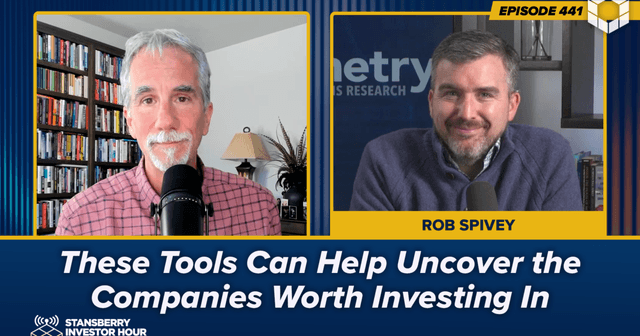

These Tools Can Help Uncover the Companies Worth Investing In
In This Episode
On this week's Stansberry Investor Hour, Dan welcomes Rob Spivey back to the show. Rob is the director of research at our corporate affiliate Altimetry. He and his team utilize their proprietary Uniform Accounting strategy to dig through the as-reported numbers in company reports to find their true value.
Rob kicks things off by posing a topic of debate with Dan regarding the Federal Reserve cutting interest rates. The two follow up by sharing their thoughts on the long-running AI narrative. Rob expresses how the talk of an AI bubble is producing a "fear of getting in," which keeps people from buying stocks. And he shares his team's thoughts on several market areas where government regulation could provide opportunities...
Any of these areas that really have been hamstrung for the last little bit, we think are areas where there's going to be a big surge in [mergers and acquisitions (M&A)]... When that happens, you can see upwards of 100% or 120% pop in a stock in literally a day. Normally it's 20% to 40%, but sometimes you can see a whole lot more than that. And this is what we see even in names we've recommended before.
Next, Rob reflects on how 22 companies recommended by Altimetry publications were acquired over the past six years. He then lists the catalysts that are key targets for company acquisitions. In the midst of opinions and market fear, Rob stresses the importance of trusting the data. And he says that even though the market is currently weak, it was due for a cooldown based on history...
We did an analysis of 1994 to 2000. And one of the things that jumped out to us is that everyone looks at the Nasdaq chart, and they go, "From here to here: 600%. Wow!" But the important thing to remember from that 600% is there were 10 – 10 – 10%-plus drawdowns in that market... We're going to have pullbacks.
Finally, Rob shares three steps to picking a great stock according to some of the greatest investors. He says that these three things can help provide consistent wins in the market. This leads to Dan and Rob discussing the benefit of finding a stock with consistent dividends that an investor would hold on to, whether the price goes up or down. And Rob reiterates the importance of not staying out of the market...
Do not sleep on the opportunity that is out there right now... We're about to see a surge of M&A, and there are going to be three big beneficiaries of that that are going to be the right places for you to put your portfolio... [Identify] great strategic acquirers, [identify] the investment banks that are going to participate in being able to make fees from it... and try to identify which are the obvious acquisition targets.
Click on the image below to watch the video interview with Ben right now. For the audio version, click "Listen" above.

(Additional past episodes are located here.)
The transcript is coming soon.
This Week's Guest
Rob Spivey is the director of research at our corporate affiliate Altimetry. He leads a team using their proprietary Uniform Accounting framework to deliver equity, credit, and macro research... often leading to market-beating returns you won't find anywhere else.
Rob's rich background spans his time as a hedge-fund analyst advising some of the largest investment managers in the world. He has appeared on CNBC and been quoted in Barron's, Bloomberg, U.S. News & World Report, and Forbes. He has presented at Northeastern University, DePaul University, and Hult International Business School, and has been a judge at the CFA Institute Research Challenge.
Dan Ferris: Hello, and welcome to the Stansberry Investor Hour. I'm Dan Ferris. I'm the editor of Extreme Value and The Ferris Report, both published by Stansberry Research. Corey's out today, so I'm by myself. I'm going to talk to our colleague and friend, Rob Spivey of Altimetry. Rob is a very smart guy and he's great. He's full of information. He's got lots of enthusiasm. He talks fast and tells you a million things. So, get out your pens and pencils. Listen close. Take notes. So, let's do it. Let's talk with Rob Spivey from Altimetry. Let's do it right now.
Rob, welcome back to the show. Always good to talk with you.
Rob Spivey: Dan, a pleasure as always.
Dan Ferris: Now, as I understand it, most of the time I just start beating the daylights out of my guests with questions that are on my mind. But as I understand it, you may have something on your mind that you kind of wanted to share with us. Is that accurate to say?
Rob Spivey: I think that is accurate to say. I mean, so the biggest thing that's on my mind and on our mind at Altimetry is around the world of mergers and acquisitions. But I [want to] have a friendly debate with you, Dan, which is we think that when you look at May 2026, we think that everybody who's panicked about the Fed right now in terms of where – whether or not [Fed Chair Jerome] Powell is going to cut rates in December or not is genuinely totally missing the thread, because the fact of the matter is, if Powell doesn't cut rates in December, that only increases the odds that by the back half of next year, we're well on our way to 2% interest rates because that means [President Donald] Trump is almost guaranteed to appoint a new Fed chair who will give him the low interest rates he wants. Now, I know how you have some strong views on stuff like that, so I thought that would be a fun place for us to take this conversation.
Dan Ferris: Yeah, I hate to disappoint. I don't have a big strong view and I don't think it's super important right now. I think next year is going to be a raucous year up and down – either up or down or both. And I think the – for example, the AI narrative is getting really old and really, really overdone but the reality of it is that it's hard to go through a day without encountering it and using it. And I think people are learning in organizations up and down, organizations all over the place, people are learning how to use it in a focused, targeted, intelligent sort of way. So there's – and you heard – you've heard stuff like [Mark] Zuckerberg say we're going to get rid of all the middle-level developers and all this kind of stuff, and Amazon and other folks. So, I think there will be real consequences, one of which will be that organizations will be more efficient. And it will be – overall, I think it'll be a wealth-creating event.
Rob Spivey: Yeah, I mean, I think I agree with you. I mean, and if you look, you already heard – I think Jamie Dimon – I love this little sound bite. So, he had a meeting with Satya Nadella, I want to say it was earlier this year, where Satya said to him basically – Saya Nadella, CEO of Microsoft, basically said, "Hey, look, you know how busy we are at Microsoft. None of my leadership team are asking me for a head count." And Jamie, basically, the way that he talked about it at this conference, his eyes popped out of his head and he goes, "He basically required every single one of his direct reports to become attached to a junior person who knew a ton about AI because he said, 'We need to figure this out because we are – there's a whole lot of reasons why we don't need the head count possibly that we have.'"
And I think that – I mean, I think you're right, Dan. I mean, there's the way that AI, the narrative of AI is playing out right now in terms of people being obsessed with Nvidia chips or anything else. But you look at what's really going on, and I think there's two bigger things going on which kind of hint to what you were saying. The first is really revolving around this idea of the biggest bottleneck is not in chips or anything like that - it's in power. And I mean, I think that – what is it, 30 – I think Buffalo in the last five years has seen the average cost of power in Buffalo go up 300%. And this is like – I mean, when you have numbers like that, you have to have the investment cycle. But I think the other thing, to your point, is going to be AI users, people who are going to use and unlock AI to create a whole lot of wealth creation in a business, and on top of that, just a whole lot of new products, too. So, I think it's a really, really important thing to watch for 2026. I totally agree with you.
Dan Ferris: Yeah, I think the analogy with the Internet is fine. I mean, there's – we know – we all know there's differences. There are differences in how the infrastructure build-out is funded and all this – all kinds of stuff you can name, and the nature of the infrastructure, the fact that they built scads of dark fiber, whereas the data centers are at 100% capacity the day they're done. So, there's differences. But what's similar is that no business or person will escape it, like the Internet. And that alone – and there'll be a bubble and a consequence of a bubble but it'll never be the same. We'll be using this forever now.
Rob Spivey: I mean, and I agree with you. And I think that the analogy of – and to your point, I mean, well, you know I've harped about it a lot, but I mean – and I get the idea – but if you play out the actual parts of the story there, it really does look like, from a data perspective – and this is the idea – we are far closer to 1997 in that story, though, than we are 2000, which I think a lot of people want to scream the idea that we're already in a bubble, and the fact of the matter is we are so far away from being in a bubble because when you look right now, the places that we're actually seeing have value creation, that we're seeing stock-price appreciation, are companies that are creating genuine earnings and have genuine investment going on.
You'll know we're in a bubble when two important things happen: One is when the companies that are getting crazy valuations are actually companies with no cash flows in the public markets. Private markets are a different animal, but in the public markets, when those companies are starting to go public and being valued insanely in the public markets and everybody is rushing to IPO and everything else, that's when you know we're in a bubble. But the second way that I think that you'll know when we're in a bubble is when no one is talking about us being in a bubble, because that's – when everybody's telling you you're in a bubble, that means everybody's still afraid and on the sidelines, and we've got this sense of – there's not a fear of missing out right now... There's a fear that you're too late getting in. And so, there's a whole lot of people – and this is – we talk to on the institutional side of our business, we talk to big investment-research shops and some of the brokerages and whatnot. Goldman Sachs' trade desk has kept on literally throughout this whole entire year, as we've seen the market rally been like – it's so weird because we are not seeing the mania and the supply-demand issues that we normally see when we have a really tight, wild market. There is still a whole lot of people on the sidelines in terms of where we're seeing fund flows. And I think you paint all that together and it says, "Hey, we are not at the mania part yet. We are still fundamentally in the third or fourth heading and this has a lot of room to run."
Dan Ferris: I'm sorry, Rob. I have to admit my eyes glaze over the minute anybody says "sidelines." It's a funny concept to me because there are no sidelines. And – but yeah, you could make arguments either way. I think sentiment is a different animal now. And it's like, sentiment indicators are completely worthless. They're just not worth anything. The surveys, they're just worthless. And if you can't see it in the market, you're kind of blind, I think. When it's – whether you agree it's there or not, that's where you'll see it.
Rob Spivey: Oh, no, I think that's fair, which is why we thought of the whole entire idea of the fund-flow stuff, because to your point, you look at active equity-investor allocations and stuff like that, to your point, it's all sentiment-driven in terms of surveys. Those things can – in terms of who reports and everything else, who knows. But when you talk about the idea of fund flows, it matters.
But no, I mean, I think, to your – the idea of, though, kind of uncertainty and whatnot, one of the biggest, interesting things that we saw earlier this year – and I'm going to pick on a survey, Dan, which is dangerous because you just called them out. But I want to say it was – I forget if it was Evercore or one of the other investment banks who has these big, long, long longitudinal data points. I mean, Evercore has been gathering this kind of deep economic data for, like, 30 or 40 years. And they were tracking – they were having conversations, asking people about general economic uncertainty and then trade uncertainty through this year.
And I think that if you want to talk about the idea of why it's fair to point to the idea that people are, I'll call it, "not as fully invested in the stock market," I guess you would say, in terms of, maybe, instead of "on the sidelines," I mean, you look, for most of this year, the uncertainty tag that CEOs were giving on uncertainty of just general economic uncertainty was the highest that we had seen since 2020 because of everything going on with the Trump tariffs and geopolitically. And then for trade, it was, like, 6 times higher in terms of uncertainty than we had seen ever before. Again, explainable and logical why they were, but I think you point to all that and it highlights the idea that, well, no, I mean, everybody isn't all in yet because there was a lot of reasons for people to climb that wall of worry.
Dan Ferris: Yeah. Yeah. And there are other things, too, like in the dot-com [era], at the top of the dot-com [bubble] – I mean, since then, basically, Internet usage has gone up, like, more than a thousand-fold, so sentiment becomes a much different animal in the age of social media. It's an odd thing to try to gauge anymore, as far as I'm concerned. That's why I just look at market prices. And ISM is a survey. Let's not go crazy with "surveys are no good." I just mean AAII and all that kind of stuff.
Rob Spivey: Yeah, I completely agree.
Dan Ferris: And even Investors Intelligence. I mean, I just, I don't pay attention to it. I need things to not pay attention to because there's too much.
Rob Spivey: Yeah, there are too many [things].
Dan Ferris: The sentiment surveys are an easy one to sort of forgo. But – so, is this Fed thing on your mind? This is what – and the sentiment, this is what's been on your mind? This is what you wanted to talk with us about?
Rob Spivey: Well, no, I mean, what – it gets actually to what's really on my mind and what's on our minds, mine and Joel [Litman]'s minds, which is around the world of M&A [mergers and acquisitions], because we think that there's a whole lot of reasons why we have a ton of pent-up demand for M&A right now, because you stack that whole entire idea of you've had basically four years – well, because of Lina Khan and because of the stance of regulators, really no M&A was happening. It wasn't just that Big Tech was afraid to do M&A. You talk to people in the biopharma space or health care space and they were all really reticent to even try to do M&A. Big banks were like, "Oh, the idea of trying to do M&A – I mean, the hoops we're going to jump through."
And so, earlier this year, the change that the Trump administration really put into place in terms of regulatory change of basically saying, "Hey, look, we're going to focus more on how do we basically do deal-structure things to allow a company to acquire another company and resolve antitrust issues as opposed to just saying no? How do we make it so that basically we're just making it easier for companies to do acquisitions?" And everybody would have thought that, earlier this year, because of that, we would have seen a surge of M&A. But then, because of all of the issues in terms of CEOs basically being like – basically, the moment that April hit, everything that was going on before Liberation Day, everything that was going on before that in terms of what the Trump administration was doing anywhere other than regulation, in terms of trade, in terms of geopolitically, in terms of what they were thinking about from a policy perspective – are we going to tear down everything from clean energy? Are we going to back this kind of energy? Are we going to back these farmers or not? Everybody was like, "I don't know what's going on in the next week. And if I'm going to do M&A, I need to be confident in the company that I'm going to buy, that I can have visibility in those cash flows for the next three or four years."
And so, what happened was all the M&A that we should have had earlier this year just didn't happen. But what we finally started seeing really since June, July, you can see it in those in-depth Evercore surveys, you can also start to see it in terms of voting with their feet. We finally started to see companies actually do M&A. I mean, we had one week, what, we had – I think we had a day where we had $80 billion of M&A. You started to see the banks finally start to do some consolidation: Fifth Third with Comerica, PNC with FirstBank. And we're starting to also see some of the biotechs in terms of the smaller biotechs get scooped up.
We're starting to see these early, early signs that we're going to see an M&A surge. And anybody who has worked in investment banking and in Wall Street before knows the end of the year is always a crazy, crazy time for M&A no matter what because everybody's rushing to get a deal done before the end of the year. And this year it's going to be especially primed because there's so much pent-up demand. There's the regulatory changes. And then on top of that, we've got, Dan, lower interest rates that are making it easier for people to finance, that are going to keep on getting lower. And we also have some issues in terms of, for instance, the Big Beautiful Bill that had specific rules that would push companies to close acquisitions by the end of this year. So, we just think that we're going to see a big surge in M&A as we get to the end of this year and really next year. And that's what Joel and I are most excited about right now.
Dan Ferris: I see. And so, as we speak, we're, what, seven weeks or so from the end of the year, six, seven weeks, something like that?
Rob Spivey: That sounds about right. Yep.
Dan Ferris: And so, you think – OK. And just in any particular industry, but – or not.
Rob Spivey: Yeah, and I mean, we think that the biggest areas are going to be areas where regulation and government hands influencing things are the most important areas. So, the areas that we see, it's like, we think it's going to be a lot in banks. We've already started to see it in banks and we think that we're going to have more. When we look in some areas of technology and data where really there were a lot of walls thrown up during the Khan era, that we just think that a lot of that is going to be able to open up a lot more.
We also think in energy. There's real reasons to see more consolidation in the oil and natural gas patch. And a lot of those companies have been, again, hands tied because it's viewed as a strategic resource and everything else. And to a certain extent, also, less our core competency, admittedly, but we think that there is also going to be some in biotech pharma and those areas of health care, too. Any of these areas that really have been hamstrung for the last little bit we think are areas where there's going to be a big surge in M&A. And we think that both the opportunity – and this is what happens, because when that happens you see these – you can see upwards of 100% or 120% pop in a stock in literally a day. Normally, it's 20% to 40%, but sometimes – and I mean, you can see a whole lot more than that. And this is what we've seen even in names we've recommended before. So, we just think we're really excited because we think that that's coming down the turnpike, if you will.
Dan Ferris: And you're not worried about, let's just say, well, like Tricolor and First Brands? That doesn't have you thinking incipient financial crisis in the back of your mind at all?
Rob Spivey: Well, I mean, we've talked about this before, that when you look at the consumer, the consumer has been under pressure for two years. And we have harped on this. There's a reason why the consumer, which is normally like 18% to 21% of the S&P 500 market cap, is down to 15% of the S&P 500 market cap now, because everybody knows the consumer has been under pressure. And if you look at those companies, what really went wrong – I mean, one, there was absolutely fraud at First Brands. But if you look at what happened, I mean – and Tricolor, I mean, literally a subprime auto financier, that company should have been under pressure and it was.
But when we look at the banks that we think are interesting, there's two things. One is a lot of the banks that we think are the ones that people are targeting are banks that are leaning into C&I [commercial and industrial] financing as opposed to into consumer financing. And two is as we also – for the banks, as we get lower interest rates, yield curves get more steep. Banks can make a lot more money. And we think that a lot of banks are hunting around that. But when we actually look at the real credit data – so real, real credit data, the Senior Loan Officer Opinion Survey, the Chicago [Federal Reserve], financial indicators, data around just overall bank lending, public market lending, all those say that the bond markets are wide open. And there's a real issue for the consumer. But in terms of for corporates that we – and companies that are and banks that are lending to corporates, they're set up in a very good way. And also, all the banks – and this is the really interesting thing. If you looked at when Zions [Bancorporation] had the issue and Western Alliance had the issue with the real estate firm, all these banks have built up such healthy reserves. This is not 2023 or certainly not 2007, 2008 when you had banks that were way, way, way high levered, very, very low capital buffers, or anything else. They're in a healthy place to absorb the consumer issues. But it's also an opportunity for consolidation because of that. I mean, the consumer is going to continue to be under pressure unless we do get interest rates cut dramatically and very quickly, in which case that will throw them a lifeline. But yeah, the consumer is going to continue to be under pressure. We wouldn't be investing in the world of consumer right now. But outside of that, yeah, it doesn't have us spooked about the market overall.
Dan Ferris: Yeah, but how much do you think you have to cut to really help people out? And how much, and is there a real risk that the Fed cuts the short end and the long end hates it – which we've seen recently?
Rob Spivey: No, I mean, I think it's fair. I mean – two things. One, there is the – as we like to say, and I always remember this from my days at the hedge fund that I worked at, which would always be really funny. I would sometimes be sitting in a meeting with our portfolio manager and other analysts and one of the analysts would start talking about, "Well, such and such a company should do this and such and such a company should do that." And our PM [project manager], a very thoughtful guy, Stephen Abernathy, founder of the firm, would always be like, "There's what you think the company should do and there's what the company is actually going to do. And what you think the company should do is irrelevant if we're not going to be active."
And so, when you think about the Fed, there's this narrative, too. It's like, what do I think the Fed should do? I think that if the Fed cuts rates two more times by the middle of next year and we were in that 325-basis-points range, structurally, that would be a decent amount of easing in terms of if you think about where interest rates naturally are. [To calculate the] real interest rate, generally, you take inflation, long-run inflation, then you add basically 200 basis points. So, if we think inflation is 2.5%, 4.5% would be – 4% to 4.5% would be neutral inflation – I mean, neutral nominal interest rates for the Fed. And if we're at 3.5% to 3.25%, we're already being pretty stimulative.
But if you listen to what the administration is saying, Trump is very, very clear: "I want interest rates to be at 2%." He actually wants interest rates to be at 1%, but that's just not going to happen. That would be insane. 2% is also a little bit too low, certainly way too stimulative. But I mean, if you listen to that, if you get that 2% interest rate, all of a sudden you're able to unlock the value of home equity. You've got home buying and selling starting to happen because mortgage rates are at a semireasonable level.
To your point, Dan, the yield curve is going to steepen because the back end of the curve is not going to come down. And even the back of the curve might steepen a little bit. But you've also got them having conversations about doing things like basically managing the curve. All, by the way, Dan, very, very scary things in terms of where it could take the company over the next five years, 10 years, and we need to watch that if that doesn't. But I mean, in the short term, it's kind of one of those things that's like, should they do it? I have opinions on whether or not they should do it. But also, my portfolio doesn't care about what I think they should do. My portfolio cares about what are they going to do.
Dan Ferris: Yeah, I completely agree. I'm like, "should do" for the Fed is they should close down. They should stop existing. But that isn't going to happen. And nor is it going to happen that you and I are going to tell them what they should do and have it mean anything. I couldn't – we don't waste time on that around here. If we get a – if I get a really – if I'm interviewing Ron Paul, I want to hear what he thinks the Fed should do. But again, cease to exist is the answer. So, we don't bother. All right, so you think lots of M&A is coming. This is a bullish narrative. This is a bullish argument.
Rob Spivey: Oh, yeah. And I think, I mean, when we look at it, we think – and the whole entire thing is we like to believe that we have a reason that we can have this opinion thoughtfully. And just for context, in the last six years since we started at Altimetry with what we do – what we've been doing with Altimetry, we've seen 22 of the names that we've identified, the stocks that we've identified and recommended across our portfolios, have after we recommended them gotten acquired. And so, we think that we have a pretty good pulse in terms of the kind of companies that get acquired and are likely to get acquired. And I mean, when we see them really, really push, this is when we can see – we've had names like H&E Equipment that had a 102% pop the day that it first got announced that United Rentals was going to acquire them before it got bid up by one of its competitors.
Or you can see things like Atlas Construction was another company that we recommended and then basically a little while later it got bought out for 120%. We think that we're going to see a lot of environment like that just because, again, when you look at the playbook and what's set up, you've got a regulatory environment that's pushing companies to acquire. You've got companies that have been on the sidelines that are finally going to get active. You've got a whole bunch of pent-up demand because they haven't been able to do it for four years. And then, if you've gotten an environment with easing interest rates, they've got easier ways to finance it. All of that to us just creates this phenomenal recipe to see this surge that we just – we're really just not seeing anyone talk about.
Dan Ferris: I'm sorry, Rob, you went through that list of these – of the categories a little quick for me. I heard "companies on the sidelines that isn't too active" and then – what are these categories again?
Rob Spivey: Yeah, of course. Yeah. So, in terms of the things that we think are the catalysts is, one, you've got companies that have been on the sidelines for a while because we've seen from a regulatory perspective for the last four years. You've got –
Dan Ferris: And we mean – I'm sorry, that we mean – that have not bid on or not been bid on? Either one.
Rob Spivey: No, that have not been – both. That have not been making acquisitions and are ripe targets for acquisitions that haven't gotten bought. Exactly.
Dan Ferris: So, both. OK.
Rob Spivey: Yeah, exactly. And then, the second thing is we also have a deregulatory environment where regulation is getting easier in a dramatic way, really since the start of the year in terms of new – the FCC [Federal Communications Commission] and the FTC [Federal Trade Commission] basically easing executive orders, a whole lot of other stuff that's been passed in terms of let's make it easier. That's two.
Three, we had also a delay in this kickoff of M&A activity that we would have expected happening earlier in the year because of all of the economic uncertainty that was happening, which has pushed all of the M&A that might have been spread out through this year to the end of the year.
And then, four, the last thing that we basically have along with all these other things is, if we have interest rates declining, it's a lot easier to finance these acquisitions, too, both financing, buying up public companies. And also, for all those private-equity firms who have had a whole ton of capital tied up for their investors for 10-plus years and have been dying to be able to sell companies, there's some strategic acquirers who are going to be able to pick off some of those companies. And that's the other thing that we think nobody's talking about... This is, like, absurd because I am not a fan of private equity. This is absurdly going to be the kick save moment for private equity, too, for what it's worth, also, because they can finally start clearing stuff from their balance sheets and from their funds that they've been dying to do for a while now.
Dan Ferris: And we're not worried about more tariff tantrums, not worried about it, because they do seem to resolve. There is this TACO thing out there: "Trump Always Chickens Out." It seems real at this point.
Rob Spivey: 100% it's real. The proof is in the pudding, to your point.
Dan Ferris: Yeah. So, we're not worried about that. We're not worried about the AI bubble bursting because we don't – we think we're more 1997 than 2000 right now.
Rob Spivey: Yeah.
Dan Ferris: Not worried about a financial – sort of an incipient financial crisis, another shoe to drop in companies that wake up and have no funding for whatever reason. That's – you guys have correctly sounded a bullish tone every time I've talked to you or Joel.
Rob Spivey: We – I mean, and again, all this is – the whole entire idea for us, Dan, it's always we try to steer clear of opinion because there's always reasons to find fear. And what we've done is we've built a process just – and you said this when you said, "Hey, look, I don't trust sentiment stuff and everything else," because your point is you've got to trust data. Data is what can guide you. And we've built a process – I mean, we've been running what we call the market-phase cycle, which is our macro analysis that we really built up over the last 15 years, where it's a systematic way that we look at, "Hey, if you want to understand where the markets are going to go, your first step is to look at the credit markets." Credit availability and then credit demand are what makes the economy hum. And if we're in an environment where credit is becoming more available, which we are right now, structurally, we are in an environment where credit is becoming more available each day, each month - interest rates, banks, basically private credit, every single other way that you look at it, becoming more available. That already tells you it's really hard for you to have a crash if you have access to credit because companies can refinance and borrow for growth.
And then, your second playbook is, OK, now you talk about credit availability. Credit demand borrowing leads to investment. Investment leads to revenue growth. Revenue growth leads to earnings growth – ideally. And so, you follow that path and you go, "OK, cool, so once I understand where credit is and I can understand whether or not companies are borrowing and starting to borrow to invest in growth," and they finally are, that leads to earnings growth. And earnings growth is what actually powers the market higher. I mean, because P/Es [price to earnings] are really, quite frankly – a market that's expensive does not end – does not fall because it's expensive. Bull markets end because of credit crises, not because they were 40 times P/E. Which, by the way, if you really want to get somebody going – I know, Dan, you know you could get my co-founder Joel Litman on the Investment Hour for this, but he will tell you why we are not at a 40 times P/E contrary to CAPE [cyclically adjusted P/E]. We are at a 24 times P/E, which makes perfect sense considering the accelerated earnings growth that we're seeing right now.
Dan Ferris: Yeah, I mean, and there's ways to look at CAPE where – that I've done where, since the late '90s, it's just been elevated and that's all there is to it and it's a totally different regime.
Rob Spivey: Well, and there's structural reasons for that. And a big reason why is because of accounting – and this is where what we do in Altimetry and all the cleaned-up accounting work that we do matters. Part of the big issue is how we account for companies today is so dramatically more complex and also more conservative than it was in 1998. In 1997, 1998, you didn't have stock options. You didn't have nearly as much R&D [research and development] investment. Both of those things totally penalize the income statement and drive up what we see in terms of – drive up P/Es because they drive down earnings relative to what real cash-flow-generation capacity is. You also have issues in terms of what we've done for operating leases and what's happened there since 2019. All of these things, you can go through accounting adjustment after accounting adjustment that is made. Just structurally, it's natural that if you're looking at CAPEs, you're going to look like you have artificially high P/Es because the earnings are not comparable.
And that's why we look at Uniform Accounting. And what we do when we look at these aggregates – when we look at the aggregate for Uniform Accounting, our Uniform P/E right now is 24 times. And the way to think about it is a neutral P/E would be around 20.5 to 21 times right now, just because of the fact of where inflation and tax rates are. It basically drops into inflation and tax rates, which are the two biggest drivers of where long-term valuations go because, as I think you'll respect, Dan, I can't take nominal pretax returns home. All of that ends up in the government and in inflation's pocket. And so, because of that, people care about real after-tax returns. So, those are two [of the] biggest drivers of P/Es and valuations and both of those things argue for a neutral P/E of 20.5 times. And then, when you have probably low-double-digit earnings growth this year and next, well, that gives you easily a 24, 25 times multiple in terms of just how gory boring P/E math works. That's why we look and we go, "Yeah, no, I mean, current valuations make sense and are not that extreme."
Dan Ferris: Yeah, that's the second or third time I've heard that argument from someone in the past week or so. I mean, it's not like – it's almost boring to get to 26 times or something. It's just like – it's not hard really.
Rob Spivey: Yeah, I mean, if earnings growth is real, which it does look like earnings growth is real when you look at it on a real Uniform Accounting basis and you see through all the noise, I mean, yeah, exactly.
Dan Ferris: Yeah. Also – who is it, Rob Arnott of Research Affiliates, they've rejiggered CAPE for the reason you said. And they – the numbers are lower, but I know – the chart is the same shape and the numbers are lower. I don't really know. I'm this close to saying, "Well, there goes another thing I can ignore forever," just because it's – that's what I want to do. I want to find the things that are unimportant so I can ignore them forever and get back to what's important.
And not only that, but I had a good discussion with Ben Hunt recently about the difference between value and valuation and – based on a piece by a guy named Tony Deden, who you probably have heard of. And they're different. And Ben is all about – his firm is like – they read everything and track narrative. That is their focus. In other words, they know the story and the valuation. And they know the value because Ben's an old value investor. And they know the story and the valuation. And so, I get all this. And for the past five years, I've been just kind of Mr. Skeptical, Mr. Cautious, Mr. Be Careful, Mr. – I won't say Mr. Bearish because I've never stopped making long stock picks.
Rob Spivey: And you've made really good long stock picks, I have to say, Dan, to give you credit where credit is due.
Dan Ferris: Our five-year track record on the last report card was like a mind-blower. It was great.
Rob Spivey: You're like, "I'm a really good stock picker. Who knew?"
Dan Ferris: Yeah. I mean, yeah. And the whole time I'm really worried about there being another crisis or a sideways market or things being expensive. We're just killing it. It's just – it doesn't make any sense almost.
Rob Spivey: Well, I have to say, Dan, your last five minutes have made me decide we need to go bearish now, because if Dan Ferris is actually bullish, then I actually do think that I need to be concerned.
Dan Ferris: Yeah, I mean, and I'm doing that in the next issue of The Ferris Report, which will be out by the time this podcast is out. I'm actually having to address that, because last month in The Ferris Report, I was like, "The dot-com bubble was right about the Internet. And the AI bubble, if it even is one, is right about AI." They're both going to leave no company and no human being's life untouched, just so you know. And it's worth knowing about and it's worth trying to exploit. Right?
Rob Spivey: Yeah.
Dan Ferris: So, it was the most bullish-sounding thing [we've said] since we began publishing The Ferris Report in 2022.
Rob Spivey: But I mean –
Dan Ferris: And of course since then, the market has been a little bit weak. I mean, 3% from its all-time high.
Rob Spivey: The market was so due for – I mean, what we actually have – we did analysis of 1994 to 2000, and one of the things that jumped out to us is everybody looks at the Nasdaq chart and they go, "From here to here, 600%. Wow." But the important thing to remember from that 600% is there were ten 10%-plus drawdowns in that market. There was one in 1998 in the middle of – between the Asian financial crisis, really Russia default, and long-term capital management, that was a 35% drawdown in basically two and a half months. And so, to your point, we're going to have pullbacks.
And also, we did a bunch of research around the idea of stocks that double and what to do in a bull market. And the important thing is, I mean, to your point, Dan, the fact is AI is creating tremendous opportunities but not every single company that is AI-focused – the idea that we think that we're bullish on the market doesn't just mean buy every stock. Because we did an analysis and what we found was wild is, in a bull market, if you can basically – and let's take the current bull market as having started on November 20 – or November 30, 2022, which is when ChatGPT was released to the public. If you take it there and you look, during most bull markets, if you have 100 companies that double, 54% of those companies double again.
Now, that's great because that basically means, OK, that's awesome if you just focus on companies that double. But here's the thing – this is the important thing, Dan, to your point, there's another 46 companies that don't double again, and a lot of those companies fall. And so, it is this idea of AI is going to touch everything, but you still have to do the work to figure out which are the companies that really are going to be able to ride that wave and double again once you're investing in the middle of a bull market versus figuring out which are the ones who, yeah, there was a lot of hype, but when you look at the real earnings growth opportunities and everything else, the math doesn't math, as they say.
Dan Ferris: The math doesn't math. I hate when that happens.
Rob Spivey: Exactly.
Dan Ferris: Yeah. So. The prospect that you've just named, it is a somewhat speculative prospect, is it not? I mean, when you're looking at companies that have doubled and you're trying to figure out the ones that are going to double again, it is – it does sound like a somewhat speculative proposition, does it not?
Rob Spivey: Well, I mean, but here's the wild thing. The reason why it's not is if you think about it – so, if I told you that you could flip a coin – and there's something else I'm going to say after this, but if I told you, Dan, that you could flip a coin and if the coin ended up heads, the stock doubles, and if the coin ends up tails, the stock just doesn't double, you'd take that trade all the time, right?
Dan Ferris: Right. If it merely doesn't double, that's not so bad. Right?
Rob Spivey: Yeah, exactly. It's not like it's heads, it goes up, tails, it goes down.
Dan Ferris: It's not a disaster. Yeah.
Rob Spivey: Heads, it goes up, tails, it goes down – no, that's not a good trade to take. But heads, which is literally a 50% odds it's going to double again, and tails it doesn't, you'd take that trade all the time. But then, what we did is we overlaid our Uniform Accounting work on top of that. And when we overlay our Uniform Accounting work on top of that, what we find is by just down-selecting the universe to companies that have real earnings, real earnings growth and some semblance of not insane valuations, we end up improving those odds to 3 out of every 5. And the return, if you just bought every single one of them, you end up making 160%, 170% on the average one, meaning even for the – because 40 of them aren't going to double, but because the ones who do go so much higher, [it's an] average of 160% return. This is looking over the 1990s bull market, the 2000s bull market, the 2010s bull market, and then the first COVID-19 bull market that we had in 2020 – and so, and 2020 on.
But I mean, you just look at it and you go, "Wow." I mean, it feels, Dan, to your point – as a person who came from the world of value investing, it feels, it certainly feels speculative. But in this kind of market, what all the data tells you is there are two factors that work in any bull market. And those two factors are not valuation. They are not small versus large, the traditional factors. It's, are you a high-quality return, [do you have] high returns, and is there stock momentum? Stock momentum is one of these things that obviously Fama and French and the guys who do factor investing say, "Ah, stock momentum shouldn't work. The idea that you can just know a stock is going to go up because it went up shouldn't work." But what all the data shows you from Cliff Asness and everybody else is, actually, the one factor that's worked almost every single year for the last 25 years has been stock momentum. And in this market –
Dan Ferris: Yeah, it's real. It's a real factor.
Rob Spivey: Oh, yeah, it's real. Yeah, exactly.
Dan Ferris: Yeah, absolutely. That's what I thought you were going to say. But yeah, and I mean, whoever says momentum is not a real factor is just – you're not paying attention.
Rob Spivey: Yeah, that is definitely ostriching. They're definitely head planted in the sand because they just don't want to admit that the market isn't efficient.
Dan Ferris: Right. And overall, stock market valuation is just, like I said, it's one of those things where I'm just about to shut my eyes to it because it's certainly not a timing mechanism. Now, the fact that if you look at a CAPE chart, no matter how you decide to build the earnings in it, the fact that you look at one and there's a peak at all these places where you really got a poor return over the next whatever it is, 12 to 36 months, the fact that that happens, well, of course, that's to be expected. But it's whether or not the data in real time is something you can use to place a bet, however you want to frame that otherwise. It's just not. It's just not. It's not valuable in that way.
Rob Spivey: The way we always explain it to our clients, institutional and individual investors, and the way that the data shows, is valuation impacts amplitude of move. It doesn't impact the direction of the stock or stock market moves. Valuation does not drive the stock market up, it does not drive it down, but it says, "Hey, if you're trading, if you are actually trading at 40 times and you've got 20% earnings growth, well, the stock market isn't going to go up." In fact, the stock market might even go down. But if you're trading at 40 times and you have 100% earnings growth, well, that means the stock might not double. The stock might only go up 25%, 30%.
And so, the way to contextualize it is valuation can act as a meter in terms of how fast things rise if expectations are – because really what you're talking about, P/Es are just a heuristic for what we talk about in terms of Embedded Expectations. When you were talking about the difference between value and valuation, about – P/Es are just a heuristic to be able to figure out how high earnings, how high earnings expectation, growth expectations are. And so, when you have really low P/Es, well, that means that if you get bad news, the market isn't going to drop as much. And if you get good news, it means the market's going to move more, just because it's an amplitude thing. It's about readjusting Embedded Expectations. But it doesn't drive the market up or down. It just tells you how far can that move happen. And I think this is a point of when you talk about high P/Es. What high P/Es do is they meter the opportunity for the market to rise more if those P/Es – and this comes back to the idea of Uniform Accounting versus CAPE or anything else – if those P/Es are looking at the correct real economic data, which is what we focus on with Uniform Accounting.
Dan Ferris: Other things equal, any given moment, a higher valuation from those fundamentals is going to get you a lower return than a lower – I mean, that's just kind of axiomatic. But my point was that – forget about a number as an indicator for the overall market and even for a lot of stocks, depending on the characteristics. And assess the – I'm serious, assess the multiples if you insist on using them in terms of the story. What's the story in the multiple? That's the breakthrough that Mike Barrett and I used to get the great five-year performance that we were talking about a moment ago, is that we – instead of the traditional discounted cash flow or modeling or whatever it is, it plugs in future inputs, it predicts performance of the business rather than plugging in whatever inputs justify the current – get you to the current valuation, and then assessing that and saying, "Am I optimistic – is that too optimistic, too pessimistic, or somewhere in between?" That's the big breakthrough for me. You realize that all the data you're looking at, that's a fact, is history. It's in the past.
Rob Spivey: No, and you're exactly right. I mean, what the great investors tell you – you look at the Bill Millers of the world, the Seth Klarmans of the world, the [David] Einhorns of the world, all of them, when you look at them, they always talk about there's three steps to picking a great stock. And the first step is understand what the market is pricing in, meaning what is the narrative, exactly to your point, Dan, what is the narrative that drives the earnings growth expectations the market has for the company in the future? You have to know that first.
And then, once you get the [answer] to that, then you have to ask your question, "Does that narrative make sense to me? Or is that narrative too bullish or too bearish?" Because if your – if you basically say, "Yeah, that narrative makes sense," move on because the stock's fairly valued. But now when you think that the narrative is wrong, then you have to figure out what is the market wrong about? It's always about narrative, because all that numbers are, all the stuff that we do with Uniform Accounting and anything that you look at, P/Es, ROAs [return on assets], any of that, that's all output, exactly to your point, Dan, of narrative and fundamental decisions from a business of operation. So, you always have to focus on operations first, because whatever happens for performance and valuation, that is a secondary and tertiary impact of what's going on for the narrative of operations. But then, they say – then the second step is, OK, figure out what the market's wrong about and figure out what that means in terms of how earnings growth is going to be higher or lower.
And then, the third thing, which is the most important, obviously, is then figure out what's going to cause the market to realize it's wrong. What's your catalyst? And if you can do those three things, you are going to consistently produce – I mean, you're not going to hit 100% because nobody hits a batting average of a thousand, but you are going to bias yourself to crush the market, which is why Bill Miller has had as many multiple impressive runs he's had, why Seth Klarman has been able to be one of the most successful and beloved hedge-fund managers for the last 45 years, etc., etc., etc.
Dan Ferris: Yeah, and everybody has – all those guys have had their – they have their periods of underperformance, just like everybody else. But over time, they're just unbeatable. They're just incredible. And it's funny that you named Miller and Klarman and, what, Einhorn, three totally different ways of looking at things.
Rob Spivey: Strategies, right?
Dan Ferris: Yeah, just three totally different strategies. That's an interesting group to study, especially. To me, Einhorn helped me a lot in the past few years because he said, "We used to do this thing where we'd find this company that we thought was X multiple and we knew – we saw a reason why it should be higher," and sometimes it would be, to your earlier discussion, an acquisition target of some kind. And so, we did great doing that. And then that stopped working. So, he then said, "We have to focus where there is a real – we have to be able to identify a real cash return from the operation of the business." And they did – I guess they bought things like coal companies and whatever else, things that were generating gobs of cash and paying them out in dividends or buying back lots of stock, delivering a real return to the shareholder in cash, a return that clanked when you dropped it on the ground.
Rob Spivey: Yeah, right. Exactly. You could feel it and put it in your pocket, to your point. It actually ends up in my pocket. It is [Steve] Ballmer owning $150 billion of Microsoft stock that he will never sell and he doesn't care where Microsoft stock is. What he cares about is he gets a 1.7% dividend yield, which means he has literally a billion dollars ending up in his bank account every single year that he doesn't know what to do with. That is what Einhorn is talking about. Yeah, exactly.
Dan Ferris: Right. I know – yeah. I know – I met a guy whose father bought Walmart. I met the guy, I don't know, 10 years ago and he told me this maybe just in the – sometime during that period, the last eight or 10 years. And he said his father bought Walmart at a split adjusted price of, like, 35 cents a share. And I mean, the dividend's, what, a multiple of that? It could be 10 times that by now.
Rob Spivey: Comfortably, yeah.
Dan Ferris: Would you ever sell that? Do you care if the stock price goes down 30%? You don't?
Rob Spivey: Of course not. Right. And this is the whole entire thing, when you think about [how] Porter's got his Forever Portfolio. We talk about this in terms of these – there are some companies – and Visa is a company that's like that for us, where every once in a while we see a reason to have a concern about Visa because – maybe it's blockchain is going to disrupt them and stablecoin – and then you come back and you go, "Literally, this company has one of the most defensible moats the world has ever seen." And is earnings ever going to go to zero? No. And are they going to probably end up being the ones who provide people access to whatever it is that they want to be able to buy, even if there's a stablecoin or anything else? You just have to embrace that.
I mean, when you've got companies that are that durable, you just buy them and you hold them forever and you don't try to get clever in terms of trading in or out. I mean, this is really what [Charlie] Munger and [Warren] Buffett were trying to teach everybody, was just that. It's the risk of being – this is the whole "not" adage – what is it? The risk of being out of the market is higher than the risk of being in the market so often, and especially when you find a great company that you should just own forever.
And I mean, so when we look at – talking about just the acquisition stuff that we talked about, the M&A stuff earlier, one of the things that we found, which is really interesting, is there's this adage that depending on which of the studies you look at, 80% or 90% of all M&A destroys value. But what was really interesting was there was a piece a few years ago out from Harvard Business School, and I think Bain was involved in it also, but there's a lot of data that we've seen about this in terms of our own empirical study, too. But the reality is you have to bifurcate. There's really, really dumb acquirers, which are the companies that try to make transformational acquisitions. This is AOL Time Warner or something like that, where you're literally buying a company of equal size or bigger than you or something that's going to be really hard for you to digest because you're trying to reach for something. Those companies always destroy value. It's not even 80%. It's like 99%.
But when you can find the great strategic acquirers, companies that really know how to just – like Danaher – that know how to basically say, "I'm going to make an acquisition and then it's going to be small, easy, bite-size. I know exactly how I'm going to plug that into my business, how I'll extract value and everything else," the TransDynes, the Danahers, the United Rentals of the world, those are the kinds of –
Dan Ferris: Constellation Software.
Rob Spivey: Absolutely. Constellation Software. Those are the kinds of businesses that when you think about buy it and hold it forever, those are those businesses. I mean, United Rentals is up, like, 4,000%, 5,000% in the last 15 years or whatever because it's a great strategic acquirer. And those are when you get to that idea, Dan, of – and those companies also, even though they're making acquisitions, they end up throwing off a ton of cash flow, too, because they just do such a great job in their business. And so, I just think that those are – when you think about those long-term compounders that you just buy and go to sleep and you end up with a Walmart split-adjusted price of 36 cents, those are the kinds of companies that you want to own that are like that, those great, great, great strategic acquirers.
Dan Ferris: OK. Why – God, you'd think I would remember the guy whose book, How to Make a Few Billion Dollars, the United Rentals guy.
Rob Spivey: Oh – oh my God, I'm embarrassed because I'm forgetting it too. So, there was two big –
Dan Ferris: Yeah, we're spacing on it.
Rob Spivey: There was the guy who – Wayne Huizenga and – I think it was Wayne.
Dan Ferris: No, it's the other guy.
Rob Spivey: It was Wayne and the other one, who is RSC. So, URI [United Rentals] and RSC, which was the other big player and URI ended up buying –
Dan Ferris: No, it's not – no, no, it's – go ahead. Keep talking. I'll find it.
Rob Spivey: But I was going to say – but, so, he and the other guy who I'm also blanking on his name, they have done this in multiple different industries where they both built a company and then started being strategic acquirers. They both did this in Waste Management and – what was the other one that got bought by Waste Management? But Waste Management, I know, was Wayne Huizenga. And then –
Dan Ferris: Brad Jacobs. Geez.
Rob Spivey: What was the name?
Dan Ferris: Brad Jacobs. How to Make a Few Billion Dollars.
Rob Spivey: Yes, Brad Jacobs was the other one, who – Brad Jacobs also did XPO Logistics, too.
Dan Ferris: Yep, XPO. Yep.
Rob Spivey: But yeah, Brad Jacobs and Wayne Huizenga did this in multiple industries. But yeah, Brad Jacobs, world class in terms of understanding that strategy.
Dan Ferris: I can't believe we couldn't remember Brad Jacobs. I mean, this guy is like, "I pick the industry, roll it up, and make billions of dollars every time." Just like –
Rob Spivey: Exactly. I mean, literally, to your point, at least three industries, because I know Waste Management, I know equipment rental, and then logistics companies. I know those three, but I think he did it a fourth or a fifth time. Obviously, Wayne Huizenga did it first with Blockbuster, I mean, also.
Dan Ferris: Yeah. Yeah. And you're right. And Republic Services came out of that, too.
Rob Spivey: Yes. RSG.
Dan Ferris: That was the other one that came out of all that. We put – that was one of the stocks we picked that did so well in Extreme Value. Yeah, we've told that story – we actually had a good run with Waste Management. And we told a little bit of the story, then we told the rest of the story and recommended RSG, as well, and did pretty well with it, too. And we still have it. So, yeah. And we've noticed that, too. You find somebody – and I said Constellation Software, Mark Leonard, who just – it's just like you – it's a wonder more people don't do this. So, I forget who the guy was. I want to say Jeff Ubben, who said, "Warren Buffett did what he did. Why aren't more people imitating this?" Truly imitating it. People claim they are, but then they're using lots more leverage or – Buffett got his leverage from the insurance company. But – and why don't more people aim at an industry and roll it up intelligently and do that? I don't know. I don't know. TransDyne, we've recommended them, too.
So, yeah, that's – it's interesting that we got into this starting off talking about M&A and finishing up talking about these companies that are just genius rollups. But we are – it is time to deal with our final question. OK? Same final question for every guest, no matter what the topic. The question is simple. It's for our listeners' benefit. If you could just leave them with one thought, one takeaway, what one thought would you like to leave them with today?
Rob Spivey: Yeah, I mean, I think the biggest, one single takeaway right now that I would say for any investor, and this comes back to M&A and where it came from, is do not sleep on the opportunity that is out there right now in terms of we're about to see a surge of M&A, and there's going to be three big beneficiaries of that that are the right places for you to put your portfolio, which is identifying great strategic acquirers, identifying the investment banks that are going to participate and being able to make fees from it, and then being able to – and this is what we do on a regular basis – try to identify which are the obvious acquisition targets and consolidating industries. And that is – if I were to basically say what is the best barbell approach I can think of right now to set yourself up for some quick wins and some long-term compounding, that's the best place to be right now, because as you heard us say, the cards are kind of already laid out in a pretty clear way once you look at them in the right way.
Dan Ferris: All right, great answer, great summation of your message today. Rob, always a pleasure. Thanks for being here, man.
Rob Spivey: Dan, it is always fun, man. I wish I could come on more often, but I know that I talk your ear off too much anyway. So, I appreciate it as always, man, and I'm looking forward to next time.
Dan Ferris: We like good talkers, Rob. Come back anytime.
Rob Spivey: Awesome. Thanks, Dan.
Dan Ferris: A pleasure to talk with my friend Rob Spivey, who, as he said at the end, he talks my ear off. He's a great talker because he knows a lot and you get a lot of information. Again, I always recommend that people take notes for the podcast – and that's why, because we get guys like Rob on the show who know a lot, they have a lot to say, and it's always good to take notes.
It's interesting to me – as I said during the interview, Rob and Joel from Altimetry, every time somebody else has been talking about a crisis, they've always said, "Well, not really so much." And once again – we've had guests recently and we'll probably have some upcoming ones that are talking about an impending crisis and they're saying, "No, not really, if you look at the data that we find valuable." And they've been right ever since we've – ever since they've been around, they've been right, and all the doomsayers have been wrong. So once again, I'm – maybe I'll finally start to take their word with a little more weight than others. And I'm happy to have Rob on the show again so we can give ourselves an opportunity to counter any negative narratives with something that has been working solidly for years. OK? And their approach obviously is based on a rigorous – sort of a re-understanding of the accounting that is distributed in public financials, the SEC [Securities and Exchange Commission] filings and so forth. And they have an understanding of accounting so they know how to look at it, they know what the rules are, and they know how to sort of reinterpret it.
And frankly, that's what the financial statements have always been and should always be. Financial statements aren't where the analysis ends - they're where it begins. Always. And Rob and Joel just have a great way of doing that analysis that works and shows you the kind of accounting and operational truth of a business rather than just sort of taking the narrative and the published financials and saying, "Oh, well." It's really valuable, obviously. So, that was a great talk again with one of these guys who knows the truth about what's happening under companies' financial statements.
All right. That was another interview, and there's another episode of the Stansberry Investor Hour. I hope you enjoyed it as much as we really, truly did.
Announcer: Opinions expressed on this program are solely those of the contributor and do not necessarily reflect the opinions of Stansberry Research, its parent company, or affiliates.
[End of Audio]
From Tweets to Trades: This Trader Scrapes Social Media for Trading Setups... It BEATS Wall Street
10:1 Risk/Reward: 3 Drug Monopolies Built for Massive Upside

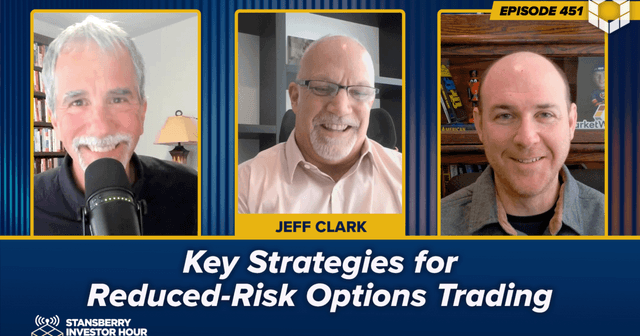
Key Strategies for Reduced-Risk Options Trading
Finding Worthwhile Energy Stocks Amid Rising Risk