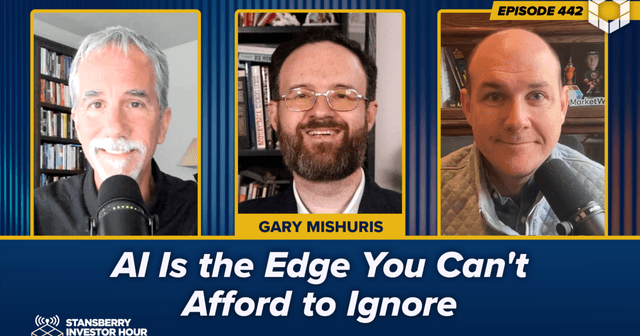

AI Is the Edge You Can't Afford to Ignore
In This Episode
In this week's Stansberry Investor Hour, Dan and Corey welcome Gary Mishuris back to the show. Gary is the managing partner and chief investment officer of investment firm Silver Ring Value Partners. He has kindly allowed listeners to download the PDF of how he uses AI to aid in his strategies. You can access it here.
Gary kicks things off by sharing how he uses AI in his investment process. He cautions against the extremes of thinking of AI as being a "genie in a bottle" that solves every problem or that it's completely ineffective and should be disregarded completely. The truth, he says, is in the middle. There are two use cases he argues for using it, with the second one being a "holy grail" method. And while AI can be accessible for most folks, Gary warns that it will not level the playing field...
People think that AI may be able to completely level the playing field, and the return to skill will go away because everyone will have access to these genius AI systems that they can just replicate... It's the opposite... The return on the real skill and insight is going to be magnified by AI... What is going to go away is the grunt work required, or at least a chunk of the grunt work required, to execute those insights.
Next, Gary reveals the one AI tool that he thinks is critical in utilizing AI in investing. It's not a popular model that makes the headlines, but Gary shows how effective it can be – and it's FREE. He then acknowledges how AI prevents him from falling into any biases and emphasizes that even though AI provides resources for him, he still does the research needed for investing and makes the final decisions for investing...
AI is amazing at [preventing biases]. You start with AI, you use it a little bit less as you go deeper and deeper into [your] idea, the pure human part. And then at the tail end, you use AI to help you avoid mistakes.
Finally, Gary explains how AI is a viable tool that is being used in real investment scenarios. He also bemoans YouTube influencers who use AI as a hype gimmick to market their online courses. Then he expresses his opinions on the wider market piling into AI data centers, stating that expectations are too high for what the technology can provide today...
Valuation is probably the worst indicator of what's going to happen in the next six to 12 months. But it is good to lower expectations, that's for sure. And that I think that... if you think, "Oh, I've heard markets are returning 10% per year... and recently it's been more than that" and you think that's guaranteed from this starting point, I would go and recheck your assumptions because I don't think that's going to happen for a while.
Click on the image below to watch the video interview with Ben right now. For the audio version, click "Listen" above.

(Additional past episodes are located here.)
This Week's Guest
Gary Mishuris is the managing partner and chief investment officer of Silver Ring Value Partners. Prior to Silver Ring, Ben was a vice president at Evergreen Investments and a managing director at Manulife Asset Management, where he was the lead portfolio manager of the firm's U.S. Focused Value strategy. Gary has earned both a Bachelor of Science in computer science and a Bachelor of Science in economics from the Massachusetts Institute of Technology.
Dan Ferris: Hello, and welcome to the Stansberry Investor Hour. I'm Dan Ferris. I'm the editor of Extreme Value and The Ferris Report, both published by Stansberry Research.
Corey McLaughlin: And I'm Corey McLachlan, editor of the Stansberry Daily Digest. Today we talk with Gary Mishuris, chief investment officer of Silver Ring Value Partners.
Dan Ferris: Gary is an old friend, and he is a great investor and a very smart guy, and he's figuring out how to use AI to do investing, to analyze stocks, and make recommendations and do research. And we will give you a link to download his PDF so that you can see what he's up to and learn how to do it, too. So, let's talk with Gary. Let's do it right now. Let's talk with Gary Mishuris.
Gary, welcome back to the show. Always good to see you.
Gary Mishuris: Likewise. Thank you very much for having me.
Dan Ferris: I was really happy that you reached out to us with a topic that, of course, everybody's fairly well obsessed with these days. And I thought, wow, this is exactly – you picked the exact perfect moment for this. So, good on you. I know you're not in a marketing business, but if you were, this would be the time for that message. And the message, just for our listeners' benefit, Gary reached out and said, "Hey, I have a process that uses AI for my investment analysis and I want to share it with you." So, I thought, "Yes" because I'm trying to do that myself and I haven't necessarily come up with anything really super organized. So, I'm a listener today as much as a host. So –
Gary Mishuris: Well, I think we're going to have a good conversation. It's a good topic that I think everyone is struggling with right now.
Dan Ferris: Yeah, so I feel like I should put it in your hands. Wherever you want to start with this, your AI investment-analysis process, just go for it.
Gary Mishuris: Yeah, no, absolutely. I think – look, for some background when I started as Fidelity as a young analyst 25 years ago, Excel was a pretty common tool, but you had some grizzled veteran portfolio managers who were still using the legal pad. And I literally remember as a young analyst seeing them do modeling on a yellow pad. And I think pretty soon, if not already, if you're not using AI, that's what it's going to feel like, meaning that it's maybe hardcore that you're doing these things manually, but I think that it's not optimal.
And I think there are two extremes. People are going to either the extreme of "Hey, AI is going to solve everything, it's going to be a genie in the bottle, and it's going to give you these amazing stock picks, and all you have to do is figure out the right magic prompt and rub it the right way and the genie will come out." And then there's the other extreme of "It's all hype, it doesn't work, real investors don't use AI." They just sit there like Warren Buffett and read 10-Ks, ideally physically printed, not even in digital form. So, somewhere in the middle, I think there's an actual opportunity to add value without sacrificing quality. And that's, I think, what I've been working towards.
Dan Ferris: It's ultimately a tool. So, if you don't have a hammer available to you and someone gives you one, it feels great and it makes putting nails into wood a lot easier. Right?
Gary Mishuris: Absolutely.
Dan Ferris: But it doesn't actually – it doesn't really solve all your problems. It doesn't tell you how to design a house that won't fall down, etc., etc.
Gary Mishuris: No, for sure.
Dan Ferris: So, yeah, but it's a great tool. Yeah.
Gary Mishuris: And I think, look, there's two types of use cases, two – as I call them, Category 1 and Category 2. And I think Category 1 is basically something where you're trying to save resources. And that could be primarily time. It could be money. But you're saving – you're doing the same thing you could have done as a human. you're just doing it faster, cheaper, some – using less of something. And that's probably the most common.
And then there is this elusive – what I call Category 2. And Category 2 is you're actually doing stuff with AI that you couldn't do as a human, or couldn't do nearly as well, even if you had nearly unlimited resources. And I think that's where maybe the holy grail is down the road. I think most of the use cases I've been able to figure out right now are Category 1, but I think I have one or two use cases which kind of enters Category 2. And I think – you mentioned the framework. And so, I put together this AI equity analyst framework that I think – I've made freely available, partly for selfish reasons. I want people to read it and tell me either what I'm missing, or where I'm wrong, or what I can do even better, because this is the Wild Wild West. But that being said, I think I have a pretty good starting point, which is what I think it is. It's not the final answer to anything. It's a working kind of framework that I actually use day to day because it's just amazing once you roll up your sleeves how much AI can improve the process of a long-term serious investor.
Dan Ferris: Amen to that. Even just – for me, just like as a search tool through multiple 10-Ks and stuff, it's that – it's unbeatable. If you just feed it 10-Ks – if all you ever do at this point for me is feed the thing 10-Ks and use it for search for various prompts, that alone, I'm like "Wow."
Gary Mishuris: And that's not wrong. I think that's a great use case for sure. I just think there's so much more. And I think if you – I think that actually – even just to step back, the way you use AI right now is actually probably of secondary importance to start using it. So, if you're listening to this right now, just roll up your sleeves and start building it into your process, because if you don't, if you wait for some iteration of ChatGPT 17 or Gemini 12 or whatever, you're not going to have the experience. It takes reps. It takes – you have to kind of do trial and error because, by the way, there are some pretty atrocious results obtainable with AI as well. So, in this framework, in the AI equity analyst, I've tested each prompt and some of the versions I had to go through to get to what I think is a working version, they were atrocious. And some of the use cases AI is just not ready for. But you're only going to find that out if you start doing it now. But – and if you do, you're going to start layering AI into your process. And I think that could be different for you. It might be a lot more than me or a lot less. But I think start doing it is the main message, I would say, even more important than some clever prompt that prompts AI just the right way or something like that.
Corey McLaughlin: Yeah, that's a –
Dan Ferris: I'm really glad you said that.
Corey McLaughlin: Yeah, I'm glad you said that, too, because the conversations we've been having lately – or even I've just been thinking about, about AI now, compared to, say, even a year or two years ago when it was "What is this? How is this going to change the world and take everybody's job?" Now, some people still think that last part, but the conversation now is just more practical, like what you're saying. You could have a more practical conversation about how does this actually work, what are the benefits, etc., if you start trying it, is the key thing. And so I'm glad you brought that point up to the table.
Gary Mishuris: Yeah, no, absolutely. And I would say, again, there's a lot of focus on prompt engineering. And I guess I just mention it can be important. It can definitely make a bad use case good. But I think, – and this is my – I don't have any data to prove it, but in my subjective experience so far, having the right use case – so, asking the right question – is, like, 80%. And then figuring out how exactly to prompt AI for that question is the other 20, because I think that some of my best "Aha!" moments with AI in the last six months – I have literally spent over 100 hours building this out because it's – the return in that time is just so huge. I invested 100, 200 hours, but I'm going to save hundreds of hours per year. So, the [return on investment] is incredible. But some of my biggest "Aha!" moments were like, "Wait, what if I use it for this?" And then I would this blocking, go "Oh, no, no, it's going to be terrible at this. No, I'm not going to do it." Well, let me try. And maybe at first it's terrible. Well, maybe it's 80% terrible but there's a 20% useful component.
And this is another very important point. I think people talk about AI hallucinating or AI giving you the wrong numbers. And then they use that as a reason to not use it. I think that that is actually lie completely backwards. You have to figure out where is it OK to have hallucinations? Where is it OK to have wrong answers?
Let me give you a very straightforward example. So, at the top of my investing funnel I have idea generation. So, I'm looking for potentially attractive investment candidates. And it actually does not matter if the list the AI generates – and I have two prompts in the framework: special situations and that kind of a Phil Fisher compounder prompt that I put together and I test it out. But it doesn't matter if it gives me 20 ideas and 16 of them are terrible. What matters is are there four good ones in there? Because I'm not saying you want to delegate everything to AI and go to the beach and come back and see how the portfolio is doing. That's not it. I'm saying you use it as a tool, you stay engaged with it, and you basically go and say, "OK, now I have these 20 candidates that AI generated that I would not have had." And again, using both my own knowledge and also other AI tools, saying, "OK, go through one by one: garbage, garbage, garbage. Oh, interesting. Garbage. Interesting, interesting. Maybe. OK." And now I have generated something that I wouldn't have had, even though most of the output might have been not great. So, that's an important point, I would say.
Dan Ferris: Yeah, it's a – learning to use it is a process of trial and error. I agree. And it's worth it. And there's no other way to go about it. You're riding a bicycle. You're going to get on the thing and you might fall and that's the way it is. I'm glad you said that it's – I'm glad you emphasized early in what you just said that asking questions and querying, prompting is really important because finally – there's finally a place in the world for somebody who might not be able to write code and might not be a highly technical individual but who has a lot of questions about what they're doing. And let's face it – if you're looking, as we are, as you are in our somewhat different roles, investment ideas, you have a lot of questions all the time and you want to know the best company in this or that industry or the company that has the least debt in this industry or anything like that. And much more that's much more complicated than that. It's just a wonderful – it's a wonderful thing, I think, that's happened to us, that we have this resource that we can just ask questions to without needing a degree in computer science to do it.
Gary Mishuris: Yeah, no, absolutely. And I think – it's funny you mention it because I have my T-ring here. I do a have computer science degree from back a quarter century ago, but I don't think it's useful because it teaches me how to code something. I think – and I think this is an important insight. People think that, OK, AI maybe will flatten and kind of completely level the playing field and the return to skill will go away because everything will – everyone will have access to these genius AI systems that they can just replicate that. And I think that's actually –
Dan Ferris: No, that's not what we're saying at all.
Gary Mishuris: Yeah. No, it's the opposite.
Dan Ferris: We're putting the human in the driver's seat.
Gary Mishuris: I think the return on the real skill and insight is going to get magnified by AI. Right?
Dan Ferris: Exactly.
Gary Mishuris: Because if you can – what is going to go away is the grunt work required or at least a chunk of the grunt work required to execute on those insights. But if you – imagine if you could think about yourself as, OK, you have the true value-adding things you do, whatever they are – again, different for you than for me, and different for you, the listener, than for me as well. But you have them. And then there's all the blocking and tackling to actually make those insights useful and make them get into your investment portfolio. And so, now you can just leverage those insights so much more and you can skip some of those steps. But again, you're not – and this – and when I wrote the framework there's a big orange warning on page two or something of the PDF, which is "This is not a shortcut." This is not meant – if you're lazy and you just want, again, that magic genie in a bottle, this is not it. What this is is it forces you to be explicit about your process and allows you to do more quality work faster, not just cut corners and hope for the best, which I think is an important distinction.
Dan Ferris: Right, right. So, I'm glad we agree that the human being is in the driver's seat. This idea that AI makes our humanity redundant is ridiculous. All right. So, shall we – we should get into this a little bit. And I'm sure our listeners' are like "OK, what – how does Gary really use this? What is he doing? What's the secret?" And you have a document that you've created that tells this information, but we'll introduce the listener to that. So, where should we begin? Where do you begin? You said idea generation.
Gary Mishuris: Yeah. I mean, no, absolutely. And I think idea generation is a great use case because when you think about what is AI good at, one of the things it's good at is synthesizing a lot of information rapidly. And so, I think that – so, I have two prompts – so, in that PDF you mentioned I have 13 well-tested prompts that work. And two of those prompts are idea generation problems. So, you start at the top of your – the beginning of your research funnel and you say, "OK, what candidates should I consider?" And one of them is a Phil Fisher problem. So, Phil Fisher, famous growth investor. I always think of him as just a long-term intrinsic value investor with a focus on growing companies. But he's known as a growth investor, so I'm not going to quibble on that.
And you basically tell AI, "OK, act like Phil Fisher." This is not the exact prompt, but "Go and find ideas with certain parameters." Let's say I want certain countries, certain market cap ranges, what have you. And have the – "and give me a list of things that fit." And Phil Fisher, by the way, in his book, Common Stocks and Uncommon Profits, had these 15 points, kind of a checklist. So, you're basically having AI run through the entire market or some subset of the market and have it judge each of these companies on those 15 points. You're going to get some list. It's going to take a long time, by the way. This is not like you're going to put it in, have lunch, go to the gym –
Dan Ferris: It's not like a quick Google search. Yeah.
Gary Mishuris: Yeah, it's going to be – it's not going to be instantaneous. But you're going to get a list and you're going to go through that list and you might find some hidden gems in, I don't know, New Zealand that you never would have heard of otherwise. So, that's a very cool use case. Again, a lot of human oversight. You don't want to assume that it's right. Some of them, you'll be like, "Huh, really?" And there's the "I," the intelligence in the AI. "Wait, that doesn't – this can't possibly be a fit for what I'm looking for." But ignore that. Don't worry about it because you only care about the ones that are interesting, not the mistakes.
And a complete different approach, let's say you are into just deep value, you want special situations, things like that, which I know I love, a lot of my investor friends do. And people, there are shops that have a full-time special sits analyst. All they do is find and kind of prep these ideas for the PM to look at. Well, you can go and have AI do that for you, find all the special situations, spinoffs, restructurings, whatever. We don't need to get into the whole nitty-gritty. But the point is come up and run that monthly. You can run – or you can even create a task to have it update you for – when new ones come. So, I think at the top of the process the sky is the limit. And I think that is just a terrific use case where – again, not saying that that's the only way you should generate ideas. I think there are other ways as well. But I found these two ways to be pretty cool, to be honest.
Dan Ferris: I find it pretty cool, too, man.
Gary Mishuris: Glad you agree. That's good.
Dan Ferris: I'm glad you mentioned Phil Fisher, too.
Gary Mishuris: Yeah. And that's my point, too, is that this approach is really agnostic to how you invest. It really doesn't matter if you're looking for a completely different set of things that make an investment attractive to you than would make the attractive to me. That's what I mean: Make AI your own. It's there to serve you, execute your process, not my process, and not someone else's process.
But another question is OK, so you find this list, and what do you do with this? OK, and you can go hardcore, go to the library, put on your favorite music and your headphones and start reading 10-Ks. But that is – and there's a place for that, I think, still, but I think it's too early. You're getting this giant list, you're paring it down to some subset, and now you want to go through it and figure out which companies are actually worth the effort.
And so, I have a whole bunch of prompts from basic company history and description to put your Michael Porter structural analyst hat on and analyze the quality of the business, all kinds of stuff that the main purpose is for you to get to a quick no. Because you get this giant list and you don't really want to spend your manual labor hours equally on every company on that list. That would be foolish. So, you – what you do is you essentially use AI to give you enough analysis to say, "Ah, no, no, no. Maybe. Ooh, this is interesting." Now when you say, "Ooh, this is interesting," this is not "Ooh, I'm going to buy some." This is "Ooh, that's when I'm willing to spend the human research time and go deeper."
Dan Ferris: That I want – I want our listeners to know that that moment right there that Gary just described is – it's the one – I don't know how he feels about it but I feel strongly about it. That is the moment you pray for every day. "Oh, this is interesting," because so much of the time you say, "No, no, no. Too much debt. Commodity business. No moat." Whatever it is you're looking for. Like you said, it can be any investment style. But that moment when you go "Oh, this is worth looking for," there's – something happens where you're confident that even if you wind up saying no, the next hour or two of your time is going to be really well spent
Gary Mishuris: Yeah. And by the way, I've done this for a quarter of a century now, and even though I'm a process guy and I'm very rational and methodical, I've just learned to trust my gut a little bit. It's OK to do that. And you get this feeling like you have to put every – at least I do – I have to put everything else aside and start researching this company. That's a good feeling. That's how you know.
Dan Ferris: Oh, yeah. That's what I'm talking about, man. It's like "Finally, I –" because otherwise – I don't know how you feel about this but I hate the feeling of being unfocused. Sometimes I just push back from my desk and say, "Whoa, whoa. I need to step away." Then I sit down and I write with a pen on a piece of paper what I'm doing next to kind of refocus, because that focus – man, focusing on something and really putting your – aiming your power at it, aiming your high-powered rifle of your mind at it, hopefully with a good accurate scope and good marksmanship, is what we really live for, we analysts, we equity analysts. So, beyond – so, here we are. We are – we have – we've gotten into idea generation. We're now at that moment where we say, "Hey, this is interesting." And then you're talking about trusting your gut and reading the 10-Ks and all that. So, what what's left? What's left for AI tool –?
Gary Mishuris: Well, there's one more step. There's one more stop. And I think there's a tool – I'm sure you've heard of it but I don't know how many people have actually used it seriously. And I honestly think it's the most powerful free AI tool bar none. And it's not ChatGPT. It's not Claude. It's not even Gemini. It's Google's NotebookLM. And if –
Dan Ferris: You're the second person to tell me that. Yes.
Gary Mishuris: Well, introduce me to the first. I want to get to know them.
[Crosstalk]
Dan Ferris: Yeah, it's our research director – Matt Weinschenk – told me.
Gary Mishuris: There we go. But I think it's so important because I've had all these companies pitch me on their AI products, and I have nothing bad to say, but any of them, I might use some of them down the road. But NotebookLM, totally free, number one. Number two, it basically – so, if you don't know how AI works, just a step back, there is something called the context. An analogy. So, AI, the reason why a lot of AI – so, large language models ("LLMs") hallucinate is they have this – basically it's sucked in, Hoovered up the internet or some portion thereof into their context. And then when you type in, you're adding context and they're basically kind of combining those two and finding the answer for you. I'm simplifying. There are other steps. There's thinking models and all that.
So, NotebookLM is like a blank slate. The only context that has are the sources that you upload. And you can upload up to 300 sources. And so, I'll tell you exactly how I use it. So, for example, you – I start with downloading, let's say, 20 annual reports if they're available. PDFs are fine. You throw them into your notebook – so, in NotebookLM, you create a new notebook. Again, it has not sucked in the internet. Its knowledge is limited, it starts in zero, it literally starts in zero, and then you pop – you tell it what you want it to learn. So, now rather than prompt engineering you are context engineering. You are engineering what context you want the LLM to assess.
And you – let's say you put in these 10 annual reports or 20 annual reports, and then you ask it "OK –" first you can just have it – say, "Tell me the story. Tell me a quick story of how this company evolved over 20 years." By the way, if you really want to save time, you can create a podcast. Speaking of podcasts, you can create a podcast with two hosts using just information that you've uploaded and go to the gym, take a walk, whatever, and then come back and you'll have learned a bunch of stuff about this company.
There's another level to the game here, which is – I mentioned earlier on that there are some of these category two uses, things that AI might be able to do that you and I can't, no matter how much time and money we throw at it. And so, what I've done is – so, I use expert interviews as part of my research process. So, as I go deeper into a company, I don't want to take management's word for it. I want to go ahead and say, "OK, what are other people saying? Customers, former employees, suppliers, and so forth?" So, let's say you have access to an expert network and you can download the transcripts. And you add those to NotebookLM. And I have a really cool prompt in that AI equity analyst framework that I mentioned which actually, I think, is a kind of a category two prompt in the sense that what's happening there is you're asking it to find common themes and trends among the interviews. And let's say if you had 50 transcripts or something like that, it would take you a long time. But even then you might not connect the dots, like "Oh, this happened here and that happened here. This former employee said that and the customer said that." So, amazing use case.
And – so, when I was a young analyst at Fidelity they brought in CIA former interrogators and they kind of tried to teach us how do you interview people? How do you detect if someone is lying to you? And one of the things that always kind of stuck in my mind is that they told us when people lie they don't actually tell you a complete falsehood, usually, in relation to the question you're asking. What they frequently do is they'll answer a slightly different question.
So, let me give you an example. Let's say you're interviewing a former employee of a company you're researching and you say, "Hey, how is the culture?" And the person said something like, I don't know, "I really liked the guys. We really enjoyed going out for beers afterwards." So – and you might just move on and feel no cognitive dissonance whatsoever because you feel like you've gotten an answer and you got a good answer. But if you pause for a little bit, you might realize "Wait, that wasn't an answer to my question." I didn't ask you if you liked the guys you worked with or if you went out for beers. I asked you how the culture is. Because maybe you're going out for beers with the guys you like to bitch and moan about how bad the culture is. And so, AI has this amazing way of – and the prompt literally tells AI, "Find things that were unsaid that are literally between the lines." And I think it's – I've seen it tease out some pretty neat things in my experiments. And I think it's an awesome use case that's perfect for the tools that are available right now.
Dan Ferris: Oh, yeah. I love that idea. I love the idea of feeding it conference call transcripts and saying, "What aren't they telling us?"
Gary Mishuris: Yeah. Exactly. Omission. So – I think I omission stuff is also a big way people lie. They tell you part of the truth but not the whole truth. And I mean, man, I was just talking to a former IR officer of a large company that we've known for a while, and I'm not going to mention the company, but the things that the person told me, whoo. The things you don't know on the outside of a public – a company that are going on the inside sometimes – sometimes that's a big – it's a big category of things, let me tell you.
And so, I think that especially – look, as a concentrated investor, which I am, if you have 20 basis points in each idea, maybe you don't care, maybe you're investing based on, I don't know, qualitative factors, that's a different game than what I do. But if you're a concentrated long-term investor like myself, then having a big blow up can be very costly. And I'm not saying this will prevent all of them, but if you can reduce them, that is very valuable, at least to me.
Dan Ferris: Absolutely. So, is there a point in your process, Gary, where – beyond which AI just simply – you've still got to tough it out the old-school way?
Gary Mishuris: Yeah, absolutely. I mean, I don't want AI to do the thinking for me. So, once I've kind of sunk my teeth into an idea, I do still do all the deep research. I do read – now, some of it I do it faster but I still do it. I still come up with my own range of values. I still make the decision. And there's actually – so, all of that is me. And in that framework I literally have a flow chart which has steps in the process. And blue steps are AI, blue and orange steps are a combination of human and AI, and orange is purely human. And what you'll see as you go further and further through the process is that at the beginning of the process there's a lot more blue, or blue and orange. Towards the end it's mostly orange – it's mostly me. But that way I can do the mostly orange, the human part on a lot more ideas.
Dan Ferris: So, this is a very interesting topic because I've seen studies where medical diagnoses were done with AI only, human only, and then the combination, and the AI outperformed the other two. So, a medical diagnosis is not an investment decision – I get the difference – but you understand why it's an interesting question at least. Right?
Gary Mishuris: No, for sure. I mean – and by the way, listen, maybe that's where we're going. Maybe in some number of years AI will be hiring me and AI will be saying, "Gary, this is what I need you to do today. I will make – I will – I've got this." So – and then, by the way, I've seen some LinkedIn posts where they show the org chart of a company and all the C-suite is AI. CMO is an agent. So, you've probably seen those too. But I think today we're not there.
I also – frankly, I'm a little bit old school. I know what the studies might say, but I don't know when there'll be some glitch, when there'll be some issue, when there'll be something. And so, again – see these gray hairs I've gotten through the hard knocks in the markets over the last quarter century? And I just feel like when the people are trusting me with their money, they're not trusting me to go to the beach and turn on some AI algorithm. They want me to actually make the decision.
So, I think it's super important to – I mean, different people will come out at different places on this. But for me, I'm bringing actually AI in. And let me tell you how I do it because I think it's very important. So, you probably know that I'm a big fan of behavioral finance. My Substack is called Behavioral Value Investor for that reason. I think essentially in investing we are frequently our own worst enemies. So, there's two more steps at the end that you can do. So, you've done all that early stuff, then you've done the deep digging. And then you end up – you're going to pull the trigger. Right? Well, no. Wrong. You don't pull the trigger. You do two things. Number one is you write up your thesis and you put it into AI and you have it check it. Check the logic. Check – I'm not talking about spell checking or grammar here. I'm talking about are there mistakes of omission? Is it internally consistent, for instance? Maybe you say at the beginning, "I think investment XYZ is great because of A, B, and C," but then you only go and show A and B. Or maybe there is evidence in your own report that C is untrue. So, things like that, I think, is a very easy and useful way to have AI point out mistakes before you actually put money to work behind them.
The other thing is something I call the devil's advocate. And this is an idea I had back in the day. We got a group of grizzled investors together, friends of mine, and I got them together and I said, "OK, guys, we all know behavioral biases are real. We all know we make mistakes. So, how about we kind of create a pact, a little club where once a year you'll be asked to spend a couple of weeks coming up with a serious opposite case, a devil's advocate case based on information someone sends you on a company." And your work buys you – once a year you can ask someone else to do that for you.
And it worked for all of six months. And then people got busy. Listen, it's a heavy lift to ask someone to spend a couple of weeks on an idea they don't truly care about. It's – we're human. It's like – I talk to college students where I teach at Babson and I talk to other groups about investing and I always have these slides in my deck where – about – comparing investing to dieting. So, you have – I have one slide with this really fit young woman and with healthy foods and exercise, which is what we know we should be doing, and then there is the next slide, which is the big fat guy chomping on a donut, which is what happens in reality. And so, investing is a little bit like that. There's what we wish we were doing ideally and then there's the reality. Hopefully it's not as bad as that but I think you get the gist.
And so, now I have this AI devil's advocate prompt where its goal now is not to stay limited to just my report. Its goal is to go and be this hunter-killer of my thesis and help me find things that are missing, like obvious common bias, called confirmation bias. What is it? You kind of seek out things that agree with your predetermined conclusion and you kind of ignore things that go against it. We all do it, except for me. No, I'm just kidding. We all do it. That's the whole point. Yeah. So, I think AI is amazing at that. So, you start with AI. You use it a little bit less as you go deeper and deeper into your idea. And then, you do the pure human part at the tail end. You kind of use AI to help you avoid mistakes.
So, that's kind of my process. If – I'm sure there are people who have found things I haven't. Again, it's the Wild West, but that's part of the reason I'm sharing this because it's so exciting. And I think there's so much we have to gain from each other in terms of collaborating and looking at how different people are doing this because we can only get better together. That's the only outcome.
Dan Ferris: OK. Maybe before we go any further, we should tell our listener how they can get to this document of yours, because you want everybody to read it, right?
Gary Mishuris: Yeah, no, I mean, I think it's a good one. I think I've had a lot of positive feedback and I've had people kind of give me some good pushback on some of these things. And at some point, there'll be a version two that will be even better because of it. But I'll share a link with you that you'll have. It's just a 33-page PDF where I kind of go through everything step by step. And also, for some reason, if you can't find the link, if you go to the Behavioral Value Investor Substack, it's – there was an article a couple of weeks ago that I wrote which describes the overall framework where you – and then you have a link to download the PDF.
Dan Ferris: Sounds good. Sounds good. Thank you for that. Where do we go from here, Gary? It sounds like this is – it sounds like early – you put a lot of work into it, but this is early days. You're going to get feedback from perhaps dozens, hundreds, I don't know, of people and then you're going to come up with a 2.0 and you are – just to be – I just want to be very crystal clear in case this isn't clear to anybody. You are using this to allocate real money for your investors.
Gary Mishuris: Yeah, absolutely. I was – I just had my annual meeting for the partnership on Friday and I was talking about this with my partners and I literally pulled up the screen of a notebook I have with a gazillion sources of a British company I'm researching and showed some of the kind of live stuff. It's great. It's not like a "Oh, let's design some theoretical thing and see – throw it out there on the internet and get some feedback." It's actually what I'm doing, understanding that you still have to iterate, and what I'm doing right now will probably be better when I do it in six months and 12 months and 18 months and so forth. But it's absolutely a useful tool today and will only get better.
I mean, I think one – so, I think you and I met at Vail at Vitaliy's conference for the first – a bunch of years back. And I was in Vail this summer and I gave a talk on AI there. And so, one of the things I had – you know how these things g. It's a short talk, and then you do Q&A from other experienced investors. And so, right where I was supposed to take questions, I said, "Wait, actually this time we're not going to do that. And the reason is I already asked AI what questions you guys are going to ask. And here they are." And so, we all had a good laugh. And of course, I took questions.
But I kind of – it was interesting to see what AI thought the objections were or the challenges were with using AI. And one of – a few things stood out. One was "Hey, is this somehow going to dull your ability to do research? Are you going to atrophy your primary research muscles?" And I think the answer is you could if you use AI incorrectly. But if you use it correctly, you're actually going to get more reps on the things that are the most value-adding. And you're going to spend less time – you're going to – let me put it this way. You're going to spend less time going to the gym and setting up the weights and doing all this other stuff and changing into your clothes and more stuff on the bench pushing at the weights. So, I think that's how I view it.
Dan Ferris: I was going to use the analogy of a carpenter who gets better with his tools over time and becomes more creative and productive. Yeah, no, absolutely.
Gary Mishuris: The other thing AI pointed out – and this is the million dollar question or maybe the billion dollar question, is AI – one of the questions was "Hey, it's awesome that there's all these tools and you can do all this stuff, but is there any evidence that AI actually improves returns?" And the honest answer is we just don't know. I think the head of Citadel was on Bloomberg a couple of months ago saying, "Nope. It's nice in making junior analysts more efficient but it's not going to add alpha." And maybe he's right. I don't know. And I think he doesn't know, to be honest. It's still being kind of worked out and decided. I can tell you with near certainty, though, is if you don't use AI, you'll be at a competitive disadvantage. So, maybe you – if you use AI well, it's not going to magically give you 300 basis points of alpha or extra per year. But if you insist on doing things kind of the old way completely, I think chances are you'll be at a disadvantage. I don't think you need to do that because it's not that hard to do it well.
Dan Ferris: Right. And if we're just sort of, how does one say, analogizing about how this works or might work out in light of the Citadel guy's comments, the first thought that came to my mind when you were talking was Renaissance Technologies. I mean, if you would have told me before that happened that a bunch of mathematicians and physicists were going to get together and go through a period – I think it was 20 years of 80% annualized returns, 80 – 8-0 – something truly insane – it might even be 60 or 80, but any of those numbers, they're just off the charts insane. If you had told me that, I would have said, "Oh, that's silly. They're not Warren Buffett." You know what I'm saying? It just would have been crazy. But that's exactly what they did. So, who knows? This is a tool just like the mathematical tools they were using, maybe, we could say, or similar enough to. And maybe there's an AI renaissance out there that's going to just shoot the lights out.
Gary Mishuris: Hey, there may be. Although, I'm going to just push back just a little because I think that there's a danger here, too –
Dan Ferris: Please do, yes.
Gary Mishuris: – in that – I'm a process guy. I'm a long term guy. But there's so many hypesters out there. And I know it's not you or any of your listeners. But do you ever watch YouTube and get these commercials like, "Hey, bro, get my trading system and make a million bucks from your couch"? And I feel like AI and the hype surrounding it just gives more ammunition to those shysters basically, people who are selling hope. I's a confidence game. But – and I think this is why – I'm not out here saying, "Hey, I have this magic AI tool. Go buy it for $300 and you will get amazing returns." I'm saying I have basically, essentially a very useful public white paper that's completely free and that you can go and do whatever you want with it. Even if you get one idea from it, it's going to be helpful. But I think there's going to be a lot of other people who are going to try to make money not investing using AI but taking advantage of the gullible by selling them some pipe dream that AI is going to be some magic solution. And I think you have to be careful. Yeah, you don't want to fall for that.
Dan Ferris: Yeah, human beings are vulnerable to that type of an appeal. They want to hear that there's a button they can press and they – and if you're a novice, let's just say, or just really don't know anything about how investing works, you may think that there is some way to just kind of figure it all out so that you never, ever lose money and you're never wrong and you're always making lots of money. And that just doesn't exist. It just simply doesn't exist.
Corey McLaughlin: Yeah, that's how you lose money. Yeah.
Gary Mishuris: Yeah, no, for sure.
Dan Ferris: Thinking that is how you lose – that's right.
Gary Mishuris: And it's funny. I actually saw a cartoon post on LinkedIn a few weeks ago and in the first – it's kind of like two scenes. In the first kind of panel this guy gives the interviewee the pen and says, "Sell me this pen." You've probably all seen those, like "sell me this pen" kind of tests. And in the second panel, the guy just – the interviewee says, "It's agentic." And it's such a – for those – it's agentic, the reference to the hype around AI agents and all – right? So, it used to be social proof. It used to be, "Matt Damon used it to sign his latest contract." That used to be the right answer. Now "It's agentic" is the punchline. And it's so true. There's so much hype and so much – I think it's good that we're experimenting as a society and as a community and as investors and even beyond investors, but I think that only a small fraction of the things we're working on are going to actually work out. It's important to be realistic about what AI can and cannot do at a given point in time.
Dan Ferris: It is an exciting time, isn't it? On the one hand, lots of people like you and us are excited about how to use this new tool. On the other hand, given the business that we're in, you and me and overwhelmingly every guest we ever interview, we can't help noticing that lots of people are investing a lot of capital in data centers that are – I previously represented them as being highly utilized. The load factors, the power usage is great, but the server utilization is not. Mostly, as far as I can, tell under 20%. So, the moment strikes me as more similar to the buildout of fiber in the late 1990s, early 2000s than I ever thought, with – when there was a lot of dark – so-called dark fiber. So, there's a lot of dark server capacity and no return in sight on investments approaching trillions. There's going to be this trillion dollar – multitrillion-dollar asset out there if they keep going the way they're going and building the way they're building. And it's just – don't know how to think. We just spoke with Ben Hunt and we were saying, "Boy, Ben, it sounds like you don't think 2026 is going to be a very good year." And it's – I don't know, do you – just now that we've talked about AI there, let's talk about it as investors. Do you have a macro view? Do you have a view on how this is going to play out in the next six, 12, 18, 24 months? Do you indulge that sort of thinking?
Gary Mishuris: Yeah, no, I hear you. I'm a much more bottom-up investor, but listen, I think about these things as well. But – and I think like the Gartner hype cycle kind of framework is perfect for this because I think we've seen this so many times where there is a promising technology, it is capable of doing a lot of new things, but then the expectations for it what actually can do and how quickly you can get those things done, they're way overhyped. And I think that some of the studies I've seen, like the amount of extra revenues you need to actually generate a return on the trillions of investments that are going into AI, those are huge numbers. And I know Elon Musk is out there saying there's going to be an army of robots and 10 years from now no one's going to need to work or something like that. But it's Elon. He likes – he's an amazing creator of wealth but he also likes to fantasize about the future ad a lot of his forecasts don't quite come true.
So, I don't know. I mean, I also know recently – I'm sure you've been following the Michael Burry saga with his – related to your capex, the questions that these companies are manipulating their earnings, they're all balance sheet debt, their depreciation is insufficient. So, there's a lot of froth in the market. I think that there's a lot of gullible people. Frankly, the last 15 years we haven't had a real bear market. We had mini corrections where the government quickly stepped in and flooded the market with liquidity. And so, there's a whole generation of investors who they know that stocks can go down, but they – in the back of their minds they expect the dip buyers will come and they will buy all the stocks and it will be all OK. And that might be true. But as a student of financial history in markets, we – you and I both know there were decades where things were not that great. And we just happen to be exiting a decade and a half where the markets have been great and very benign and forgiving.
So, I think you combine that with the AI hype, and despite the fact that, yeah, it's quite real, as I think we spent most of the conversation talking about, I think at the end of the day I think there's a lot of danger in the markets. And I am very nervous that asset prices almost across the board are very frothy, or at least very full, maybe not frothy in every corner of the market, but certainly not a lot of distress or cheapness going around. And expectations are built for perfection. But what do I know? At least that's my view.
Dan Ferris: They are built for perfection. Yeah, that's – but it's funny, though, because given the generally higher market multiples and things that have prevailed, really this century, this century really post-2000, you could have said that – and I did say it. I have said it many times. So, it's – I guess I'm kind of – I want my listener to know – and if you disagree, by all means weigh in – noting that something is priced for perfection is not a timing call. Gary is not calling at the top of anything.
Gary Mishuris: No, not at all. And that's why I hedged at the beginning. Valuation is probably the worst indicator of what's going to happen in the next six to 12 months.
Dan Ferris: Yeah, I just wanted to underscore that.
Gary Mishuris: But it is a good measure of long-term expectations, that's for sure. And I think that if you – if you're listening to this and you think, "Oh, I heard markets return 10% per year, and by the way, recently, it's been more than that," and you think that that's guaranteed from this starting point, I would go and recheck your assumptions because that I don't think that that's likely to happen for a while.
Dan Ferris: Yeah, long term. From this moment, lots of people have studied that if you go back in history, from this kind of a priced for perfection moment, the S&P 500 has generally done really poorly and been flat or even down over many years, like a decade, 12 years, numbers like that.
Gary Mishuris: Yeah. And again, I'm not forecasting that –
[Crosstalk]
Dan Ferris: No.
Gary Mishuris: But I can tell you as a bottom-up investor, I'm having trouble finding new ideas. It's not easy. And I know I'm not supposed to say that because old investors, most investors are like, "Oh, I can find amazing ideas in any market. Just give me some money." I'd rather be honest and say it's tough. If you want quality and if you want a good price and you want a business you understand and you want there to be something misunderstood and mispriced in it, that's not a big opportunity set right now. At least not one that I'm finding, anyway.
Dan Ferris: Right. We – in our Extreme Value newsletter, Mike Barrett and I have done really well over the past five years. But – just like everybody else. Right?
Gary Mishuris: Well...
Dan Ferris: And much better than the market. Many, many tens of basis points more, just blow it out. But we feel like we're struggling every month now. It's really – we're going, "Oh, God, can we really recommend this with a straight face? Yeah, we can because of this and this." And I wonder when we're going to just say, "Can't do it. We just can't do it one more month." It is difficult.
Gary Mishuris: Well, I think your honesty is refreshing because I think – again, I think it's important to be honest both with yourself and with others. And I think – look, I always tell my partners it's not about how the portfolio, how terrific the portfolio is today, because what I'm doing is I'm sitting there day in and out and I'm hunting for opportunities – and maybe to bring it back full circle – using both AI and other methods as well. I haven't given up on the good old "just hard work and elbow grease." And I think the opportunity set will change. And I think if you're being properly cautious right now in how you're investing, that's going to pay dividends when you are able to take advantage of the more attractive opportunity when a lot of people maybe do not.
Dan Ferris: All right, Gary, it's time for our final question, which is the same for every guest, no matter what the topic. You've answered it before. I kind of hope you forgot because I think it works better that way.
Gary Mishuris: I forgotten. No, I'm nervous now.
Dan Ferris: Good. That's good. No, that's good. No, don't be nervous. I'll tell you. The question is this – it's for our listener's sake to give them a takeaway. So, if there's one thought or one takeaway that you would like our listener to have, what would that be?
Gary Mishuris: Yeah, well, since it's – since the main topic of a conversation is AI, I would say whether you download my framework or not or do whatever you do, start using it for investing now as part of your process and start learning how you can build it for you in a way that's right for you. So, if you walk away with nothing else, it's that just getting the reps in on – and building AI into your investing is going to be something you're going to be grateful for years to come.
Dan Ferris: Thank you for that. And thanks for being here, Gary. It was really great to talk to you.
Gary Mishuris: Of course. Thank you for having me back. Appreciate it.
Dan Ferris: Folks, the White House is on a stock buying spree that is comparable to a hedge fund that has raised billions. And the stocks in question are surging as a direct result: 200% within 24 hours in one case, 90% in another. And that's just the tip of the iceberg, which is why we're hosting an urgent financial summit, "The Stocks That Save America," on Tuesday, November 18. That's tomorrow. This event will feature a man you may know well: 50-year investing titan Rick Rule, along with my guest today, Nick Hodge. Together they'll reveal why the success of some stocks could now be a matter of national security, how a select group of U.S. companies could soon play a historic role in rebuilding the nation's industrial backbone and the wealth of regular people, and the name and ticker of a free stock recommendation they believe could soar as this story accelerates – a stock I personally love, by the way. If you enjoyed today's episode, this briefing will be a must-see follow-up. Now head over to www.whitehousestocks.com to learn more and reserve your spot. Again, that's www.whitehousestocks.com. Don't delay.
Well, it was great to talk with Gary, and it was great to hear somebody sort of get into it with using AI in an investing process, and I'm so glad that he has this PDF. I have not read it yet. He just gave us the link shortly before we did the recording here and I have not gotten into it. I am going to tear that thing apart because I'm struggling right now to sort of figure out AI in my investment process. I use a lot of queries but they tend to be kind of general, and I wind up having to do a lot of work to get the garbage out of it. But that was really – as always, Gary's a very thoughtful, process-oriented guy. So, that was perfect, I thought, and perfect for this moment.
Corey McLaughlin: Yeah, very great resource he's put together, it seems like. I haven't checked it out myself yet either, but I will. And it's – it just reminds me of how I'm trying to think about all these AI tools that are out there now, about really looking at it as like an assistant or like an entry-level assistant job sort of role, which is good news if you have a job already and are kind of mid or upper career. You can afford to do this and put these – let these tools help you. We're seeing right now also that's a problem for people who are trying to find kind of entry level jobs in kind of the knowledge economy, maybe junior level analysts and those sorts of things. But there will be – there's got to be ways to use it from an entry level perspective as well too, and that'll work itself out over time. But what Gary was talking about is super interesting, practical ways of putting this technology to work. I love his thing about – if you didn't know anything that he was saying, his points about prompts and asking the models questions and then NotebookLM, just kind of a tool where you could dump a ton of information, like the information that you want, and it's like a second brain. It's like all the stuff you wanted to ever remember, you could dump into like a single folder essentially and have the AI pull pieces of information or analysis from it. So, those two things alone are super valuable to do if you're trying to figure this stuff out.
Dan Ferris: Right. I just realized as you were speaking, you and I – of course, you write the Stansberry Digest virtually every day and I do it once a week usually. And at Stansberry generally, even in our newsletters, when we make recommendations, we're mostly targeting – and we're – overwhelmingly, our subscribers are self-directed individuals who are managing their own money. There are plenty of investment professionals running other people's money among their subscribers, but overwhelmingly it's the self-directed individual. So, we do a lot of storytelling and we try to get our analysis – we don't just throw a lot of numbers at people. We try to do the analysis and then make it far easier to understand the thesis than a Wall Street analyst might make it. And that storytelling we do, I think, is really important. I have found that I use AI, and I do general throw it out to the internet kind of queries to hunt for this stuff. I'm using it to find the story almost more than to do analysis, more – definitely more at this point. And I'm wondering – you do a lot of that same kind of storytelling every day of the week just about and I'm wondering what your specific use case looks like.
Corey McLaughlin: That's interesting you say that. I haven't really used it at all to find stories or narratives. I did early on – this is probably at least over a year ago – early on, I was like "All right, let me see what this – how I could incorporate this to daily – the daily work."
Dan Ferris: Let me qualify. It's not like I use it to find the story or the narrative, but I definitely use it to hunt down as many sort of facts and details to amplify the narrative. So, just to clarify.
Corey McLaughlin: Yeah, yeah, yeah, I get it. And early on, I was curious, "OK, how great can this AI search be essentially?" So I'd say, "What are the top five stories people are talking about in the stock market today?" And it would give you some vague representation of it, which wasn't very helpful for me at all. Now – so, I use it more as from a writing, editing perspective on, as – like I was saying, as an assistant. You would have – we have editors too, and we will, but to have something written and then have an AI look at it, it may be able to fill in some gaps or tell you if you're missing something or "Did you think about this?" Kind of what Gary was saying about towards the end you just kind of, yeah, use it as a filter.
So, that's really mostly – from a daily perspective, it's different because – or for me, I feel like, because there's so much happening every day, that a lot of times, for me, it's just easier – I'm still at the point where it's easier for me to think with my own brain and just put it on the page instead of the interstep of going to the – going to a technology to tell me what's going on, rather than me just doing it myself. I'm still at that point with a lot of this, if that makes any sense, but I definitely see the value in adding it to a workflow to just kind of do things that you're – not necessarily mundane tests, but stuff that's been routine over time. And just once you start using this thing, I think you even start realizing, "Oh, I don't need to do that anymore. And that's OK. I don't need it anymore." And then you just do other stuff and then you'll just do other things. You won't even be realizing it.
Dan Ferris: Interesting. OK. Well, I just wanted to see where you were. And I'm sure it will be different a year from now. Right?
Corey McLaughlin: Oh, yeah. It'll probably be different in a couple days. But –
Dan Ferris: Yeah, that's right. Yeah, me too. But one thing I definitely am going to do is learn how to use NotebookLM, which I really haven't truly done yet, to focus just – so much of what we've done certainly in Extreme Value and in other publications is focused on – focuses on really high quality sources: 10-Ks, company reports on-the-ground due diligence, etc., etc. And doing that faster is a dream come true. And that's what you could do with NotebookLM. Anyway, that was awesome. I hope everyone else got lots out of it and took some good notes and will download Gary's PDF and take a look at it. It was a really great fun interview and a great episode. I hope you enjoyed it as much as we really, really, truly did.
Announcer: Opinions expressed on this program are solely those of the contributor and do not necessarily reflect the opinions of Stansberry Research, its parent company, or affiliates.
[End of Audio]
The Hidden Flaw in Wall Street's Trillion-Dollar Maths
George Noble: Why the Tesla and AI Bubble Will 'End Badly'

Everyone Trades Too Much... And It's Costing Them Everything
What Big Money Is Doing While Everyone Else Is Guessing