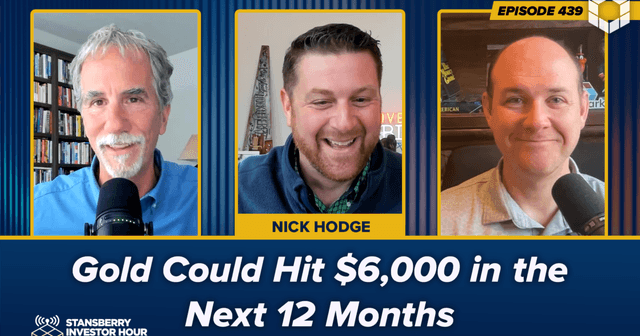

Gold Could Hit $6,000 in the Next 12 Months
In This Episode
On this week's Stansberry Investor Hour, Dan and Corey welcome Nick Hodge to the show. Nick is the editor of Underground Alpha at Digest Publishing and an expert natural resource investor.
Nick kicks off the show by discussing how he got into natural resource investing. He says that he began with a focus on clean technology but switched lanes after the great financial crisis hit. Sharing a case study, Nick talks about antimony miner Perpetua Resources and notes that "the smart money is now here" in the natural resource space. Nick also makes his bullish case for $5,000 or $6,000 gold over the next 12 to 18 months – there are more buyers than sellers, the metal is "underowned," and crypto traders continue to enter the space...
These crypto soldiers are training for the gold Army. They were learning about things like fiat currencies and what that meant [eight to 10 years ago]. And they were learning about things like counterparty risk and what that meant. And I think there's still some of those folks and some of that money. That crypto money that's going to come into the gold space could be another driver.
Next, Nick says his specialty is evaluating junior miners, so he dives deep into what he looks for in each company – both in terms of share structure and management. After that, Nick covers human psychology versus the cyclical nature of natural resources, the U.S. outsourcing the production and refining of rare earths and minerals to China, and why the federal government is now scrambling to reverse the outsourcing. He explains that we're still at the very beginning of this growth trend, so there's time for investors to profit for years to come...
The inertia is so great. Like I said, we need 50 million pounds of uranium. We produce less than 1 [million pounds currently]... We had a 12- or 15-year dearth of capital, a dearth of expertise. And that's not solved with a couple of hundred-million-dollar government checks. You have to have real action, right? And you have to have continued investment.
Finally, Nick explains the nuance in precious metals investing, including the difference between heavy and light rare earths. He then shares the name of a technology company he likes today that tracks and digitizes mining-company data. Nick says that it "brings mining out from the opaque nature that it has into a transparent nature." And he closes with a conversation about the importance of investing in precious metals in such rough economic times...
These politicians on either side aren't there for you. You see how they enrich themselves on both sides of the aisle while the middle class continues to erode. And we get this K-shaped recovery ever since COVID and then the vast wealth inequality. So I firmly believe you need to focus inward and on your family and do what's best for you and be an asset owner.
Click on the image below to watch the video interview with Nick right now. For the audio version, click "Listen" above.

(Additional past episodes are located here.)
This Week's Guest
Nick Hodge is the co-founder of investment service Digest Publishing. At Digest, he produces multiple publications, including the free daily newsletter Daily Profit Cycle, as well as paid newsletters like Foundational Profits, Digital Dispatch, and Underground Alpha. He also co-hosts the investment podcast Investing in Bizarro World and has written two books: Investing in Renewable Energy and Energy Investing for Dummies.
Previously, Nick founded the Outsider Club and grew it into a major financial publishing powerhouse that reaches hundreds of thousands of investors and brings in tens of millions of dollars in revenue. Over the years, he has made millions for himself and his clients while helping to finance some of the most exciting early-stage companies in the resource, energy, cannabis, and biotech sectors.
Dan Ferris: Hello, and welcome to the Stansberry Investor Hour. I'm Dan Ferris. I'm the editor of Extreme Value and The Ferris Report, both published by Stansberry Research.
Corey McLaughlin: And I'm Corey McLaughlin, editor of the Stansberry Daily Digest. Today, we talk with Nick Hodge, editor of Underground Alpha.
Dan Ferris: Nick is a very smart guy. He knows a lot about natural resources investing. Get out your pens and pencils. You might want to take some notes because he's going to give us a lot of good details about how he operates his strategy and what kind of companies he looks for. So, let's do it. Let's talk with Nick Hodge. Let's do it right now.
Nick, welcome to the show. Very happy that you could be here.
Nick Hodge: Oh, it's a pleasure to be here, Dan. Thanks for having me.
Dan Ferris: So, my co-host and I will pepper you with questions for the next hour. But first, maybe – you're a new guest on the show. We haven't spoken with you before. So, maybe you could just tell our listener a little bit about what you're doing now and how you got there.
Nick Hodge: Sure. Well, let's start with the latter and then I'll get to the former, how I got here. I came into the newsletter space in the mid-2000s, before the global financial crash or crisis happened in 2008, and I was tasked with writing about clean technology stocks. This was 2007, post-Al Gore Inconvenient Truth. You know, every day there was Chinese solar stocks on the front page of the Wall Street Journal, and there wasn't a lot of expertise in wind and solar and geothermal and batteries, and I was young and hungry, just out of university, and I became a self-taught expert in those things. Went to all the conferences, shook all the hands, read all the research reports, etc., and carved out a little niche for myself in the clean tech space, which lasted precisely until the economy crashed a year or two later. And I started learning about other facets of the economy and markets, including monetary policy, bailouts, central banks, etc., and ended up gravitating to the natural resource space just as the gold boom was ending in 2011 and 2012.
So, I have spent the past 10 years making money in a resource and commodities bear market, which I'd like to think honed my skills and sharpened my tools. It seems to be a little bit easier now, given the environment that we're in. I worked for a Baltimore-based publisher for 13 or 14 years. I grew a big division for them. It was called the Outsider Club. And when I was making them enough money and I realized I could do it on my own, I offered to buy that division, which didn't work out. And so, I left in 2020, as many folks did, not just in this space but across the U.S. There was a lot of quitting of jobs and going out on your own. And that's what we did.
So, we started Digest Publishing in 2020. And then we've grown that to a decent-sized little publisher with a couple of letters that cover many facets of the business. We're a little different than some other newsletters out there in that we eat our own cooking. We write about how we're managing our own money. We've actually made money with our own recommendations. No knock to you guys or anybody else, but I see a lot of paper traders and newsletter writers with no skin in the game. That is not us. So, that's what I do. I manage my money with an agnostic approach, but I definitely gravitate towards the natural resources.
Dan Ferris: Natural resources is a tough business, and it's very tough to make money in a long bear market. Really tough. Some people might even say it's impossible, but you would not say that, it sounds like.
Nick Hodge: Oh, no, I mean, there were fits and starts over the past 10 years. Uranium didn't have the greatest run, but we got some rate cuts in 2016 and we had a little bit of a bull market. And yeah, it's largely cyclical, of course. When the tide is rising, all the boats go up, like we're seeing now, but we did pretty good over the course of the past 10 years by knowing some good folks in the space, getting a real education on how resource companies are formed and financed, learning a lot about share structure and capitalization and the importance of people, and generally avoided a lot of the missteps that folks make when they come into this sector.
Dan Ferris: Yeah, knowing the people in the space is everything, isn't it? Matter of fact, just for me, I've known Rick Rule for 30 years, and he's introduced me to a lot of people in places like Vancouver and Toronto. And just knowing those people has made the difference between potentially going on my own and really finding out the hard way that most of the, especially the sort of nano-cap stuff is really toxic. Being really conservative about my natural resources picks and understanding and getting great results with natural resources just by picking a few stocks here and there. It's – knowing the people is like – and there's two groups of people. There's the really good ones and the really bad ones, the ones you've got to stay away from. We don't talk about those but we talk about the fact that they exist. We've got – so –
Nick Hodge: Yeah, I mean, just to touch on that, a couple of themes there that I talk about a lot, some groups of especially microcaps or nanocaps, as you put it, they're not trying to mine anything but shareholders. They're paper miners. So, they pay their salaries and they buy the luxury cars and send their kids to school, but they're only raising money to do that, to pay their salaries, etc. And then there's the really good folks that Rick talks about. And he's been gracious with his time with me as well, ever since I was a young lad in this business going back to those early 2000s when I was speaking at Cambridge House conferences and things like that. Rick always seemed to take a liking to me. And I have spent some time with him and have actually invested alongside him in a couple of deals over the past few years. And yeah, he's drilled it into my head and in many others. Every time he takes to the dais, he's always talking about the Lundins and the Ross Beatys and the Robert Friedlands, for example, and success breeds success, and the serially successful continue to be successful and find deposits and build companies and build mines, which is really tough to do. Not to dive right into it, but something like one in a thousand targets turns into a mine. It's really, really tough to do. And even if you find a good deposit, there's so many extraneous factors, from government to local population to red tape to cost of capital to permitting that it takes sometimes 20-, 30-plus years to go from first drill to first pour.
Dan Ferris: Right. Yeah, I was going to touch on that too. I mean, the one in a thousand and then you're waiting decades. So, it's –
Nick Hodge: Well, I'll tell you a funny story. We're here in 2025, and critical metals are all the rage. You guys might have seen antimony in the in the headlines recently as one of those critical metals that the government – or, the U.S. doesn't produce any amount of. We were invested in a company back in 2012 that we knew was going to be the only source of U.S. antimony production. That company was called Midas Gold. It's not called Perpetua Resources. It's John Paulson's company. He's the largest shareholder, the billionaire. And folks like Rick and others were saying, "Nobody's wants this stock at 30 cents. Nobody wants this stock at $3. They're going to be fighting over it at $30. You wait and see." It's just going back to that cycle that we were talking about earlier.
And lo and behold, that's exactly what's happened. So, that project went into permitting. It's in Idaho, by the way. I always tell this story: The year my daughter was born, 2016, my first daughter, and they just got their permit this year and she's 9 years old obviously, if she was born in 2016. So, nine years in permitting. But more importantly, the Department of Defense is writing checks to Perpetua Resources. JPMorgan and Agnico Eagle just put in $250 million. And so, the smart money is now here, Dan.
Dan Ferris: Off the top of your head, do you know the share price appreciation in that period of time?
Nick Hodge: Yeah, for sure. I mean, just even in the past 12 or 18 months, it was a $3 or $4 stock in Toronto, and it's over a $40 stock as we speak.
Dan Ferris: Wow. Yeah, it's been quite a call it year and a half, 12- or 18-month period generally. And lately, of course, gold has had a little hiccup here, as it normally does, but really, compared to the type of corrections that resources normally see, it really hasn't been that – it's been nothing. I mean, it's a blip. And yet, I still hear people telling you "Well, it's over" or "It's a bubble" even, I saw. But mostly just "It's over. I'm short gold. This is only going to end one way." And on the one hand, of course, a ballistic price chart doesn't usually resolve by going sideways, so there's a point there. But fundamentally, how do you bet against gold from here? I don't know. Fundamentally, I don't see it.
Nick Hodge: Yeah, I mean, I'm happy to pick up on that. I think you saw a textbook correction over the past 30 or 45 days, gold up around $4,200, $4,300, settling down to $3,900 or $4,000. I mean, that's textbook 10% correction. And as we record today, gold's had a $100-plus week. Last time I looked at the chart, it was $4,200 gold and $53 silver. So, that would point to the fundamentals as well. Don't tell the central banks that it's over. They just bought the most gold last month that they bought all year, for example. China is still buying. Brazil bought many tons of gold.
And other people see it as well. Tether, the large stablecoin, is now buying as much gold as some central banks. I think they were buying 2 tons a month at some point this year and they've even acquired gold royalty companies. So, some of these big institutions like countries, central banks, and Tether, which by the way has a greater market cap and is buying more U.S. bonds than South Korea, for example – I mean, that's a big entity. For them to go into gold and make gold acquisitions, I don't think the fundamentals are over. And I could keep going on this for a while because the debt just hit $38 trillion. I don't see that slowing down at all. DOGE was an absolute failure. The debt continues to rise. The M2 money supply continues to rise. We've just got a Federal Reserve rate cut, and the market is pricing in another one for the next meeting. And on down the line. So, the fundamentals are certainly there and the central banks can continue to buy and so do those Asian nations that covet gold. They're still buying as well.
Dan Ferris: Yeah, I mean, of course we don't know, but I'd bet real money Scott Bessent still has it as his largest position. I think he said that maybe last November or even earlier – maybe summer or so of 2024, did we find out about that, I think? And I think it's –
Corey McLaughlin: Yeah. And I heard him just a couple weeks ago, Dan, somebody asked him about the gold price and he said, "Well, there's more buyers than sellers."
Nick Hodge: Buyers than sellers.
Corey McLaughlin: And he didn't say much more than that. But that was enough. Nick, do you have a price in mind for gold in the next, say, year or two?
Nick Hodge: Oh, gosh, that's a crystal ball type question. So, I mean, it largely depends on – well, I won't say largely. Some of it depends on government actions. You listen to Rickards or these other folks and how they're going to adjust the price of gold to pay off some amount of the debt. Those are sort of black swan, crystal ball things that are tough to predict by their very nature. That's what a black swan is. Given what gold has done in the past 12 or 18 months, given that we just talked about its 10% correction, it could have gone all the way down to $3,600 and still been in a bull market and did not. I don't think there's – and the other thing is on a technical basis, all-time highs is like the most bullish technical indicator there is because there's no resistance ahead and there's only blue skies. So, but "Trees don't grow to the sky" is something I say a lot and – I'm hedging as I'm forming the answer to this question. I think $5,000 to $6,000 gold in the next 12 to 18 months isn't an unreasonable type prediction.
You've seen Goldman Sachs come out and say that, and Morgan Stanley as well has been increasingly bullish on gold, saying that just if 1% of the world's reserve capital goes into gold, you'll see it go to $5,000. And it's still under-owned. That's another thing that Rick says a lot, but that's because it's true. So, you just saw Morgan Stanley this year augment their 60/40 portfolio from 60% equities and 40% bonds to including some mix of gold in there. That is something new that hasn't happened before. And that brings in those generalists and retail investors and financial advisers who are typically adverse to holding some percent of gold in their clients' accounts because they don't get paid for it as much. We're seeing that start to change. And so I think there's still drivers and buying ahead that could take you to $5,000. Sorry for the long answer.
Dan Ferris: No, that's a good – we like long answers around here. Complete and thorough.
Corey McLaughlin: Yeah, no, it's great. I know it's a tough thing to pin a number on in a time and – but I was more interested in what – how long the drivers are still going to be in place. And that retail piece of it seems like it's still not really even close to that, from my view. I don't know what you think about that but…
Nick Hodge: Yeah, I mean, I agree. You see the folks buying Costco gold bars, folks that know what I do, like my dentist or other parents and my kids and stuff, starting to ask more about gold and things like that and some of the headlines that they're seeing about rare earths and the government investing in mines. So, it's tough because I look at it every day and it's so ingrained in me and has been for the past 10 or 15 years that I sort of – I'm not drinking the Kool-Aid but I see the headlines and I know what's going on. So, it's interesting when I see and hear people that aren't typically interested in that stuff start to ask about it. So, I agree that that's coming. And one other thing I would add is – I already mentioned Tether, but I was giving talks at conferences eight and 10 years ago talking about how the crypto crowd was – my line was "These crypto soldiers are training for the gold army." They were learning about things like fiat currencies and what that meant, and they were learning about things like counterparty risk and what that meant. And I think there's still some of those folks and some of that money, that crypto money that's going to come into the gold space that could be another driver, as evidenced by the Tether example that I sort of already cited.
Dan Ferris: That's a good point. And it's an interesting comparison, gold and bitcoin, isn't it, because some people call bitcoin the electronic/digital gold –
Nick Hodge: Sure.
Dan Ferris: – I think they call it. And one analyst we've had on the show, a quirky, interesting, brilliant guy named Hugh Hendry, he was talking about the difference between the total market cap of bitcoin versus total market cap of gold and the potential for those to achieve parity as a reason to be more bullish on bitcoin than on gold. I'm not sure how I feel about that, but I think bitcoin certainly has a lot of potential. Do you agree or disagree?
Nick Hodge: Oh, I agree. I'm a bitcoin owner and I own it in the same way that I own gold. So, I have my insurance gold and I have my insurance bitcoin that's in my safe next to my guns and bullets, as I say. And I don't touch that stuff. I don't want to sell it. I don't trade it. I just stack it. There's a box of gold and then there's a USB stick or a cold storage wallet as it's called that that has my bitcoin. And then I layer it into my accounts as well. So, I'll own the GLD and I'll own one of these bitcoin ETFs that has popped up in the past 12 or 18 months., which have been the fastest growing ETFs, by the way. So, yeah, I own both of them for the same reasons.
And that's why I don't get the Peter Schiff arguments about gold versus bitcoin. And I don't get the "You've got to do one or the other." You should totally be doing both. And I do. And that's what I've been preaching for a long time. And I own them in sort of similar ways as I just laid out there. But yeah, just to reiterate, I mean, God or whatever you believe, the universe only created so much gold. It's in the ground and it takes a certain amount of capital and human ingenuity to get it out of the ground and extract it. And similar with bitcoin, the way it was designed with a 21 million cap. Some people argue that that could potentially be augmented or lifted and you could get some dilution, but just taking it, what it is, it's a finite currency. It's anti-fiat. It's not controlled by the government. It can't be printed. We're not handing it out and it gets increasingly harder to produce, the same way gold has gotten increasingly harder to produce as we've mined out all the high-grade stuff and we've got to go deeper and lower grade. It's the same with the bitcoin halvings and the increase in the calculations and the energy needed to produce those bitcoins. So, in my mind, I mean, that's a that's a two-track road. One is gold and one is bitcoin and I own them both, for sure.
Dan Ferris: Yeah, you'd think that either/or mindset – especially, you mentioned Peter Schiff, which we should have him on the show. I hate to talk about the guy when he's not here, but I would think the idea of competing forms of money would appeal to someone who is really into gold. Right?
Nick Hodge: Well, and really into capitalism and libertarianism as well. I mean competition is key. Yeah, for sure. But he's got – again, I'm talking about a gentleman that's not here, he does have a product.
Dan Ferris: Yeah, we have no idea. That's right. We'll talk to him about it someday maybe.
Nick Hodge: I just saw him last week at the New Orleans Investment Conference by the way. There was a lot of good folks down there.
Dan Ferris: Yeah? Man, I haven't been to that thing forever. I went to – it was the first thing I ever did with – when I worked for Agora Financial long, long ago in 1998. And it was the last year that Jim Blanchard was there. He died some months after that.
Nick Hodge: Well, at least you got to see him. Yeah.
Dan Ferris: Yeah, yeah, I got to meet him. Anyway, just a little blast from the past there. But yeah, it's a great event. I'd love to go back there sometime. So, let's talk about –we all have thoughts about gold, but your expertise is really in investing in the mining sector, the natural resources sector. Within that general category, do you have any kind of a specialty or a focus or a – just a strategy generally?
Nick Hodge: Yeah. So, at the end of the day, I like to bill myself as a generalist, but I do have a specialty in evaluating share structure and people as it pertains to the smaller end of the spectrum of the mining world – that is, junior miners. We talked a little bit about the people already. So, I was lucky enough to get a mentor in the space 13, 14 years ago who taught me the ropes, just like you were saying about Rick Rule, showed me how companies are capitalized and put together. And so, my expertise, if I have to put myself in a box or into a corner, would be I like to say I'm a BS detector. Rick Rule doesn't like when I cuss on the air, but I can look at a company, I can sit with the management for 10 or 15 minutes, go through the structure and the slide deck, and have a good sense of what their intentions are and if it's a well-structured company. And I can take you through some of those things if you like.
But that's primarily how I've been trained in this space because I'm not a geologist. I can't see underground. And while I know about the different metals and mineralogy and host rocks and different types of deposits and jurisdictions and I've learned all that over the past 10 or 15 years, what I really look at first when I'm introduced to a new company is I go right to the – either in the presentation, the share structure slide, or on the website, the stock info slide, and I want to see how many shares are outstanding? To whom were they sold at what price? Did they come with warrants? And then, how were those warrants priced and when do those warrants expire? What's the – this is an important one – what's the insider ownership? And then, did they pay real money for those shares? In a lot of these early-stage junior mining deals, the founders can issue themselves shares at any price they want. I mean, I've seen deals that were built on a house of sand at 0.01 cents per share for the founders' stock.
I mean, just so your readers understand, because we're getting a little bit granular, if somebody's got point 0.01 cent paper, or even 1 cent paper, just to make the math easier, at 2 cents, they've doubled their money. They don't have a lot of incentive to stick around and build a company alongside the other shareholders that they've raised money from. You wonder sometimes where the selling is coming from in those deals and largely, it's those early shareholders. And also important is where those shares are held. So, you need them to be registered and held in their name. They need to be reporting insiders. None of this stuff where they're in their wife's name or their mother's name that don't have to report. And again, I'm getting a little bit granular, but that – you asked what my expertise was.
Dan Ferris: We like granular. Do granular.
Nick Hodge: And that's what it is. I'm not content even just to see that share structure slide. I want the CEO or the CFO to e-mail me a full cap table. That's something your listeners can ask for. Let me see the full capitalization table. Every share that was sold at what price and who you think owns it. And so, that's super important in the early-stage mining space.
And then, back to people is have they done it before? This is a hard industry, as you said. It's tough to make money unless the commodity prices are really going in your favor. And so, you have to have expertise in multiple things to run an early-stage mining company. You have to be good at the metals, obviously, and you've got to have some sort of mining or geologic or engineering background, but you also have to be good at capital markets and know when to raise money and know how to keep your share structure intact and not blow it out in case you need to pivot, and know where that next round of funding is coming from because these stocks aren't making any money before they produce anything. They're just earning money, either drilling or developing or whatever it is.
So, you need to make sure that those people are able to do that. And hopefully, they've done it before. If you're building a nickel mine in Brazil, I don't want you to be coming from a crypto miner in Toronto. You know what I mean? That sort of stuff. And you see that in the early-stage world because you get these different booms and busts, like we had cannabis and then we had crypto. And some of those folks, those entrepreneurs that – they're serial entrepreneurs. They're not serially successful. They just jump to the latest sector and raise money. So, yeah, to wrap it up there, that's – my expertise is in evaluating people and share structure.
Dan Ferris: You have reminded me of one of the most remarkable slides and moments in a mining company presentation that I've ever seen in almost 30 years, more than 30 years actually of investing in mining companies. I've covered Altius Minerals since 2009, and I think they're some of the very best people in the business. And they did something I'd never seen anybody do before, which is they produced a slide that called out the contracyclical nature of their capital allocation. They allocate when the capital has dried up and the pricing is really great, and then they harvest when the pricing soars and it's great the other way and has risen dramatically. And I've never seen anyone do that, but that's what you want. You want somebody who can allocate like that over a long period of time.
Nick Hodge: True contrarians are hard to find.
Dan Ferris: Yeah. And what has Rick told us? The one thing Rick has said, Rick Rule has said many, many times over the years, "In natural resource investing, you're either a contrarian or a victim." And of course, what's the reality? The reality is that the capital – it's stingier. It's just not there near the bottom when you really ought to be allocating it. But it pours in when – another thing Altius did was to show me the incentivization prices – I think they did copper actually – and they pointed out, well, at the time, they said the incentivization price was probably about $5 a pound, meaning that's when capital should be employed to produce the stuff. But they said realistically, though, the capital comes pouring in double the incentivization price. So, $10. That's when we're going to get that moment, like you said, they're clamoring for it at $40 a share. They could have bought it at 4 cents or 40 cents. But it's human nature, isn't it? It's just the way it goes.
Nick Hodge: I was just going to say human nature is incredible. It really doesn't change. Biology evolves, but I'm not sure psychology does. And one of the folks that I was fortunate to befriend in the newsletter space was Mr. James Dines. I don't know if you remember that gentleman or not.
Dan Ferris: Oh, yeah.
Nick Hodge: And he wrote the book on mass psychology, which is definitely on the shelf right behind me here. And yeah, booms and busts and tool-ups and all that. Human nature is tough to fight against.
Dan Ferris: Yep, but if you can do it, there's a fortune to be had. And it's that way to some extent in the stock market, but the point here is that it's an essential skill as a natural resources investor, right?
Nick Hodge: Absolutely.
Dan Ferris: Sure.
Corey McLaughlin: This might not be a psychology point, but in terms of capital pouring in, a lot of news recently or the last couple months with the government, U.S. government taking stakes in companies, what do you make of that trend? And I mean, is it healthy? What do you make of the sudden rush from the government to get involved here?
Nick Hodge: This is going to be a real long answer, so get your get your drink. I think I'm going to wet my whistle even before I tackle it.
Corey McLaughlin: Okay. All right. Just getting you going here. Yeah.
Nick Hodge: So, I told you that I started my career in the clean tech space. In the United States and in fact in most of the developed world, we wanted to cut our emissions. And to do that, we were content to export emissions-intensive industries, specifically mining and the refining and smelting and production of lots of the commodities that we need as a country for our industry and for our defense. I'm talking about lots of metals: uranium and copper and rare earths. So much so that over the past two decades, we've lost lots of production and we've lost lots of expertise. The U.S. has something like 100 nuclear reactors, give or take. We use something like 50 million pounds of uranium a year. As recently as 2016, 2017, we were mining precisely this amount of uranium: zero. And we were content to import that from other places.
And the same thing happened with rare earths and other critical minerals and metals. I've already mentioned antimony. Some 65% to 85% of the production and, perhaps more importantly, the refining and processing of these metals was outsourced to China. So, what happened was the world's emissions didn't go down. We've missed every COP target there was right because China continued to emit. All we did was export the production and expertise.
And this is something that I've staked my entire career on and ultimately has led me here to speaking with you gentlemen, is I saw very clearly after the global financial crisis when I started learning about metals and resources and uranium and all those sorts of things and I started scratching my head thinking, "Well, if you guys want to build more nuclear and we need more clean energy, it's going to need a lot of copper and it's going to need a lot of steel. All that stuff needs very real input, stuff you can drop on your foot." And there was no capital, monetary capital or brain power capital being applied to that in the Western world. Like I said, we were content to export that all out.
And that's largely what's led us to where we are now where, again, going back to Rick, either the prices have to go up or the lights go out. And that's across many commodities, because the U.S. is reliant on them. So, antimony, for example, the U.S. doesn't produce any of but we need it for military uniforms. It stops things [from] burning. We need it for missile guidance systems. We need it for other critical applications. And the same thing with these other metals. And so, for me, it was always one of those "when, not if" questions.
And so, over the course of the past decade, it's still been tough to permit these projects. I gave you the example of nine years, my daughter's 9 years old, and one of the projects I was invested in went into permitting the year she was born. We weren't permitting these things. We weren't funding these things. And now you've got the Department of Defense, the military complex, and the United States government with their backs against the wall. So, it's sort of like a coiled spring. And that's also, again, one of the reasons why the resource market is cyclical. You get that underinvestment, you get that lack of brainpower and commitment to the industry, and then the cure for low prices is what it's always been: low prices. So, you had that bear market and that's now played out. And then you have Trump come into office and start a trade war with China, and China says, "Okay, pal, we're going to turn off the spigots to the rare earths and these other metals." And you get what you've seen over the past 12 to 18 months with copper going from $4 to $6 and gold and silver doing what it's doing and the explosion of not necessarily rare earth prices, but certainly the equities related to rare earths.
And so, yes, what we've seen now is a capitulation to our side. The folks who were previously scolding us and smacking our noses are now patting our tushes. I mean, and you want me to talk about if it's socialism or not, I think, but I don't really care because I'm government-agnostic. I don't lean left or right. I worry about myself. I'm a true individualist. And so, I sort of knew in a grand sense how this was going to play out. I couldn't tell you exactly how or when but I think we're seeing that now. It's playing out now and it's playing out by the government almost being forced to do many things, to cut the red tape, to expedite the permitting, which is what we're seeing with the FAST-41 permitting and other tracks like that. I mean, good Lord, I've seen projects permitted in 30 or 45 days that would have taken a year in previous administrations or in previous years in the U.S.
And then, there's a couple other things going on. You mentioned they're taking direct stakes. They've done that with a number of companies now, MP Materials on the rare earth side, Trilogy Metals on the base side with the large Ambler Road project up in Alaska. Lithium Americas, they've taken a direct stake in. And so, when those announcements come, those stocks have doubled and tripled and quadrupled and sextupled in a matter of days and weeks. I think Trilogy Metals went from something stupid, like $2 or $3 to $8 or $9 in three or four days after the government made that announcement. So, if you weren't ahead of the puck, I'm sorry, but – a nod to my Canadian resource friends – you've got to be Wayne Gretzky and know where it was going to go. And that's where it is.
So – and then, the last thing is that the price floor is – so, not only are they cutting the red tape, not only are they taking direct investments, in the case of the rare earths deal, they even set a price floor because, again, going back to China in the beginning of this answer, we were content to externalize all those costs. And believe me, there's costs associated with mining and refining and doing it cleanly. If you want to do it in the U.S., you've got to add carbon scrubbers and you can't dump the effluent in the river like they do in China. You've got to – those costs, those external costs of the past two decades, we now have to internalize in the U.S. And so, if we want to do that here, if we want to produce those metals and we want to refine those metals, it comes at a higher cost because we're not just going to spew the byproducts into the air and into the waterways. We have to account for those costs. And somebody had to do it. So – and really, to get meta or philosophical on you, one of the reasons I believe the U.S. is in the reserve currency and will continue to be is something I heard Dennis Gartman say in my formative years. Two words: aircraft carriers. And if you want to keep your military as strong as it is, the strongest, most well-funded military in the world, you need all those inputs, all the things that I've just gone through. And when you have a trillion-dollar military budget, throwing $400 million to MP Materials doesn't really seem like that big of a deal.
Sorry, that's, again, a long answer. But that's what's happened over the past decade. And here we are.
Dan Ferris: No need to apologize. As I said, we like long answers. They tell us a lot.
Corey McLaughlin: Yeah, you explained it all in just a couple of minutes there, which was great.
Dan Ferris: Yeah.
Corey McLaughlin: It's been a long journey to this point, as you point out. Yeah.
Nick Hodge: For sure. Fifteen-year overnight success. Yeah.
Dan Ferris: That's right. It's interesting. Just – as you spoke, you talked about your Canadian friends getting ahead of the puck like Wayne Gretzky. Obviously, you can't do that after the price has run up. As soon as they announce these things, it's over if you don't own the shares. But they did – part of the Big Beautiful Bill – this is all part of the Big Beautiful Bill and it started this strategic – what's it called? – the Office of Strategic Capital or something like that at the Pentagon that is doling out in the first round $100 billion, and I bet there will be more after that. And that's what all these things are with MP Materials and all the rest of them. But they made a list, didn't they? They published a list of what they were calling the critical materials. Antimony is on there and gallium and germanium and lithium and nickel and graphite and rare earths. And a bunch of them. So, one could – I mean, I'm just spitballing. We're just a couple guys talking here. One could potentially put together an Office of Strategic Capital portfolio. You could look for domestic situations where you're producing or exploring or doing something with each of the metals on that list. Just a thought.
Nick Hodge: Yeah, I think banks are doing that. So, in the past month, I think you saw JP Morgan announce a trillion with a T, a trillion-dollar investment – and not all of that is going directly into the miners; some subset of it is. But they're talking about a trillion-dollar investment in the critical metals and the infrastructure and the processing and all that. So, I think you're going to see bolt-on and additional capital start coming into the sector in addition to the government. There's been other large money groups, like Appian Capital announced a fund recently. I'm pretty sure the Qataris announced a fund recently. So, yeah, that money is going to come. The generalists, the banks, the folks who haven't been in the sector are going to come into it. And they are coming into it with these announcements that we're seeing. And so, that's what's going to give the sector continued buoyancy and, with any luck, actually make a dent in how far behind we've gotten as a country here in the U.S.
So, one other thing you said, Dan, is it's tough to get ahead of the puck. I don't think you're behind it yet. I mean, certainly it was good to be relatively ahead of it. But the inertia is so great that, like I said, we need 50 million pounds of uranium. We produce less than one. So –
Dan Ferris: Totally agree. Yes.
Nick Hodge: So, much more has to come that this is something that can, I don't want to say explode, but that can go up for many years to come. I mean, we had a 12- or 15-year base out, a dearth of capital, a dearth of expertise, and that's not solved with a couple of $100 million government checks. You have to have real action, and you have to have continued investment. And there's things people aren't even thinking about yet. Like, everybody – not everybody, but we've mentioned MP Materials here a few times. And that was a really big deal. I mentioned the price floor, I mentioned the capital investment. The other thing that happened that same week was Apple signed a big deal with MP Materials to start recycling their rare earth materials. That was a couple of hundred million dollar deal too.
What a lot of generalists don't get is – and people who haven't spent a lot of time in the sector – is the nuance. So, just taking rare earths as an example, there's a group of a dozen or more rare earth elements that are divided up into heavy and light rare earths. And it's mostly the heavier rare earths, the europium, the yttrium, the dysprosium that are needed for these military applications, of which MP Materials doesn't produce any. Those are NDPR guys. They're neodymium-praseodymium guys. Those are the light rare earths. They produce precisely zero heavy rare earths. So, we've still got to solve that problem. And if it took $400 million and a price floor for the light rare earths, what are the heavy rare earths going to going to look like?
And so, I think that's where you'll see additional capital and government support and some of these individual or private investment funds like JP Morgan, you'll start to see them going into those avenues. And by creating a portfolio, which is what you alluded to, is – that's what I'm trying to do. And that's what I have been doing. So, positioning in these companies that can solve these problems that have assets, maybe not in the U.S. but in free trade agreement companies. I think that geology spans borders and you're not going to be able to solve all our problems with the resources that we have in the United States. I think you'll see money from the government, the U.S. federal government, go into assets that are located in Canada and Mexico and other South American countries because it's easier to produce there, it's a faster timeline to produce there, and we can make inroads through these trade negotiations that we're having.
So, yes to what you're saying, and that's what I've done. I have a portfolio of copper, nickel, base metals, rare earths, companies that I think can help solve this problem and that have already received government support. I'm in a tiny prospect generator. It's a U.S. prospect generator, primarily with assets in Nevada. There's one in Oregon where you live and one in Idaho. And this is a tiny company. I'm not even going to mention the name, less than a $100 million market cap, but they were already able to secure FAST-41 permitting for one of their assets in Nevada. And so, yeah, and I think that's – one of my goals is to get in those projects, get in those stocks that have a decent shot of getting that government support and that FAST-41 permitting. I think that's what you were alluding to there.
Dan Ferris: Well, I just suspected that of all the people of the world, Nick Hodge would be able to flesh out the idea that you could build a portfolio. I mean that's why we're talking to you, Nick. Exactly. You're exactly right.
Nick Hodge: I appreciate that.
Dan Ferris: Yeah. I actually just this morning saw a little presentation by Brent Johnson at Santiago Capital that – he went into the whole thing about the Office of Strategic Capital, if I'm getting that right – OSC, something like that – at the Pentagon. And that money actually, it comes out of Pentagon Ex-Im Bank, Export-Import Bank, and goes through asset managers, which I didn't know that. That's interesting to me because normally you would have government bureaucrats throwing money at their friends or whoever else. But the money is going to asset managers and they raise money and then the government gives them money too. They'll match what you can raise up to a certain amount. And their incentive to deploy it is a whole lot better than a bureaucrat. Right?
Nick Hodge: Sure.
Dan Ferris: So, it – and what's his name, the guy founded Cerberus, Feinberg is behind a lot of this. Steve Feinberg. So, one of the biggest P/E firms on the planet. They've you know had controlling stakes in national defense-related companies and stuff. So, I'm not crazy about the idea of this – it's almost fascistic right. "Fascism," the root means "to bind." So, fascism wants to bind government with business and everything together. That's the idea behind that word. I'm not crazy about this. But it has a prayer in hell of working and it's a followable – you can follow it and form a strategy as an investor based on this. And I'm talking to you as one of the things that we can do to help investors do that. And plus, I've got my own designs. I heard that pitch this morning. I was like, "Oh, yeah, I like this." If the government insists on throwing money at something, I insist on getting some of it into my pocket and into my readers' pockets.
Nick Hodge: That's it. Correct.
Dan Ferris: It's – like you say, it's agnostic. It doesn't make you a Trump supporter or detractor or anything like that. And that's not important. What's important is recognizing the situation in the world and taking care of yourself and your loved ones and your readers and everybody based on that.
Nick Hodge: I don't think I could have said that any better. That's very close to my worldview. I deal with it as it comes. In my 20s, I think as many people are, I was young and full of piss and thought I could change the world and I quickly learned that I couldn't. So, I just take the world as it comes to me. And it might be messed up. I've got a sign behind me that says "Investing in Bizarro World." That's the name of my podcast, for a shameless plug. But yeah, I don't try to change it. I just read and react like a good defensive corner or something like that.
Dan Ferris: We knew so much more when we were young, didn't we?
Nick Hodge: [Laughter]
We sure did.
Dan Ferris: I knew so much. And now, I don't know –
Nick Hodge: It's amazing how much, yeah –
Corey McLaughlin: We thought we knew more. We thought we knew more.
Nick Hodge: That's right.
Corey McLaughlin: Yeah.
Nick Hodge: We know less and less now. That's right.
Dan Ferris: Yeah. Yeah, we know less with each passing year. So, okay, are there any names – you mentioned a little company so small you don't want to name it. You got anything you do want to name for our listeners? It can be one name. I don't – anything off the top of your head that you really have been excited about recently.
Nick Hodge: Oh, man. Sure. I'll do it, and I'll tie it all together. So – and biased, again. I told you at the top, I eat my own cooking. I invest in these companies. There's a company called MineHub, M-I-N-E-H-U-B. So, it's more of a technology company. They don't mine anything. What they do is they track things. So, they partnered with the largest copper mining company in the world, Codelco, and then they onboard all the Codelco suppliers and partners, their fuel suppliers, their transporters, their trucking contractor. And so, they can get a sense in data terms – I won't say on a blockchain, but in digital terms how much fuel is being burned, how much emissions are being generated, how much concentrate is being produced, how much ore is being crushed, what's the percentage of recoveries. And they're putting all that into – they're digitizing it essentially. And that's important for a lot of reasons.
So, the first one I'll start with is battery passports. Right now, you go and buy a car and there's a sticker on the window that's called a Monroney sticker, and it tells you the cost of the car and the expected fuel mileage, etc. Soon, batteries are going to have what's called a battery passport. It's either going to be a sticker on a window or it's going to be a QR code that you can scan. This is already the law of the land in Japan and in Europe. And you mentioned the Big Beautiful Bill. In order to get your EV incentives, your tax incentives through that bill, a certain percentage of the inputs of the battery have to come from North American Free Trade Agreement countries: Mexico, U.S., or Canada. But there's no way to track that. At least there isn't until MineHub comes along. Mining is an antiquated industry. We're still doing mining logs and things with pen and paper and pencil and scanning them. So, this is a way to digitize that information. So, when Volkswagen, for example, has got to put a battery passport on their latest EV, all this data has been tracked from ore to smelter to refining to final product.
The other reason it's important is – I'm sure you and your readers have read stories of the LME being short a certain amount of metal. Even in the recent weeks, they were short some silver. Or I'm sure you've read these articles about a cargo ship showing up to a metals exchange and whoops, it's painted rocks. It's not really nickel or metal or something like that. This can't happen when you're tracking the ore and the concentrate from the mine through the shipping all the way to the final destination. MineHub does that. The stock has tripled in the past year. And one of the reasons it's done that is because there's another company called Abaxx, which is a larger company that's invested 19% into MineHub. Abaxx is run by a gentleman named Josh Crumb, who comes from the resource desk at Goldman Sachs. He's a very sharp individual.
And what he's done is created a brand new commodities exchange. So, you're familiar with the COMEX; you're familiar with the LME. What you're not familiar with is the Abaxx exchange, which has just launched in the past 12, 18 months, and they do physically deliverable contracts. So, you buy a COMEX copper contract, you don't have to take delivery; you can sell that contract, and profit on the difference. Abaxx does physically deliverable commodity contracts. They started with gold and lithium, and they'll be going into other commodities. But in order to offer a physically deliverable commodity contract, you have to have all the input data to prove where that commodity came from and that you actually have it. So, that's why Abaxx has been buying chunks of this company called MineHub that I'm talking about.
The other reason it's important in mining is the cost of capital. You mentioned, Dan, how it's tough to raise money. No one wants to lend to miners. What this does is it brings mining out from the opaque nature that it has into a transparent nature by having that data. So, in the most recent example, MineHub can facilitate financing. They're partnering with banks and lending institutions to say, "Here's this cargo ship full of –" I'll just stick with nickel. "We verified where it came from, that it's there, what the grade is." And you can get lending on that nickel while it's still on the ship as opposed to having to wait. That might not mean a lot to some of your listeners, but that's hugely important in the game of mining and capital raising and capital allocation. If you can get lending sooner in a more transparent fashion, then you can redeploy that capital and grow or whatever it is you need to do.
So, hopefully I explained that fairly well, but this tracking of the emissions and the ore and the inputs and all that stuff, I think, is going to be hugely important for all those facets that I outlined, emissions and cost of capital. And so, MineHub is a tiny company as well. Again, I own it. But that's been one of the stories that really resonates with me and I think is easy to tell and is easy for people to get.
Dan Ferris: That is cool. That's a really cool story. And it looks like – I'm just looking at the over-the-counter ticker, MineHub Technologies. Looks like about $65 million in market cap U.S.?
Nick Hodge: Yeah, it's a small company, for sure.
Dan Ferris: Pretty small. Yeah. So, is most of your universe that you cover pretty small? Sounds like it.
Nick Hodge: Yes and no. So, I write a monthly macro letter and the things that are in there are not small. If I want to buy copper, I'll either buy Freeport or BHP or I'll buy a copper ETF. I'm not doing the tiny –
Dan Ferris: Not small.
Nick Hodge: Correct. So, in that sense, I'm expressing themes and via large entities. I'm not going to do a deep dive on BHP's earnings and all that stuff. But if I think copper's going up, I'll buy BHP. So, in that sense –
Dan Ferris: I do the same thing.
Nick Hodge: In that sense, I don't do the small stuff. And then in my weekly letter, Underground Alpha, I definitely do smaller stuff. So, the bulk of it is under $100 million market cap, but we go up to half a billion, billion-dollar market cap. So, there is some larger stuff in there.
And then, the other thing I do is private placements. I write a lot of checks directly into companies. So – and those sometimes are very tiny: $5 million, $10 million dollar market caps on the TSXV exchange. So, I manage multiple portfolios, but I'm really just managing all my wealth in different ways. I've got my IRAs and my converted Roths or whatever where I'm buying those BHPs and those ETFs, and then I've got my full-service brokerage account where I'm taken delivery of physical certificates from financing companies directly. So, yes, the bulk of what I do is on the smaller end, but I allocate capital to the whole spectrum.
Dan Ferris: When you finance companies directly, is it something – this is something you just do and write about? Or do you actually have a group of investors who participate with you? Is it just your own capital, I guess is the real question there?
Nick Hodge: Yeah, it's funny how it started. So, it started with just my own capital and folks I knew in the space that were doing deals and financing companies and would invite me in. And being the newsletter writer that I was, I wanted to get it to a broader audience. How can we form a letter or a product around that? So, in 2015, I did that. I formed a private placement service that's still in existence today. It's called Private Placement Intel and we do – as you say, we have a group of accredited investors that access deals that me and my partner are investing in. Yeah, you've got to be accredited, of course. And it is a small group. That's important to say, because I just said that we're investing sometimes in $5 million or $10 million market cap companies. Well, a $5 million company is only going to be raising $1 million, $2 million, $3 million. So, you can't have thousands of people on that list. They're not going to get the allocation that they want. So, we keep it small. It's under 250 people. It's a high-price product. And yeah, we write checks alongside each other, sort of like an investment group.
Dan Ferris: That's really cool. People have talked about doing that around here but never really – never did it. Never pulled it off.
Nick Hodge: Well, when you're a smaller company or an individual, you're able to be more nimble than larger institutions, I suppose.
Dan Ferris: You're telling me. Okay. I mean, look, I have no complaints. I have the greatest gig in the world and I have for 20-odd years. We've hit the moment when it's time to ask our final question, which is the same for every guest, identical question no matter what the topic. Even for non-financial guests that we have once a blue moon, same identical question. And if you've already said the answer, please feel free to repeat it, okay? But it's really just – I would just like you to give our listener a takeaway. So, if you could leave them with just one thought, one idea, one takeaway today, what would it be?
Nick Hodge: Worry about yourself, not extraneous factors. I spent a lot of time reading and thinking about generations and generational cycles. I don't know if you've come across some of those books by William Strauss and Neil Howe, for example, The Fourth Turning.
Dan Ferris: Yep.
Corey McLaughlin: Yep, I got one right behind me.
Nick Hodge: And I think that – yep, it's on my shelf as well. I firmly believe that that we're in the thick of that. It's pretty easy to see looking around you what's happened in the past couple of administrations in this country, the protest we're seeing from both the left and the right and it's easy to get wrapped up in that tribalism and whatever else is going on. Like I said, I was hopeful and full of piss in my 20s, but as I aged and matured, I became very independent and individualistic and I focused on myself and my family. And that's what I preach to my readers and then anyone else who's willing to listen. Those politicians on either side aren't there for you. You see how they enrich themselves on both sides of the aisle while the middle class continues to erode and we get this K-shaped recovery ever since COVID and then the vast wealth inequality.
So, I firmly believe you need to focus inward and on your family and do what's best for you and be an asset owner, because given the non-transitory inflation that we've seen since 2020, your costs are going up and incomes aren't rising as fast, and that inflation that's eating away at your way of life and your spending power is able to be owned, at least in some respects, in your account by owning the things that are inflating, i.e. gold at $4,200 and silver at $53 and copper over $5. So, you've got to be an asset owner. I read a lot about this hustle economy and having a side gig. If your side gig isn't owning assets, you're going to need a third job. So, worry about yourself and own the assets.
Dan Ferris: Well said. Thanks for that, Nick. And thanks for being here. Really great to talk to you. I had a great time.
Nick Hodge: Yeah, no, that was fantastic. I love running my mouth, and you guys let me do it. So, thank you.
Dan Ferris: Yeah, we like your style. Run, run away. That's fine. We like people who know something and are willing to tell us all about it because one of the big reasons we do this at all is because on the mainstream and even not so mainstream, you get about five or eight seconds. And I did that a bunch of times on like Fox Business and a couple other things. And they give you five seconds or seven seconds or whatever and then they cut you off. And it's ridiculous. You can't spell out anything that's meaningful in that amount of time. It's a terrible, terrible forum. This is much better. We want people like you. We want ideas like you have. And we want to hear all of it. Don't ever apologize for a long answer with us. All right?
Nick Hodge: I'll keep that in mind and hope your listeners got something meaningful today.
Dan Ferris: Oh, I'm sure they did. I hope they were taking notes. Thanks a lot, Nick. We will definitely be calling you back at some point in the fairly near future.
Nick Hodge: Great. I look forward to it.
Dan Ferris: Folks, the White House is on a stock-buying spree that is comparable to a hedge fund that has raised billions. And the stocks in question are surging as a direct result: 200% within 24 hours in one case, 90% in another. And that's just the tip of the iceberg, which is why we're hosting an urgent financial summit, "The Stocks That Save America," on Tuesday, November 18. That's tomorrow. This event will feature a man you may know well, 50-year investing titan Rick Rule along with my guest today, Nick Hodge. Together, they'll reveal why the success of some stocks could now be a matter of national security, how a select group of U.S. companies could soon play a historic role in rebuilding the nation's industrial backbone and the wealth of regular people, and the name and ticker of a free stock recommendation they believe could soar as this story accelerates – a stock I personally love, by the way. If you enjoyed today's episode, this briefing will be a must-see follow-up. Now, head over to www.whitehousestocks.com to learn more and reserve your spot. Again, that's www.whitehousestocks.com. Don't delay.
That was a lot of fun. I've never spoken with Nick before, but man, he's very knowledgeable and a lot of fun to talk to and a good talker himself, as we pointed out.
Corey McLaughlin: Yeah, that was fun. I loved that – I mean, the last thing on my mind now is his last answer about just trying to navigate this crazy world and multiple income streams essentially. And that's where I ended up too. That's how I ended up here. I had my job writing and editing and I was like, "Listen, I need to figure out how to – this is not – I'm not keeping up with any costs, no matter how hard I try, I think." Just things out of your control. Eventually I'm like, "All right, I need to put some – I need to figure something else out." And having your money work for you and create things when you're not having to actually put in any physical labor at least is so valuable and, yeah, aligns with the way I think about a lot of things. And he seems like he's a guy you want to be following if you're interested at all in natural resource investing, I would say.
Dan Ferris: There's no substitute for a well-connected guy in natural resources. If the person that you're talking with claims to be knowledgeable in natural resources and they don't know everybody, be careful because that is the key. And the fact that he focuses his strategy on that, knowing the people and understanding the incentives by knowing the full cap table like he was talking about, that's one of the more brilliant things I've heard because I've always felt like "Oh, boy, I just – I really need to know more geology." I'm like, "Maybe I need to know more of that. I need to get those cap tables from every CFO in the industry. That's what I need to know."
Corey McLaughlin: Yeah, I loved hearing that too, the cap table thing. It reminds me of looking at insider buying and selling of – I was just writing yesterday about this CoreWeave stock, the AI data center, and all the – the CFO has been selling $100 million of shares in the last month. Hello. That means something. Right? So –
Dan Ferris: Yeah. Nice work if you can get it.
Corey McLaughlin: Yeah, that sort of stuff is awesome to hear and...
Dan Ferris: Yeah, really smart guy, really tight focus as an investor. It's a good recipe right there. Well-connected, smart guy, tight focus with a strategy. That's really a good combo. Great conversation. That's another interview, and that's another episode of the Stansberry Investor Hour. I hope you enjoyed it as much as we really, truly did.
Announcer: Opinions expressed on this program are solely those of the contributor and do not necessarily reflect the opinions of Stansberry Research, its parent company, or affiliates.
What Big Money Is Doing While Everyone Else Is Guessing
The Diesel Crisis That Could Send Gas to $10 Overnight

The Five Best Turnaround Stocks in 2026 to Buy Now
These Energy Stocks Are Still Cheap... Not for Long