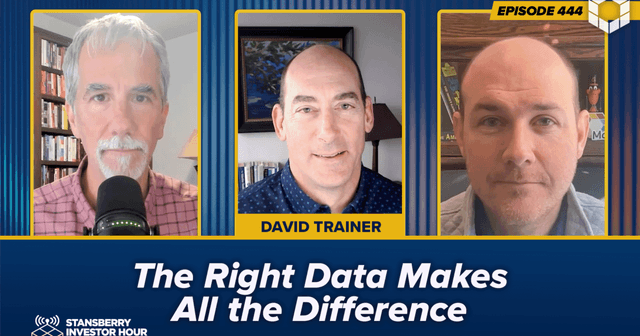

The Right Data Makes All the Difference
In This Episode
In this week's Stansberry Investor Hour, Dan and Corey welcome David Trainer back to the show. David is the CEO and founder of New Constructs, a research-technology firm that uses human expertise and machine learning to analyze companies and get superior financial data.
David kicks things off by providing the key to what he believes makes AI as good as it can be. Then he discusses how he and his team use machines to scale analytics. He follows that up with how his data led to a partnership with Google. And he notes how the data his team uses has been shown to be better in studies...
It's all [Securities and Exchange Commission ("SEC")] filing data... And this [Journal of Financial Economics paper] systematically [compared] our data to everything else out there, and they wrote this 70-page paper proving that our data is better. And by better it's not just that it's different or that it predicts next period's earnings better. Better means it produces alpha... And that's what we mean by better data. It's better fundamental data.
Next, David points out that machines can't read through company filings until humans show them how to do it. He then shares the process he has gone through with AI and how it's at the stage where it can teach itself and learn from its mistakes. David notes how now is the time for the private sectors to fix the problems that the government has failed to do so...
More people in the private sector have to step up, because we can't trust the government to do it anymore. We've said, "Oh yeah, the government's going to do this. They're going to take care of measuring inflation or labor stats." And we eventually learned these are highly dysfunctional organizations whose numbers really can't be trusted. Or maybe the SEC is going to make sure companies publish true earnings. They don't do that. Someone in the private sector has got to step up and do that.
Finally, David bemoans how Wall Street has shifted from being a "steward of capital markets" to becoming an "exploiter of capital markets." He also gives an example of how his clients can use his system to navigate market complexity. Ultimately, David wants folks to do their own research so they can be on guard against useless and deceptive information...
Do your diligence. Don't trust just what you see on the news. Don't trust what you see in social media. Those people are trying to sell to you, not inform you. They only want you to be informed to the extent that it leads to you buying what they're selling... Something that's lost in today's world is people willing to be [as] discerning as they need to be about what's right, what's wrong, what's good, what's bad, what's healthy, what's not healthy. And I just wish them all to put some put more effort and focus into being more discerning and diligent.
Click on the image below to watch the video interview with Ben right now. For the audio version, click "Listen" above.

(Additional past episodes are located here.)
This Week's Guest
David Trainer is the CEO and founder of New Constructs. Before founding his company in 2002, he gained more than six years of experience as a Wall Street analyst. He joined Credit Suisse First Boston in 1996, where he created an economic-based earnings model and brand, spearheaded the effort to apply consistent analysis equally across industries, and managed the Value Dynamics Framework project, a separate business for the company across three continents.
In 2000, David joined Epoch Partners, where he covered the customer-relationship-management software industry and developed a proprietary framework that quantified the sector's return on investment. David earned his Bachelor of Science in international business from Trinity University in San Antonio.
Dan Ferris: Hello, and welcome to the Stansberry Investor Hour. I'm Dan Ferris. I'm the editor of Extreme Value and The Ferris Report, both published by Stansberry Research.
Corey McLaughlin: And I'm Corey McLaughlin, editor of the Stansberry Daily Digest. Today we talk with David Trainer, the founder and CEO of New Constructs.
Dan Ferris: David is a great guy and a brilliant investor. Like me, he is a fundamental bottom-up investor, but he does it in a whole different way using very powerful data and very powerful AI models – AI-enabled models, I should say. It's brilliant stuff. I can't wait to get into it with him. Let's do it right now. Let's talk with David Trainer. Let's do it right now.
Dave, welcome back to the show. Always a pleasure to see you.
David Trainer: Great to be here. I'm glad to be back and looking forward to the conversation.
Dan Ferris: Yeah, me too. And as we just established before we hit the record button on this, it's been a little too long. It's been since April of '24 since we had you on. And you're one of my AI investing gurus, so I feel we've been a little remiss. We should have had you on two or three times since then.
David Trainer: Well, let's – we can make up for lost time.
Dan Ferris: Yeah, absolutely. We've got to do some catching up here.
Corey McLaughlin: Negligent. Yeah, geez.
Dan Ferris: So, you're – a year and a half or more ago whenever you were using AI in your investment process. And I've just begun using it within the past two months and I've been using it regularly for various things in a casual way for about a year or so. But you were deep into it. We interviewed you in April of '24 and your investment process was deeply – had AI deeply wired into it at that time. So, it makes me wonder if things have changed, if you've evolved since then. What does it look like now?
David Trainer: Yeah, AI has come a long way. One of the things that has not changed about AI, and we write about this a lot, Dan and Corey, is that it's really no different than any other machine in the history of the world. It's only as good as the inputs. And so, when we started building New Constructs over 20 years ago, it was always with AI in mind, or with the concept in mind that, look, the quality of the fuel, the quality of the data is paramount. That's – if you don't have that, it doesn't matter how good the technology is – you're still going to get poor results.
And so, we actually – speaking of AI, we actually recently partnered this summer with Google Cloud to really show the art of the possible with respect to AI and investing. And by art of the possible what I mean is what happens when you take great AI technology like Google Cloud – they're one of the best. We all heard Gemini 3.0 is the best that's out there at this point – you combine that with deep subject matter expertise like what we have at New Constructs – and I'll give you a little more specific. Instead of a large language model, we use a small language model, which means that we are on a smaller domain, not the whole world. We take a particular domain like financial data and we build a pristine data set. We build rules on top of that. And those rules are proven to generate alpha in the stock market in a variety of ways. And I'll go into that in a second. But when you have a perfectly clean data set that has rules that produce results that we know generate alpha and you put that into an AI, well, now you can really demonstrate the art of the possible.
And that art of the possible is now the art of the actual. It's an agent called FinSights. Google built it based on our data. They chose us because of our data and our signals and our track record. And so, now we are getting really to roll this out, Dan, an AI that actually works. You can go in and say, "Hey, show me the best stocks in the tech sector" and it will give you our highest rated stocks. And those stocks that get a very attractive rating are proven to outperform the S&P by an index that Bloomberg created that's tracked them over the last five to 10 years. Same is true with a lot of our other research. There's an ETF based on core earnings leaders, which is just all the companies in the market that have better core earnings as opposed to reported earnings. And then there's another index that's just an enhanced version of the S&P 500, where instead of weighting S&P 500 stocks by market cap, you wait them based on their core earnings power, core earnings being a proprietary measure that we have that's been proven superior in a variety of other ways too.
But it's basically just a smarter way to pick stocks. And we demonstrate that through these indices. And we also have a live traded ETF that's dramatically outperformed the S&P 500 over the last year, year to date. So, if you have something with those kinds of powerful signals in an AI and you start asking questions about companies and stocks and who's the best, who's the worst, you're going to get answers that are so much truer and better than you can get from just about any other AI now.
Dan Ferris: So, when you say that you found rules that generate alpha, you can do that sort of thing without AI, can't you? People have been doing that sort of thing for a long time, haven't they? What's different about the way you do those rules and – what's different about it?
David Trainer: Yeah. So, the difference between us – and you're absolutely right. Look, there have been portfolio managers that outperform for – since the beginning of time. What we have done is use machines to scale our analytics. So, for example, we cover – you can go in here, you can see we cover about 10,000 stocks, ETFs, and mutual funds. You go to our coverage page. There are 3,466 live covered stocks. There's another 3,700 stocks that are out of – that are no longer trading that we have in our back test system. We've got about 1,000 ETFs and 6,000 mutual funds – so 10,000 securities overall. And this is done with a system and a methodology that's consistent across all ETFs, mutual funds, and stocks. So, if you type in a ticker for Microsoft, or you type in a ticker for JPMorgan, you're going to see that the rating system is very similar. If you type in a ticker for – let's see, we're going to show a mutual fund here – an ETF, you're going to see a very similar rating system.
So, we've used AI to go through all filings in the public domain from actively traded companies. We don't have coverage of the some penny stock that basically has no real business anyway. But for all the companies and ETFs and mutual funds that matter we've got AI that's gone through and analyzed the filings, put together a financial model, produces signals and analysis and measures of things like ratings and core earnings where we measure the true earnings of the business and systematically produce signals that at the end of the day drive significant outperformance. This is the core earnings leaders total return index. And then we've also got our very attractive stocks index. That's what this ticker is. This is the enhanced S&P 500 ticker. And you look over five years, you compare this to the S&P 500 – whoops, I've got to give a specific index code here. And you can see the S&P 500 significantly lags all of them. Very powerful.
Dan Ferris: Cool. OK. Well, you said they generated alpha and you meant it. All right.
David Trainer: Yeah, exactly. Yeah, this – we're not joking around on any of this stuff. And it's really not just –
Corey McLaughlin: So, I want to go back to how you – the relationship with Google interests me a lot obviously there. I assume you've got to be pretty happy the last couple of weeks too; Google's really taken a big step forward publicly with – in terms of their – all their – Gemini and their chips and with respect to Nvidia and whatnot. Everybody's kind of calling that a horse race now. But how did that relationship come to be? I'm just curious because all this stuff is – everything's new here. How did that kind of – what's the origin story there?
David Trainer: Yeah, it's a great story. A good friend of mine was head of professional services at Google Cloud. And actually, our kids were attending the same wrestling camp. And he's a buddy of mine from college. And so, we were just hanging out. And I was explaining what we were doing and he was telling me what he was doing. And he's been a really smart guy. His name is Brad Little, and he's been in technology for 30-plus years. He was on one of the original implementation teams for enterprise resource planning software, the old [systems, applications, and products ("SAP")] stuff. He's been doing it since then. And so, we were just catching up on technology, and he was telling me what he was doing at Google Cloud and we're talking about AI and agents. And I explained what we were doing and I said, "Hey, Brad, how interested would you be in an agent that could be based on empirically proven accurate data and empirically proven to be accurate and also produce signals that generate alpha?" He's like "That's exactly what we're looking for. We're always looking for that special sauce to demonstrate how our technology is superior to everyone else."
And this was back in June. This is also when everybody was talking about how much money they were spending on technology. And I said, "Brad, you guys got – you, Microsoft, Amazon, Meta, you're spending billions of dollars a month on these data centers and all this infrastructure. Well, what are you going to put in all these computers and even power them with. Where's the expertise? Don't you need to at some point embed all this infrastructure with real subject matter expertise?" And he's like, "Yeah, we do." "Well, we've got it. And by the way, there's this Harvard paper, there's this Ernst & Young paper, there's this [Massachusetts Institute of Technology Sloan School of Management] paper proving that our data is superior, proving that our financial models are superior, proving that our stock ratings outperform. Wouldn't that be something to demonstrate to power your AI, to demonstrate its potential." And he's like "Yeah, it sounds great. Let me run it by my people." And they came back and his people said, "Yeah, we should do this."
And it's a very unique project for Google. They typically don't build their own stuff. They help other people build. But in this situation they chose us because, again, it would demonstrate the art of the possible. What happens when you can marry deep subject matter expertise in a machine language format. You can't just take some expert and tell it to talk to an AI and it's going to all of a sudden figure it out. You have to have a very broad and robust database and all these taxonomies and rules built on the data to create deterministic outcomes or signals that can be relied upon. It's a very sophisticated, very difficult thing to do. I don't know if anyone else has done it in the investing business, or any other part of the world for that matter, but we've done all that. You put that into an AI and now all of a sudden you have something really powerful.
Corey McLaughlin: Yeah, that's an interesting story as well in terms of how you got connected because it's – feel like, again, all of this is new and you're just having a conversation with somebody and – that you already know and you're trying to figure out, hey, marry these two things together. Like, "What data are you going to put in the data centers? What are you using these things for?" And so, that's interesting.
Dan Ferris: Yeah. Real expertise built in. So, what's better about your data? Why is your data better? The models are a separate thing. But you said the data is superior, proven superior. What's superior about it? And what kind of data? We're talking [U.S. Securities and Exchange Commision ("SEC")] filings, historical price data, momentum, earnings? All of the above?
David Trainer: Great question. No, it's all SEC filing data. So – and let me tell you where we get that. So, let me share you my screen again, because this is something just to show. So, this is just a section of our site where – dedicated to these independent studies that have been done on our data. In particular, this one in the Journal of Financial Economics, the top tier peer-reviewed journal in the world: "Core Earnings, New Data and Evidence" by a Harvard Business School professor. MIT Sloan professor, Harvard Business School professor. And it talks about a novel data set that effectively produces a better measure of core earnings. Trading strategies that exploit these core earnings, the noncore earnings, which is the differences between our number and everyone else, produce abnormal returns of 8% a year. "Abnormal returns" is another way of saying novel alpha. So, this is a paper that was published – let's see, what is – does this have a date here – back in 2021. And these guys systematically compared our data to everything else out there, and they wrote this 70-page paper proving that our data is better. And by better, it's not just that it's different or that it predicts next period's earnings better. "Better" means it produces alpha. So, they wrote the 70-page paper on that. And that's – so, that's what we mean by better data. It's better fundamental data. And this is what we're talking about. Better fundamental data.
This is the paper. This is a free version of the paper for those that are watching here. You can download this one for free. You can't get this one for free. This is the Journal of Financial Economics. It's very fancy, peer-reviewed. And they had a lot of stipulations around what could be published and not be published. And I'll tell you guys that the academic community was not happy about this. They've got 40 years of research based on Compustat, and we come along and say, "Maybe those numbers aren't that good. There's something better now." Effectively blowing up 40 years of research. So, they put these guys really through the ringer, but they were all willing to do it because they basically discovered a new, better data set for fundamental research. And that's what we kind of talk about in that data set.
Dan Ferris: And that data set is just SEC filings.
David Trainer: SEC filings. Data we – mainly data we get out of the footnotes that other people don't understand or even collect.
Dan Ferris: Data out of the footnotes of SEC filings.
David Trainer: That's right.
Dan Ferris: OK.
David Trainer: That's right. So, for example, what I mean by that is if we are looking up a particular company – let's just take Baidu, for example. Or we can take a ticker that you guys want. Do you guys have any tickers you want me to talk about? I always like to take requests from the audience. It makes it more interesting.
Dan Ferris: I have Microsoft on the brain because of these weird headlines about their AI sales quotas this morning that seemed to be nonsense. So they say. But Microsoft.
David Trainer: Right. So, what we will do is we'll go through and we will build out a different set of financial statements, an adjusted set of financial statements, and those financial statements look like – this is a model – this is another company, Sweetgreen, just because it's a model I have pulled up already. But we pull down balance sheet, income statement, cash flow data, and we have a whole section on adjustments that outlines the differences between [generally accepted accounting principles] net income and our net operating profit after tax. And then, these are all the balance sheet adjustments. And so, we're always footing back to the original accounting so people can trace our changes back to numbers that are reported in the filing so they know we're not just making stuff up.
So, we pull all these data, all this data. We make all these adjustments. We also have a core earnings mode because that core earnings number is a very special number. And we show all the adjustments. We call them earnings distortions. We break them into categories like hidden items. So, these are items from the footnotes. All the items that are hidden are from footnotes. Reported items are stuff you can find on the income statement. See, there's kind of a lot of those. There's income-tax distortion and there's after-tax distortion. So, yes, we're categorizing the data more intelligently. And a lot of times we're also getting stuff from the footnotes that no one else gets.
Dan Ferris: David, to me, it sounds like you're doing – you're just automating and using AI to do really good, bottom-up fundamental analysis on companies using –
David Trainer: That's exactly right.
Dan Ferris: Yeah, using the original SEC filings, which, like any good bottom-up fundamentalist says, you've got to start with the SEC filings because that's the gold standard of what a corporation will put out to the public.
David Trainer: It's – exactly right. It's sort of like we're a robot version of Warren Buffett or Ben Graham.
Dan Ferris: There you go. That's what I was trying to – I was trying to spit that out, but that you said it.
David Trainer: Yeah, and that's kind of my background. I got on Wall Street before the tech bubble, and I mention that specifically because before the tech bubble, people did real work. I was at Credit Suisse. I saw the change firsthand. I had a front-row seat. I ran a special business at Credit Suisse. It was all about going through footnotes. You can see here in our models we make a very – a big point about showing people exactly where we get our earnings distortion from hidden items. So, for example, here we're showing you, look, this is an acquisition thing buried in some table on page 65 of the filing. We've got three of them – nowhere to be seen on the income statement.
We show all this stuff in particular because we know that people need to see to believe and we've done the work. But going back to my background, when I got to Credit Suisse people did real work. And then when the tech bubble came along, fundamentals didn't matter. I mean, just like today when fundamentals don't matter that much. And so, I had a lot of experience doing this kind of work manually. I love to show people a copy of a filing. This is a 10-K. This is a lot of stuff.
Corey McLaughlin: That's paper? Geez. OK.
David Trainer: Yeah. We – I don't print these off now. This is probably10 years old, man. I only need the prop once. That's the idea. But it's kind of important for people to see, this is, like, 250 pages or something.
Dan Ferris: Yeah, I used to have a garage full of that stuff.
David Trainer: In my offices in New York when I started, I had filings stacked chest-high all around. And so, I learned how to do it the old-fashioned way. And then as the bubble came along, and Credit Suisse as an organization effectively swept a lot of this work I was doing – similar to New Constructs, all manual – swept that under the rug. I'd go meet with technology analysts who joined the firm during the tech bubble and they'd laugh me out of the room, like, "What are you talking about? Look at the filings. I'm gonna make a million dollars on this IPO next week. I don't care about the balance sheet." "What?"
So, I realized that if we didn't develop technology to do these kinds of things we would – who would do it? We'd lose out. And so, I decided it was time to think about building that kind of technology. And I even proposed to Credit Suisse that they build the technology. They couldn't do it. And so, they eventually gave up on the whole idea and bought a firm called Holt Value Associates, which was just taking a data feed from Compustat like all the other systems do. And that was giving up on getting the data from the filings and getting the footnotes. And that's when I saw a window of opportunity for me to create New Constructs. And that was back in the summer of 2002. I remember I wrote my business plan in Central Park.
And so, look, it's going to be about getting technology to do this work because, Dan and Corey, to your point about kind of going back to old school, nobody wants to do this kind of work anymore. Nobody wants to read filings. Nobody wants to analyze footnotes. Nobody wants to build models. Very few people want to do that. So, technology, I believe, can do it better because the great thing about technology is it does things exactly as you tell it to do it every time. If you can scale up enough of those really, really high quality instructions, you can produce what we have, which is a system that can automatically produce alpha. It can take in a filing, grab the data, build a model, produce a signal, generate alpha.
Dan Ferris: It seems to me, David, though, aren't a lot of people going to be doing this right on their desktops? What's – is what you're doing different enough that it's really, really hard for me to just come up with it at my desktop? And if so, how? How is it – what's that competitive advantage in what you're doing right now, besides being, obviously, very obviously the early adopter here, starting in 2002?
David Trainer: Yeah, no, I think that's a great question. And people ask me that all the time.
Dan Ferris: Right. Yeah, isn't everybody going to do this? That's the question, right?
David Trainer: Yeah, can't AI just do it? Well, the answer obviously is no in terms of outperformance. Our ETFs and our index – indices, they wouldn't be beating the market if somebody was doing the work. And one of the reasons Ilike to show my prop here is to point out it's hard. It's really hard. And machines aren't going to go in and figure out how to deal with these details without a human showing them how to do it. There's not many humans who know how to do it. And so, you have a real lack of expertise and skill.
But I bring up this slide – this is from a presentation I did at Harvard Business School just a couple weeks ago, talking to the students taking the valuation class about how AI was going to affect their careers. And basically, I was saying, to your point, Dan, there aren't going to be as many portfolio managers in the future. We don't need them because machines are going to take over. And New Constructs is a great example of among the first.
So, I like to show the slide because I think it points out how the evolution of AI is going to be similar to the evolution of a human analyst. In the beginning, all you look at is maybe the press release. I should have an even smaller monkey over here. Press releases. They don't even look at financial statements. But then you go to the income statement. Then the balance sheet. And the cash flow statement. You get smarter. You take a look at footnotes. You get even smarter. Well, then you're going to take all this data and you're going to produce really advanced models or better measures of earnings, like core earnings. And then you get even smarter. You figure out how to take that core earnings number or that different earnings number and generate alpha.
Once you've taught a machine to do all that, what's next? To your point. Singularity. The machine can do it all. And we're the first to do it. Will there be others that follow? Certainly. How soon? I don't know. I don't know how many people out there to this day know how to read footnotes at scale and then have the discipline to systematically mark up all these filings, like in my presentation here, like these – all these adjustments. Someone's got to go in and teach a machine to find these things. And anyone who's familiar with filings and disclosures know that they change all the time. It is a moving target. We've got 250,000 expertly marked up perfect filings – humans validated all that – that we used to teach our machine. Then the machine could start doing it on its own.
Dan Ferris: Two hundred and fifty thousand.
David Trainer: That's like the minimum training data-set size. And we've had that for five or 10 years now. And so, we've now trained the machines. We can say, "Hey, machine, go look at this filing and let me see how well you do. And I'm going to grade you against what the human expert has figured out." And the machine comes back, and guess what? It grades itself. And when it can grade itself, it can figure out what it did wrong and then it can go back and try again. And it can teach itself. And that's sort of where I think our AI is unique, is that we've got this excellent training data set so the machine can teach itself, get smarter and smarter at collecting the data, and that's where we've gotten our scale.
Dan Ferris: All right, so another question in a similar vein is you seem to want to tell the world about this. And if I had this capability, I would probably just try to gather up as much assets as I could, or maybe just use my own capital, and I would just rip through the market and get that alpha for myself.
David Trainer: Yeah, great questions. And that's why we have an ETF. It's got about $53 million in it and we are looking to get – raise more in that. Absolutely. We're taking that route as well. And it's hand-and-glove. On one way, I look at it as just another way to serve our clients. And our clients are all – is all investors. If you want to just go straight and put money into an ETF that takes advantage of this data, we can give you that. If you want model portfolios that give you a list of stocks from our research system that we call the most attractive or most dangerous stocks, the safest dividend stocks, dividend growth stocks, we can give you those. If you want an interface like our website where you can type into a ticker and build a portfolio on your own based on our research, we can give you that. So, we have multiple ways to serve clients and we are looking to monetize all of those, but ultimately, give people better information. I think it's important, honestly, to the health of our society, because if we just let machines – if we let machines corner the stock market, if we let Citadel corner the stock market, we're going to see greater disparities and inequalities of income or whatever than even we see now. However bad or not bad you think that is, who knows? But if you get a machine that can corner the stock market and all the wealth it can accumulate, not good. So, part of my mission is to democratize this information so that everybody can participate and no one machine or intelligence can corner.
Dan Ferris: Right. So, when I think – the firm I thought of – you mentioned Citadel, huge, what, market-making type firm, among other things. And the firm that came to mind for me was Renaissance. I was thinking, well, this is super powerful technology. And if it were them, we wouldn't be talking on the podcast. They'd just be charging whatever, five and 50, or whatever crazy shit they charge to people, including their own employees have to pay five and 50, and making whatever, however much it is, 40%, 50%, 80% a year. I don't even know these days. That's what I was thinking. I was thinking of Renaissance, not Citadel. But I get the other argument, too. Yeah. Yeah.
David Trainer: No, you're right. Look – I'm no Jim Simons.
Dan Ferris: No, but you're making an argument for wanting – you want competing machines out there. You want to compete with others to – so the market doesn't get lopsided and crazy. And that'll happen. That'll absolutely happen.
David Trainer: Yeah, I think you can make a pretty good argument that it's pretty lopsided and crazy these days. Especially with order flow and Citadel being involved with Robinhood, this is – having order flow is kind of a pretty big advantage. You know what the market's going to do before it does it. That's – and these big – these five or six huge, huge hedge funds just making sick and sick amounts of money, that's – it's happening.
Dan Ferris: Yeah, I think about this stuff from time to time. It's not something I think about often, but I've been more wont to think about it ever since I read Flash Boys, the Michael Lewis book, and I came away from that feeling like, "You know something? Spreads are smaller than ever." The argument, it makes some sense. You see the flow – if you get the flow, you're ahead of the game and you're minting money. But I get filled instantly on teeny – the teeniest spreads ever. Do I really have a complaint with this? I kind of – from my perspective, just in my own little world, nobody's stealing my retirement, which was – Michael Lewis made that assertion in Flash Boys – nobody's stealing from me. It doesn't feel like it to me anyway.
David Trainer: Now I think that's the allure. I think you nailed it. And there are plenty of papers written about how the order flow and trading activity improves some of the efficiency of the market, proves as liquidity. But it's hard to know how much they're stealing when they're – when the markets keep going up and the rising tide is lifting all ships. It's hard to measure opportunity cost. And when I think other people are able to take advantage of effectively inside information, like where the market's going before it goes, they're making outside sums. Because everyone else – as long as everyone else is still making money, everybody's OK with it because they don't feel the opportunity cost. But it's hard to know what the opportunity cost is. I submit there probably is one because that money that they're making comes from someone. We're not talking about an infinite sum. It's a zero-sum game. When this guy makes – well, it's not really zero sum totally because the market wealth keeps going up.
Dan Ferris: It's a voluntary exchange. But I get what you're – the argument that they have information other people don't have, it's insider information, so called, I understand that. I just don't know if there's anything as terribly wrong with it as that. And when I say don't know, I mean don't know. I don't mean that I know there isn't. I just – I question it all. I wonder how terrible is it? I honestly don't know.
David Trainer: I think it's – that's an existential question for our time. Same is true with AI. Same is true with crypto. These are definitely advances. Blockchain. These are certainly advances that have huge potential benefits to society. But some of those benefits – there are also some things that aren't benefits. Is it going to further enable people who already have a lot of skill and education to make more money where other people who are sort of left out don't have that as much? There are other risks. Is it going to endanger privacy? There – these stories are nuanced. The situations are nuanced. And I think you're wise to say, "Look, I don't think anybody has the right answer."
Dan Ferris: Yeah. Yeah, they're complicated situations. I get into – occasionally, I get into these little confrontations on social media, usually Twitter or X, whatever you want to call it, with people about things – a lot of people want to talk about socialism and its time has come and all this stuff. And I'm constantly pushing back. And I realize it's complicated because you can't call the U.S., for example, a perfect capitalist system. The government is in everything. It's got its tendrils in every aspect of your life. It's not just a system of voluntary exchange where we protect property rights and that's it. So, it's – you're right, it is complex. We live in a very complex world. And the complexities – the connectedness, the more we become connected, the more the complexity affects us. Because you could read Demon of Our Own Design. That was a great book. And he talked – [Richard] Bookstaber, who wrote that book, Demon of Our Own Design, referred to another book called Normal Accidents by Charles Perrow about complex systems like nuclear power plants and space shuttles and things that blow up and have problems because it's all so complicated. One little thing goes wrong and poof, the whole thing.
So, I'm glad – I'm just glad that we broached the complexity of the financial system, the world, the connected world we live in because it's important. And more and more, David, I always say, "Well, nothing surprises me." It wouldn't surprise me if – and fill in the blank on anything – finance, politics, society, whatever – because of – and I realize it's because of the connectedness. We can peer into all the dark corners of finance, you can – and all the dark corners of the world. Everything is reported. Everything comes out. It's a bizarre world. When I was 12 years old, nobody ever saw this coming.
David Trainer: No, I think you make a great point. Complexity theory has been something I've studied since back in the Wall Street days, and punctuated equilibrium and sort of chaos effect and how one small thing can have a huge effect on other things. And that's precisely why I think AI is so complicated. If it's going to try to take in all this data, which the large language model promises that you can just pour the Internet into it and it's going to give you good answers. Obviously, we know that's hogwash. And that's part of why Google chose us, is because we took what is still a complex domain, financial statements and reporting, and we made sense of it all. And we created signal out of it.
And that to me is where the most value added is, because, precisely to your point, in a world where we are overwhelmed with data and noise, synthesizing all of that into something that gives real meaning is a truly, truly value-added activity. Otherwise, you've got people running around like chickens with their heads chopped off saying "We should go back to socialism." And to your point, it's like what Winston Churchill said: Democracy and capitalism is terrible... except for communism and socialism.
Dan Ferris: Right. It's the worst system except for all the others. Right.
David Trainer: That's right. That's right. And so, I think more and more – and we're starting to see this emerge right in front of our eyes – and to your point about the government having their fingers in everything, more people in the private sector have got to step up, because we can't trust the government to do it anymore. We've said, "Oh, yeah, the government's going to do this. They're going to take care of measuring inflation or labor stats." And we eventually learn these are highly dysfunctional organizations whose numbers really can't be trusted. Or maybe the SEC is going to make sure companies publish true earnings. They don't do that. Someone in the private sector has got to step up and do that.
And I think we're seeing that happen more and more where private sector folks – we're seeing this with respect to new super PACs that are created around – and I don't remember the name of it but there's one that was just on CBC yesterday that's focused on doing everything it can to keep AI safe, to keep it from exploiting things. We can't trust the government to get its act together enough to do anything to make sure AI stays safe. We can't trust the government to do anything, I think, much at all.
Dan Ferris: No.
David Trainer: So, the private sector's got to step up. And that's kind of the way I've always viewed New Constructs. Instead of me going around complaining about how bad reporting is and how you can't trust Wall Street and you can't do this or that, why don't I just build a system that fixes it and make that my contribution to society.
Dan Ferris: Hear, hear. Starting a business. People who say – people who want to change the world should start a business. Absolutely.
Corey McLaughlin: Yeah, I'm reminded of a quote. I think it was from – I don't know, I'm sure a lot of people have said it. But I remember Jeff Bezos saying, "You live in the world as you want it to be or as it is." And you just kind of start there and go from there. Like with AI, to me, it's – you can either get on board and try to learn it, or you can just totally remove yourself from it and try to survive that way if you're just – you don't want to go there at all. But if you try to just be in the middle, I feel like you're going to – if you're just scared of it totally without making a decision, you're going to – that's the worst decision, I feel like. So, what – David, what you're saying is applying all this data and what humans have done for – what you were doing at Credit Suisse to this next generation of technology, I like how you said it's just another machine. I feel like that's a really smart way to think about it.
David Trainer: Thank you. Thank you. Yeah. And I think the way to think about fundamental data – so many people got used to just using what was out there, the legacy, fact set, Bloomberg, CapIQ, you name it, that they just never thought about innovating. It's just what everybody used. There's a Harvard Business School case study that effectively predicts that New Constructs will disrupt fundamental research. It was published in – three or four years ahead of the other paper I mentioned to you. And in that it quotes meetings I have with institutional investors that said things like "Yeah, David, your data is probably better than everything else out there. But as long as everyone else is using the same bad data, I'm OK with bad data." And I'm not kidding. I heard that a lot. I heard that a lot.
And I think there's an enormous amount of inertia in the industry. Because let's face it – let's just take the mutual fund industry. Let's go back 15, 20 years when these – or 10-plus years when these quotes were coming out about data. And look at what we've seen in terms of the big disparity in terms of assets going into indexes and assets leaving actively managed. Why? Because 8 out of every 10 funds underperforms in any given year after fees. They're losing you money and charging you for it. Those guys need to go out of business. But that's the world we've been living in.
And that's part of why this change makes so much sense, because these people have been getting paid to basically steal from you. That should end. And the flows into passive are showing that the investors are getting smarter and they're recognizing that better data makes a difference. Or that the legacy way of doing things isn't working. And so – but those people have been making so much money for so long it's like, "Don't fix it if it ain't broke."
I can't tell how many of these big mutual fund complexes I went into, I showed them all that I had, and a couple of people were like, "Oh my gosh, this is amazing." Most people were like, "Oh my God, I'm going to have to work harder now? Are you kidding me? I've got to do something different? Why should I change what I'm doing when I'm getting paid 4% on my fund that's underperforming?" And so, that's getting disrupted. And with that, I think we're seeing more attention and interest paid to what it is we're doing because people – the stock markets, there are a lot more sophisticated investors now than there have been back in the day when people couldn't trade on their own. And they're recognizing "Hey, I'm at a big disadvantage to all these other folks. Let me have research that's going to put me on fair footing with the insiders."
Dan Ferris: Fair footing with the insiders. What – this reminds me of another guest that we've had on the show, Mike Green from Simplify, who – basically, Simplify seems like they're on a mission to share every institutional options trading strategy, all the big sort of usable, automatable ones with the whole world. And kind of a similar thing: Let's democratize it, share it with everybody, create a create an ETF that does whatever strategy it is so that the whole world can do it, not just the folks in the giant institution. And you sound like that as well to me. It's quite a mission.
David Trainer: Yeah. And I think there hopefully is a lot of value in it. A lot of value. Because I think you have plenty of people serving sort of the big Wall Street overlords. Look, everybody wants to get a job in investment banking. Everybody wants to go to New York. I wanted to do the same thing. I thought it was awesome. And it was an amazing experience and I learned so much. But at some point you recognize this is – and I saw it happen, I think, firsthand during the tech bubble where Wall Street became a place that was less a steward of the capital markets and more an exploiter of capital markets. It really –
Dan Ferris: Oh, yeah. Sure.
David Trainer: The corner really, I felt, turned during the tech bubble when people were doing things that were entirely unethical. They may not have been exactly illegal, but they were highly unethical. And some of the stuff was illegal. And then there was the Spitzer settlement, which was, like, $10 billion, the biggest fine of all time against Wall Street. And that was a drop in the bucket for how much money those guys made. They were making a billion bucks a month, or a billion bucks a week during those times.
Dan Ferris: Sure. And also, in the same general category, I thought you were maybe going to talk about people like Henry Blodget and that other gal who got in trouble for outright lying, pumping stocks to the public and behind the scenes saying "This is a piece of garbage" or whatever it was they were saying. So, yeah, it was like – it's like I said before, it's – our connected world, the more connected it becomes, the more we shine light into dark corners. And my wife is always – she'll see something on a news program or the television and she'll say, "Oh my God." It'll be some horrendous crime in some part of the world and she'll say, "Oh my God. Who knew that this happened?" And I feel like anybody who thinks the world is sort of getting worse really is just noticing that more of what's been always been happening is being reported. And I think that will – that affects finance, too. And hopefully, over time it gets harder and harder to be a to be a fraud.
And I agree. It's a healthy thing for the 80% of managers who aren't beating the market or even matching it to be out of business. If you're charging me two and 20 to even match the market, it's a bad deal. So – or not beat it substantially. Don't give me a bip or two of alpha – who cares – that eats the fee and then some – the fee eats that and then some. So, yeah, it's an interesting world we live in. I don't know. That's what I'm left with. I'm trying to get somewhere with these thoughts, but I just – I'm just talking about vast complexities in our life.
David Trainer: It takes a really special effort, I think, to address those complexities, and that's kind of – that's the problem that New Constructs said. We're going to solve the complexities of financial reporting, management misrepresentation, false disclosures. I've had meetings with Congress and the Senate banking committee and the SEC about how companies put bad disclosures in their filings. But someone had to go in and deal with that voluminous huge amount of data set and figure out how to make sense of it and bring truth out of it. And that's something we've been dedicating ourselves to because you're right, the complexities there, the misinformation there, the exploitation there is huge. And that was a problem we dedicated ourselves to.
Dan Ferris: Right. And that complexity, like when you started – when you mentioned, as soon as you mentioned footnotes, I was like, "Wow," because you and I both know, like you said, the structure of the filings changes. You really – like I said, it's a moving target. The structure of the filing changes. And I just thought mechanically, how in the world do you create a system that constantly adapts to where the data is located in the filing? And it sounds like an insanely complex never-ending – this machine that you've built, it sounds like it never stops morphing and changing and growing. It's like an organism.
David Trainer: No, yeah, and it – part of it requires an entirely different approach to analyzing companies because to your point about how things can change and move around with respect to accounting and disclosures, we had to bring a larger construct, if you will, a new construct to all of that that focuses on the economics of the business and something that sort of transcends just accounting. So, for us, we're always looking to understand the underlying economics of a business and capture things that drive cash flow and how much capital has gone into the business. Those are sort of the two overriding goals that we want to capture better than anything.
And then, the accounting is just a bunch of inputs than that. And then, we have to sort of determine what those inputs mean in terms of their economic consequence, how they fit into either what the cash flow is or what the capital is. And that's something that gives us the ability to really transcend how companies can mess around with stuff and – not entirely, but somewhat. We're not dependent upon the accounting infrastructure, the accounting taxonomies. We're seeing a bigger picture. So, we're not thrown off if XBRL changes a little thing or if accounting rule changes a little thing. We built our systems to capture the economics, which has always meant we're more robust and sophisticated and flexible than accounting.
Corey McLaughlin: Hey, David, I'm wondering in the spirit of leveling the playing field and navigating complexity, if we could maybe go through an example of maybe one stock – or maybe a stock to avoid or maybe something under the radar you like, like a long idea or something and just to – or even maybe one of these footnotes that come to mind recently that maybe you've come across that tells the story of why everything we're talking about is so important and how people can kind of use it to their advantage.
David Trainer: Yeah. Let me just – let me walk you through how a client could use what we have here. So this is our homepage. You want to go to the members area. And we can start with the screener. And we come in and say, "OK, listen, I'm interested in –" let's just go health care providers and services. "And I want to know all of the very attractive stocks that have a free-cash-flow yield greater than 10%. Go." We got one. So, we could say, "OK, well, I like this stock. Let me go do a deep dive here." It's a small company, $114 million market cap.
Now, the short term signal here for earnings distortion is that it's going to miss in the next quarter. But long term it's got green all the way across. So, the economic earnings compared to the reported earnings, that's a positive. Return on invested capital, very high at 120%. Free cash flow is high. Free cash flow yield is really high. The price-to-economic book value is excellent. This 0.4 means that the market is implying the company's profits will permanently decline by 60%. So, the market cap is 40% of the no growth value of business, so to speak. The no growth value of the business is implying that the cash flows will just stay flat. And if you value the business based on that, the market cap is 40% of that. So, you're effectively implying a 60% decline in profits. And then, the market-implied growth appreciation period, this is related to our reverse discounted cash-flow ("DCF") model. And I think we talked about this one a bunch last time, Dan.
Dan Ferris: We did.
David Trainer: Reverse DCF models.
Dan Ferris: Yep.
David Trainer: We run a reverse DCF model on all the companies we cover. ETFs and mutual funds, same thing. This shows the number of years of profit growth required to justify the price. You've got less than one year here because we know in this ratio the market's implying profit decline, so you need no growth. And the opposite of something like this would be – if we changed our screen to go for very unattractive, if we were to look at this company, you see here poor quality of earnings. The free cash flow is high, which could be an anomaly because maybe they're selling off assets. But the valuation looks really bad here: negative 0.2. The no growth value of this business is negative. When you look at the cash flow, perpetuity value of cash flow and subtract out liabilities, you get a negative value left over for existing shareholders. That means the stock could really go to zero. And then, you're going to need more than 100 years of profit growth to justify the price – in other words, a big disconnect between implied profits and actual profits.
And if you wanted to dig down deeper, get a sense of "OK, so what does this mean in terms of misleading earnings?" you can see economic earnings have been negative and pretty flat where the accounting earnings are showing a big rise. Shares outstanding. We like to track that too because it's bullish when shares outstanding is going down, bearish when it's going up. People issuing – companies issuing shares to cover their losses is not a good thing. We always like to track return on invested capital. You can see return on capital has been pretty flat. Return on tangible invested capital also going down. Let me know if I'm getting too nerdy here or too –
Dan Ferris: Not at all.
David Trainer: I always like to break out return on capital into the DuPont drivers. So, we want to look at the operations of the business, which is your profit margin. Net operating profit after tax margin. And then capital turns, which is the capital efficiency of the business. Here that's going up. My guess is that they may be selling off assets, so the balance sheet is getting slimmer, which is why you saw free cash flow good and capital turns going up as well. But you can see margins headed down.
And then we like to look at free-cash-flow yield. We've got a couple of ways of doing that. We have a two-year average free cash flow. You can see that yield's really high. The free cash flow is consistently high for this business. Interesting. I'm sorry, that's the enterprise value. But you can see the two-year average free cash flow is pretty high. The free cash flow every year, pretty good. And the yields, pretty strong. Not nearly as good this year as it was last year. So, the two-year average is quite a bit better.
There's a lot of noise in free cash flow. Capital cycles are very lumpy, which is why we like to look at the two-year average. Then there's the free-cash-flow margin, which is just the two-year average free-cash-flow divided by revenue as opposed to enterprise value. The free-cash-flow yield is free cash flow divided by enterprise value.
And then, my favorite chart is always this economic book value and price chart. So, economic book value, again, being the no growth value of the business, we can see that the economic book value per share for this company has been really bad, negative $270 a share where the price is around $45. You can see the price has come down a lot: $377, $46, $57, as low as $14 back in 2024, and now at $45. So, this is one of those that's kind of been all over the place, but you can see that this is – it does not look like a healthy business.
If we wanted to look and see what – what's the big difference here in terms of – well, you've got a negative net income. We're actually showing a no pat positive, slightly positive, better than that income. But the net income has been really negative for a long time, so it's hard to see – know what people see in this business. Then the assets – our adjusted assets, invested capital, really not that far off of the reported assets. Let's see – and then we can look at liabilities. And I think the big number here is really this $4.6 billion in debt. That's a super highly-levered company. And I think if we look here, it's a market cap of $744 million versus $4.6 billion in debt. That's not a good thing. If we look at the credit rating, you're going to see a really bad credit rating here, too. So, this looks like a super highly levered business that isn't really making a lot of money and has a valuation that's implying it will generate enormous amounts of cash flow. And that's bad risk-reward.
Dan Ferris: And is trading about almost 90% below its 2020 all-time high.
David Trainer: Yeah, probably for good reason.
Corey McLaughlin: Yeah. And I am looking up at this company called Clarative as you're talking about it – in health care. They have more than probably two dozen lawsuits filed against them right now, including from the American Medical Association, related to insurance, price fixing, and whatnot. So, yeah. Big insurance lawsuit against them, class action. So –
David Trainer: Yeah, it makes you wonder how they're above zero at all.
Dan Ferris: Yeah. Yeah, all that debt. Lots of lawsuits. It doesn't look good. But that's a great example. That was a great little exercise. Yeah.
David Trainer: Yeah. Yeah. When it comes to long ideas, what we like to look for – this is one we wrote up recently on Kroger, a company that's making a lot of money, got a lot of great market share. And what we always like to look at – what we think is important at the end of the day – there's the declining shares outstanding. You can see strong free cash flow. One of the most profitable in the – in its industry. But we like to look at stocks that are cheap. So, for example, the price-to-economic book value for Kroger was 1.0 when we wrote this report. That meant – that means the market is giving it zero credit for profit growth. So, we like to show these charts that will plot profits in the past and then what the profit has to be to justify the stock price for the next 10 years, just as a good round number.
So, you can see to justify the current stock price profits actually drop and then they kind of slowly come back. So, the 10 years are about the same as they are here recently. If you want to believe in $86 a share, which we say is – we believe is reasonable, you're really talking about profits that are really not much higher than what they are today. But that's what you need to believe to justify $86 a share versus the current $67 a share. This to me is a great example of just the level of transparency in the analysis that we're able to do to show people, "Hey, I'm not going to tell you go invest in Nvidia or Tesla that's got to see a 500% improvement in earnings to get to a 25 multiple." No, we're just going to walk you through the actual cash flow, grounded in cash flow of what path the company's got to follow to justify its current stock price – or to justify a target price.
And we just think that's such a more honest down-to-earth, transparent way to provide analysis. And that's kind of what you'll see with all of our long idea or danger zone ideas. The danger zones examples, you'll have – profits will be barely zero and then the future will have to jack way up. And that's – that, of course, is – it's bad risk-reward.
Dan Ferris: Yep. And I will point out, as I did the first time you were on the show, this is – that basic analysis of determining what the current share price reflects in terms of future growth, that basic exercise is what we do in the Extreme Value newsletter. My cohort in crime there, Mike Barrett, runs the model and does most of that work and I sort of do everything else. But if it doesn't pass the model – if it doesn't make it through the model, I don't need – we don't – we just move on to the next name. So, that's our – that's the basic kind of screen. We want to see a good disparity between what the market expects to happen to the fundamentals and what we expect to happen. And we've had a really good run in the past several years doing that. So, we – it works.
David Trainer: That's awesome. I love that approach. DoorDash is a good example, where we – I don't think – they don't even have profits, so we just went with gross order volume. You can see just the huge disparity of what the company's got to do to justify the current stock price, or if you go down to $115 or even $73 a share. Enormous amounts of improvement that you just – that just don't really make sense. You can see Uber right here, that DoorDash is going to be way bigger than Uber, even at $73 a share in terms of gross order volume. It's a great way – I love that you guys do that. It's an – expectations analysis, I think, is a great way to start. It's just so much more subjective. Why be a fortune teller? If Mr. Market's being a fortune teller every day, we can just identify where Mr. Market is overly optimistic or overly pessimistic.
Dan Ferris: Yep, that's exactly it. And the – there's a book for listeners if they're interested called Expectations Investing by Rappaport and Mauboussin – Michael Mauboussin and Alfred Rappaport. But –
David Trainer: Mauboussin was my mentor when I was on Wall Street. That's who I was working for at Credit Suisse before the tech bubble.
Dan Ferris: There you go. So, we're all of a piece here. We're in the same mode. Well, thanks for being here, David. It's time for our final question, which is the same for every guest, no matter what the topic, even if it's a non-financial topic. Same final question. If you've already said the answer, feel free to repeat it. And the final question is simply this – it's for our listeners benefit – if you could leave them with one takeaway or with one thought today, what would you like it to be?
David Trainer: The one thing I would leave to investors is – the one thought as a takeaway for investors that I would leave is do your diligence. Don't trust just what you see on the news. Don't trust what you see in social media. Those people are trying to sell to you, not inform to you. They only want you to be informed to the extent that it leads to you buying what they're selling. So, do your diligence. Find research. Find news that you know you can trust. Be discerning. Don't just follow along. I think that's something that's lost in today's world, is people willing to be as discerning as they need to be about what's right, what's wrong, what's good, what's bad, what's healthy, what's not healthy. And I just wish them all to put some – put more effort and focus into being more discerning and diligent.
Dan Ferris: Well said. And thank you for that. And thanks for being here, man. We'll have you back sooner than a year and eight months next time. How about that?
David Trainer: That would be great. That would be great. I'd love it. I enjoy it.
Dan Ferris: All right. Thanks a lot, man.
David Trainer: Thank you.
Corey McLaughlin: Thanks.
Dan Ferris: Always fun to talk with David. And of course, he does expectations investing, and that's what we do in Extreme Value, so he's like my brother from another mother as an investor. But he does something very different from what we do, because that 250,000 filing data set is something I would just love to get my hands on. And of course, you can You can be a client or a customer of his and do that. I think what he's doing is so cool just because I love fundamental bottom-up investing and he's brought it into the AI age. It's brilliant.
Corey McLaughlin: It is brilliant. It really is. I mean, because it's – yeah, if – it's what I would want to be doing if I were – if I needed – and maybe I do need to do it. But it's what I would want to be doing as far as – with any field – we're talking finance, but with AI right now, it's such – it's just starting. And so, if you can just stay in the trend even, it's like a rocket ship. Just get a seat and you'll figure it out. And that's – essentially we're seeing it real time here. He's built this company for 20 years based on good data and then marries it up with a friend who works at Google and here we are. They've got an ETF, a Bloomberg ETF, and very easy to see everything that they have going on. And – which is part – how you stand out in this complex world, as we got – as you got into as well. So, yeah, it's kind of just real life right now. It's trying to figure all this stuff out.
Dan Ferris: Yeah, and it's great to talk with somebody who's been of this mindset, trying to figure it out for more than 20 years, as you pointed out. I mean, that's – at this moment in the year 2025, there aren't a lot of investors you could talk to who have been saying, "Well, yeah, we've been trying to use AI and better data and all of it," not just AI, but all of it for the past 20-plus years. It's really cool to have him just sort of – just to know him because I like him because we're a similar type of investor, but also just to have a really interesting guy who took that path when he did.
Corey McLaughlin: And that – and there is a first mover advantage here too, because while it's easy to get your hands on ChatGPT or something, there's a – or these other large language models – there's friction as soon as you start using it if you get something you don't like back and you're like "Oh, this is bulls**t. This thing's never going to work." But if you are training it the right way – I think more people are learning this – if you – the better data you give it, the better results you're going to get. And so – but until that point there's people like him that are just moving on it now. And so, there is a first mover advantage too to all of this as well, but you've got to do it – not everybody can afford to do that. So...
Dan Ferris: It's interesting. We talked with Ben Hunt, who – they use AI in a completely different way. They're tracking narratives. They're basically training their system to kind of read and understand everything every day. And David is like, in a way, just the complete flip side or opposite, total 180 from that, which is total focus on bottom-up fundamental data and economic truth of the business. Boy, I bet if you could put those two things together, you'd have something pretty amazing. And I'm sure somebody out there is doing that as we speak. So, that was really cool. I just – it's such an exciting time. We're learning so much. And I'm sure we're going to learn a lot more from guests who I can't even fathom who I don't even know yet in the near future.
So, that was a lot of fun. It was a fun interview and a fun episode of the Stansberry Investor Hour. I hope you enjoyed it as much as we really truly did.
Announcer: Opinions expressed on this program are solely those of the contributor and do not necessarily reflect the opinions of Stansberry Research, its parent company, or affiliates.
[End of Audio]
This One Filing Can Tell You When to Buy or Sell Stocks
The Mag Seven Trade Is Breaking... Here's What Comes Next
Here's the Risk Investors Are Ignoring
He's Up 201% in Two Months... and Says a Major Market Drop Is Next