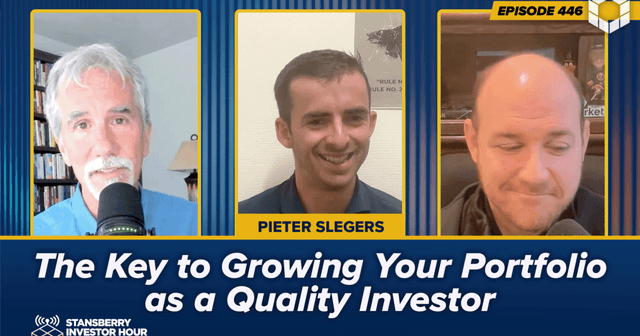

The Key to Growing Your Portfolio as a Quality Investor
In This Episode
In this week's Stansberry Investor Hour, Dan and Corey welcome Pieter Slegers back to the show. Pieter is the founder of Compounding Quality, an investment newsletter that boasts more than 507,000 subscribers.
Pieter kicks things off by discussing how AI and market momentum are doing well. However, he says that "classical" companies are currently struggling. He then talks about the need to have a tangible long-term goal in investing and shares his own investing goal and what it would do for his portfolio. And he explains the benefits of removing yourself from your normal environment to gain perspective and how to use that mindset for investing...
I am probably as far away from Wall Street as you can be, and I like that because then you don't have too [many] distractions... But I decided to... go to the Dominican Republic for one month. Let's go out of your normal life and normal offers and so on... I am very well aware of the fact that having the ability to do something like that is an absolute privilege... That's not something that everyone can do, but I would highly recommend it. Because you are not in your normal environment, it really helps you to zoom out a little bit and put things into perspective.
Next, Pieter shares how he views AI and its impact on the companies that he analyzes. He also adds how he personally uses AI in stock research. Pieter stresses the importance of doing your own reading, both in investing and in your personal life. He says that this not only ensures that you don't miss any details in financial reports but also helps you find new investment ideas in unexpected places...
[Read] everything yourself. I think that's the most interesting thing. And that's just a joy. I think that's one of the most important things as an investor: to read. I am very lucky because I love to read... It's not only for your wealth or your stocks. It's also for your knowledge. And the more you know, the more you will be able to connect certain dots or see certain things. And I think that's the beautiful thing about investing, because it never stops. There is no single day that looks the same as the previous one.
Finally, Pieter details one company that he's excited about over the next 10 years. He found multiple reasons to love it, but after some skepticism, he drove to Germany to meet the CEO. The discussion solidified his optimism for the company. Pieter expressed how talking with the CEOs of smaller companies can provide some information that most people don't have...
With the small companies, that's how you can make the real difference. If you have Apple or Microsoft, well, you can look at YouTube videos, you can look at all the investment cases available. But with the small companies, it's just really important and really fun to go out there and talk with the CEO, because then you obtain information that is just not available on the Internet.
Click on the image below to watch the video interview with Pieter right now. For the audio version, click "Listen" above.

(Additional past episodes are located here.)
This Week's Guest
Pieter Slegers is an entrepreneur and the founder of Compounding Quality, an investment newsletter with more than 507,000 subscribers. Prior to founding Compounding Quality, he held various leadership roles within the pharmaceutical industry. He's also an author, having co-written The Art of Quality Investing.
Pieter graduated summa cum laude from Belgium's KU Leuven with a master's in business administration. He also received a bachelor's degree in pharmaceutical sciences from the University of Antwerp.
Dan Ferris: Hello, and welcome to the Stansberry Investor Hour. I'm Dan Ferris. I'm the editor of Extreme Value and The Ferris Report, both published by Stansberry Research.
Corey McLaughlin: And I'm Corey McLaughlin, editor of the Stansberry Daily Digest. They we talk with Pieter Slegers, also known as Compounding Quality.
Dan Ferris: Pieter loves high quality businesses just like I do. So, this is going to be a love-in. All right? So, let's talk with Pieter. Let's do it right now. Let's talk with Pieter Slegers right now.
Pieter, welkom berug bij de show. Did I say that right?
Pieter Slegers: Wow. You surprise me right now. Congratulations.
Dan Ferris: Yeah. Oh, terug, not berug. OK. Sorry. I was looking at my screen here. But anyway, "welcome back to the show" in Dan's horrible Flemish. It's been a while. How have you been?
Pieter Slegers: It's been a while indeed. And if the audience wouldn't mind, we can do the conversation in Dutch, but I guess it would be a little bit hard.
Dan Ferris: I can – I would have to put everything through Google Translate. So...
Corey McLaughlin: You just want me to leave right now? Yeah. I would –
Pieter Slegers: It would be a great one for me. I can tell whatever I want and nobody will understand. So, that would be an interesting one. No, for me, everything is going fine. Obviously, these are very, very interesting times on the market where at least for me I see wild – or, very wide discrepancies between what's happening between some kind of companies. So, it's very, very interesting to look at the market right now. And we are heading into 2026 right now, obviously, to follow up on the portfolio, make some predictions about what can happen with the portfolio versus the current market. So, it's very interesting. Never a dull moment on the stock market, I would say.
Dan Ferris: No. And I hate to do this. I know our production people and marketing people hate this, but I'm going to date the show. The Federal Reserve met today and they cut rates a quarter point. And I love to ask this question to folks like yourself, because I know what the answer is but it's beautiful. And do you care at all that the Fed cut rates a quarter point? Does it matter to you at all?
Pieter Slegers: Oh, Dan, I'm the very boring guy. It was Peter Lynch who said if you spend 30 minutes a year on macroeconomics, you've probably wasted 10. So, I'm in exactly the same camp. So, I don't know what the Fed will do. I don't know what EVIX movements will do and so on. So, what you really try to do, and I'm writing Compounding Quality, so quality stocks, to really try to be a bottom-up stock picker and try to pick great companies, companies with a lot of pricing power. And that's the most important thing if you ask me. And Terry Smith from Fundsmith said it as well. Well, a lot of people are bothering all the time about predicting the price of commodities, predicting EVIX movements, predicting what the Fed will do with the rates and so on, but the most important question should be for you – well, I want to try and find the best companies in the world because we know that statistically that in the long-term stock prices will always follow the evolution of the intrinsic value. And the evolution of the intrinsic value is determined by the free cash flow for share growth and that's the most important thing.
And what I was also recently listening – and we can also talk about that maybe, too – the Chuck Akre presentation of the quarterly update or the six-months update. And they said it as well. I think it's an honest thing to tell. And Porter is also a wild fan of the "forever portfolio" and companies to hold forever. But if you look at quality stocks, well, they have – it has been since 1999 that they have underperformed the S&P 500 by so much as over the past six months. And you can tell, oh, that's a bad thing for quality stocks. And maybe it is. But on the other end, it also makes me very cautious about the current state of the market because we have the "Guide to the Markets" of JPMorgan, for example. And if you look at the S&P 500, statistically we could expect negative returns over the next five years, over the next 10 years.
But the interesting thing is if you look at – if you exclude the top 10 stocks, which are basically the Big Tech stocks, or just look at the S&P 400, for example, you actually see that those companies are slightly – are valued slightly below their historical average. So, everything that is related to AI, everything that is related to momentum tends to do really well right now and all the rest seems to be struggling. And you also see that when you look at traditional companies like Old Dominion Freight, for example, in the U.S. or Pool Corporation, which is active in what's in the name, everything related to pools and to maintain the pools and so on. So, the classical, boring companies, they tend to struggle, which to me might be an indication that maybe the economy, except for Big Tech, data, and so on, might be weaker than expected.
But it's not an issue, because if we zoom out a little bit, and I already said that, well, in the long term, the stock prices follow the evolution of the intrinsic value. And if I look at my portfolio, for example, I see that over the past six months also weren't the best months in terms of performance. But the valuation, the intrinsic value kept going up. The stock price went nowhere. And as a result, well, your valuation decreased by more or less 16%. So, if you do the math there, and it's also what Chuck Akre said, it has been since 2020, more or less, during COVID, that quality has been relatively seen so cheap. So, hopefully – and I see this more as a great time to buy.
And maybe, yeah, now we are about to enter 2026. Everyone, all the newspapers and so on, they call you, what's your expectations, expectations for the next year? A boring answer, I don't know, but I also think that the years for the active stock picker will come back again and that having companies with a healthy balance sheet, with high profitability, with pricing power and so on will become very important again, because over the past few years, well, anyone who didn't own Big Tech, he probably underperformed. And you just needed to own the Big Tech or the S&P 500 and then you did really, really well. But we also have the saying, "Well, everyone is a genius during a bull market but it's during a bear market that stocks return to their rightful owners." So, that will also be a very interesting thing to see. We never know when the crash will come, but by definition it will come eventually, and you don't know whether it's next month or six months or in three years, but you need to be prepared as an investor, and hopefully you can buy some great companies at lower prices.
Dan Ferris: Sure. And the great companies in an economic downturn, they tend to steal market share and take advantage of the environment much better than everybody else. Everybody else is trying to stay alive. And they're able to actually grow, many of them. It was one of the most famous examples, of course, being Proctor & Gamble in the Great Depression. They didn't spend a penny less on advertising and – all through that period – did extremely well coming out the other end of it. Anyway, yeah. Yeah, the quality is hard to beat. And I should warn our listeners, man, Pieter and I are on the same page with a lot of this stuff, so it's going to sound like mutual admiration society. I'm just warning you ahead of time. I don't know. I don't think I'm going to throw him any hardball questions because we overlap quite a bit. He mentioned free cash flow. Free cash flow is extremely important to me. It is one of the five metrics that I report every time I recommend a new stock and it is, as Pieter said, the essence of the intrinsic value of the business. That's where the value comes from, its ability to generate cash in excess of all expenses, taxes, and capital spending. And that's – and that is still important, isn't it? Even though quality has underperformed, it's still important to know this, isn't it?
Corey McLaughlin: Right.
Pieter Slegers: Yeah, it definitely is. And I think that's also something that really helps me. I don't bother about it at all. And I'm not sure whether you guys know François Roshon from Giverny Capital, but in his annual letters, each year he makes a comparison in the table between the stock price, what did our funds do, what did – how did our stocks perform versus how did the intrinsic value evolve. And he calculates the intrinsic value very, yeah, very simple. meaning the [earnings-per-share ("EPS")] growth plus the dividend yields. And doing that is really interesting because he's making that exercise since 1999, so over 20 years, almost 20 years – no, over 20 years. Excuse me. It's already after 9 p.m., so forgive me about it.
Dan Ferris: That's OK.
Pieter Slegers: Twenty-six years, right? And then you see that his portfolio, the stock price has compounded at something like 13.9% and the intrinsic value at 13.8%. So, it's almost exactly the same. Well, Benjamin Graham said in the short term the market is a voting machine – in the long term it's a weighing machine. That's exactly the case. So, when you see that stock prices are remaining flat or even declining by 20% but you also see that your intrinsic value, and you can calculate that if you want to keep it simple, just EPS growth plus dividend yield, it keeps going up. Well, it's an amazing thing to buy more.
And I'm not sure whether you do that, Dan, but one thing I also do for my portfolio, which is really interesting to me is, as you said, well, free cash flow is the most important thing. Couldn't agree more. So, what you could also do is calculate for yourself how much free cash flow your portfolio is generating for you. So, for example, let's say you own shares of Visa and you own 100 shares. Well, then you just take the free cash flow per share of Visa and multiply it by the number of shares you own, and that's exactly how much Visa is making for you every single year. And I think – or, I hope we can agree that Visa is a strong business and hopefully the free cash flow will go up. And if you do that exercise for every stock in your portfolio, you can calculate exactly how much your portfolio is making for you every year. And then you can do the same for – to calculate how much it's making for you every month, every weekend, and so on, and bring that evolution of the free cash flow of your portfolio in a chart, for example. I think it's also a very powerful thing, because then you hopefully can see that it keeps going up and up and up and up every single year.
Dan Ferris: I love this as a source of conviction for investors during tough times. This is a great idea.
Pieter Slegers: Yeah, exactly. It's a little bit like dividend investors are bringing in an excel the dividends they receive every year. It's that we, as quality investors, look at the free cash flow that it's generating for us. And then you can set goals for yourself. A lot of people are talking about financial independence. Well, I have said in one of my recent newsletters – and I'm 29 years old right now, so it will take a while, but I want my portfolio to generate half a million in free cash flow for me over time, which is a lot. You need a substantial portfolio for that. But that would also mean that you will generate over $1 in free cash flow per minute. So, yeah, that's something to work towards, too. And as Warren Buffett said, "Well, if you don't find a way to make money while you sleep, you'll work until you die." Having that philosophy and having that goal and not caring about what the stocks do but caring about how the free cash flow of your portfolio evolves, well, that's one way, one method for me to really stay sane and stay rational when maybe things are a little bit harder on the stock market.
Corey McLaughlin: I love that idea of just a tangible goal. It keeps you kind of rooted in your strategy and long term. I mean, I think everybody can take something from that idea. That's cool. We – me and Dan recently read that you took some time off in the Dominican Republic...
Dan Ferris: Yeah.
Corey McLaughlin: ... and had some clarity of thoughts. And it sounds like it. I'm wondering what that trip did for you in this environment right now.
Pieter Slegers: Yeah, sure.
Corey McLaughlin: And if you could explain it a little bit, yeah.
Pieter Slegers: I thought about things a lot. I thought about Compounding Quality as a business. Obviously about the stocks that you own. Also a little bit about your personal life. I'm not sure – think the stocks would be the most interesting part to talk about. Or which ones would you let me dive in? Yeah, I think I – so, I live in Belgium. I live in New Antwerp, north of Belgium. But anyway, north of Belgium. Belgium is peanuts for you guys anyway. So, I live in Europe. Let's put it that way. And –
Corey McLaughlin: Oh, yeah, we can get that. We got that.
Pieter Slegers: I am probably as far away from Wall Street as you can be. And I like that because then you don't have too much distractions and so on. But I decided to do, at least in my eyes, something crazy. "OK, let's go to the Dominican Republic for one month. Let's go out of your normal life and normal office and so on. And just let me think over everything and what am I doing. What kind of – am I still happy with the companies that I own. Should we add some positions? Should we sell some certain companies? And so on and so on."
And I am very well aware of the fact that having the ability to do something like that is an absolute privilege. So, not everyone who is working as an employee, for example, can say, "OK, next week I'm going to the Dominican Republic for a month. Bye-bye. See you next month." That's not something that everyone can do, but I would highly recommend it because – because you are not in your normal environment, it really helps you to zoom out a little bit and put things into perspective. Also, for example, you are looking every single day at the stock prices, which I try to do as minimal as possible, for example. And being there, it helps you to – yeah, what I, for example, did is look at the portfolio, which companies are we currently owning, and should we actually still own them? And for example, it caused me to have some extra conviction in some positions right now. For example, in – the [inaudible] this year acquired Kelly Partners Group. I also think that the insurance industry – I know [Porter Stansberry] is a big fan as well – is struggling right now. So, for me personally or for Compounding Quality – and people can see the portfolio – we have Brown & Brown, we have Kinsale Capital. They are not doing well. That's the honest confession there. I think the market for insurance is a little – getting a little bit tougher. But it still, it doesn't change or it doesn't change anything about my conviction in those kind of companies because I think they will keep doing well, the multiples contracted and so on and so on. So, for me, it's only a reason to buy more.
On the other hand, we have some companies on the list – OK, let's see. Maybe we should redo our homework there, like for example, the [over-the-counter ("OTC")] markets. If you are aware of the company, it's also a smaller company. And it's basically the Nasdaq for smaller companies. Well, some of you will have or will own companies on the OTC markets. Well, OTC Markets actually make that possible. So, like the New York Stock Exchange or the Nasdaq –
Dan Ferris: Pieter, hold on.
Pieter Slegers: Go ahead.
Dan Ferris: The ticker symbol is OTCM just for our listeners. OTCM. Go ahead.
Pieter Slegers: Right. But I think what initially attracted me in the business is Cromwell Coulson is there, the CEO. He has been there for over 20 years. There's high insider ownership. And a fun fact there as well as some people who were invested in the – with Warren Buffett at the Warren Buffett partnership – so, when he was still very young, in the '60s – are shareholders of OTCM, which tells you something about quality shareholders, as Lawrence Cunningham, for example, I should tell it. But I think the main issue OTCM has right now is indeed they haven't really been growing over the past few years. And initially, maybe, I think – I thought, maybe, OK, it's a short-term problem that might be more structural than initially thought. And nowadays, well, data is the new gold. Or, we are already saying that for a few years, so not sure whether it's really new anymore. But for the smaller companies like an OTCM, for example, it might be a little bit harder to keep their competitive advantage regarding those data. So, that's something that I learned as well for myself at the Dominican Republic. So, I'm re-looking into the investment case there.
And on the other hand, well, the other thing I'm really interested in, I'm really having fun in, is, well, we have quality stocks, obviously, but if you can find quality stocks within the small cap space or the microcap space, that's where you can really, really make a difference. Why? Because for those kind of companies – it's not possible for an institutional fund manager to buy them. It's not possible for Warren Buffett or Wall Street to buy them. One thing that I really learned, or one of the key takeaways from working in the industry, in the asset management industry, I used to – I co-managed an equity fund. Well, we were a very small fund. We had $200 million in assets under management. And even we are peanuts in a broader perspective between – we weren't allowed to buy anything under $10 billion in market cap. In other words, if you and I – we are allowed to do that. We can do it with our own money. And you can find a great company with a market cap of $2 billion. Well, that's where the real difference is made. And well, anyone who says size doesn't hurt performance is selling – I think that's exactly true.
And you see that with all the great investors in the world today. They start their career, they start their holding, their investment fund, what have you. Their outperformance is tremendous. Then more and more people start seeing that they are doing well, so they want to invest with them. They start managing more money. As a result, those kind of, yeah, super investors, to put them that way, they can't buy the smaller companies anymore, and their outperformance declines. So, yeah, global competition is weak. Where is competition weak? Probably in the small cap space. And the interesting thing as well is small caps, especially compared to large caps, are very cheap right now. I think it has been a, yeah, over 10 years that the discrepancy between the valuation of large caps versus small caps has been so large. So, that's also an interesting thing and something I want to dive deeper into over the next few weeks as well.
Dan Ferris: Yeah, the spreads between large and small, value and growth, and stocks and commodities and things like that have been interesting for a while now. They continue to be interesting. But I want to make sure – so, you would – you find Kinsale Capital and Brown & Brown attractive here and you're rethinking OTC markets.
Pieter Slegers: Yeah, exactly.
Dan Ferris: OK. I just wanted to make –
Pieter Slegers: And one – I can maybe tell about Kinsale Capital. I need to watch out how I frame it and what I can tell and can't tell on the podcast. But I go to the Berkshire Hathaway meeting every single year, physically, in Omaha, Nebraska, which, by the way, is one of the worst travel schedules if you come from Belgium because then you need to take three planes and it takes you 20 hours. But anyway. So, every year I go to the meeting, the Berkshire meeting. On Sunday that weekend you also have the Markel branch, which people who already went know. But what most people probably won't know is that the day before – so, on Saturday evening, after the Berkshire AGM, Tom Gayner, the CEO of Markel, is hosting some kind of private dinner where, let's say, 50 investors are, more or less. And I was talking with someone who had a very high role within Markel. I can't tell which role because then everyone will be able to look up his name. But he had a very high role at Markel, so I started to ask him questions about Markel, but also about Kinsale. And well, Kinsale, he said, well, they have a huge technological advantage. So, if you compare Kinsale with Markel, for example, Kinsale is doing everything in one platform, and because they do that, their data are better. They are able to offer faster codes for certain – to insurance or the risks and so on. Versus Markel, they often use 10 different platforms. It takes them way longer to offer a code and so on.
So, what many people say is, "OK, why can't a company like Markel, for example, or a new company just start from scratch again and do the same?" So, build everything within one platform; they have way more capital. Well, what he told me is that it's basically – it's virtually impossible for something like Markel to do that because everything is embedded in those systems. Well, you just can't get rid of them and it would be way easier for another company to just start from scratch again and do that and do – try to do something similar as Kinsale, because for Markel or other insurance companies, it's not possible. The advantage that Kinsale has in that case is, well, compared to someone who will start new in the industry, they have more capital. So, one fun thing he said is "Well, to some extent –" and I'm not sure whether you know that, but to some extent, we are Ryanair – and I'm not sure whether you know Ryanair but in Europe it's like the – if you want the cheapest flight with bad service and your knees against the person in front of you, fly with Ryanair. And Kinsale Capital, well, they are American Airlines or what have you, a very high reputation.
And then he said the most interesting thing, and he said, "Well, don't quote me on this or what have you –" and that's why I won't tell his name but he had a very high role within Markel. But he said, "Well, my largest position, my largest stock position is in Kinsale Capital." And when one of the major – one of your major rivals tells you that, well, I think it tells you something about the business there. So, that's an interesting one if you ask me.
Dan Ferris: Yeah, that's –
Corey McLaughlin: I would say so.
Dan Ferris: – really interesting. Wow, talk about insider buying or something like that. That is really cool. That's a great story, in fact. I like that a lot. That makes it much more – I already knew about Kinsale, but that story makes it even more interesting. So, what – right now, of course, the entire world is engulfed in trying to figure out what use artificial intelligence is and how to use it and how to make money with it or how to do all kinds of things, cure diseases and run insurance companies and everything with it. I guess I have two questions for you, Pieter. One is how are you thinking about AI in the companies that you analyze? And are you using it to analyze them?
Pieter Slegers: Yeah, that's a great question. Maybe to start with the first one, how do you think about the impact of AI on the companies you own? Well, I think everyone is a little bit afraid about AI right now and how it might or might not disrupt certain companies. I think for our portfolio, we are invested in rather boring companies with very predictable cash flows and so on. I think where the most is talked about regarding AI is in everything related to vertical marketing software – so, VMS software, to be more specific. Constellation Software and Topicus. So, they are being impacted by it and their stock price is struggling, so they are serial acquires. So, both Constellation and Topicus are serial acquires in VMS software.
What is VMS software? It's specific software developed for a certain client or a specific solution. So, think about for governments or where you have an app that you can see how long the queue is for an amusement park and so on. So, very specific. And you saw some of those people on Twitter look – I don't know, some government party is paying a VMS software company $50,000 a year, and this guy who was 16 years old just used AI and he – well, he developed a certain or similar software program. So, it caused some serious margin compression for Constellation Software and Topicus in practice.
To me personally, I'm not very concerned about it. In July, I was at the Capital Markets Day of Chapters Group. And Chapter Groups probably won't ring you a bell, but it's maybe an interesting one. They also [inaudible] – they are – it's basically the European Constellation Software next to Topicus is because they just tried to replicate what Constellation Software is doing. And what's also interesting to know is they are – a lot of people that used to work for Constellation Software are now working for Chapters Group, and they are just copy/pasting the playbook and trying to do the same. So, it's led by Jan Mohr and they are doing quite well right now.
Dan Ferris: And just for our listeners – hold on, Pieter. So, Constellation trades on the Toronto Exchange: CSU. It's been an amazing serial acquirer of software companies, run by Mark Leonard. Yeah. And Topicus is a Swedish company. It was spun out of another company, wasn't it?
Pieter Slegers: Yeah, so Topicus is – used to be part of Constellation Software. It's a Dutch company actually, so it's a neighboring country. And the set news as well for Constellation Software is a few weeks ago, two months ago, Mark Leonard retired due to health issues. Well, you could say, OK, the track record has been so amazing, so maybe that's an issue that he retired. The good news is now the company is being led by Mark Miller, and Mark Miller has been with Constellation and has been the right hand of Mark Leonard for over 20 years. So, the playbook is there, so I'm not really worrying about that. So, yeah, Constellation Software is the best serial acquirer in the world. And then, you probably – Topicus spun off from it and also Lumine Group. So, those two companies. And serial acquirers are really interesting in general.
Maybe to shortly come back to the AI topic, well, I think the key lesson there is – and that's also what Jan Mohr at Chapters Group said. Well, it's more – for VMS companies, for vertical market software companies, AI is more an add-on, an interesting add-on for those companies, that it can be disruptive. It's a little bit the same like – those solutions are embedded in government solutions and government tools. So, you really – they are really important. The price that governments pay for those VMS solutions are rather low compared to the impact they have. So, it would be a real – a huge risk to just let it be made by AI or some 16-year-old in his dorm room.
So, yeah, it will enable those VMS companies, for example, to make smarter tools, maybe do it a little bit faster, well, make them more embedded and so on. But it's not that I see it as a real risk at this point in time. But what I do think and what I do agree on is, well, as quality investors, we always look at the competitive advantage. And the competitive advantage, our moat is widening or shrinking every single day. And due to AI, well, our world is changing faster and faster. It's like a flywheel that's accelerating. So, keeping an eye on that is so important because when you buy quality stock that's losing its moat, well, the multiple goes down because maybe it's not quality anymore. And also the growth or the intrinsic value goes down. So, then you have a double-edged sword in the negative sense. And that's what you want to avoid at all costs.
I got that question in the community today as well. "Well, what I don't understand, Pieter, is that in today's markets, you don't have any direct exposure to AI. You don't own Nvidia or Arista Networks," or so on. And the answer there is, well, I just don't know. I don't know what will happen with AI. I know that it will, like the Internet, have a wild impact on us and our productivity and so on. But I don't know what company will win. And it's the same with the Internet 20 years ago. Well, obviously the Internet has changed our lives, but the majority of those companies also became – went bankrupt. So, well, as Buffett said, you have three piles regarding investment: yes, no, and too hard. And I would say for me AI is in the too hard pile. And I don't care as long as the companies that remain tend to do well. So, that's a little bit my view on AI there in general.
Maybe then regarding your second question, well, do you use AI yourself for doing stock research? In short, I would say – or, my answer would be I don't trust it yet because you'll notice I'm still making mistakes. I also feel like if you use it for doing stock research, it makes you a little bit lazy and it allows you – and being lazy will, yeah, will result in mistakes from time to time. So, I'm still the boring – I'm 29, but sometimes I feel like an old boring guy because I prefer to dig into the 10-Ks myself, do all the homework there, and do it that way. AI will only become better and better, of course. And sometimes you can use it – "OK, I have a specific question about this company. Can you clarify regarding with ChatGPT or Gemini or Grok or whatever you use?" But it's so, so important to double check everything and never make investment decisions just based on AI because it can be – make a lot of mistakes.
One fun thing is – and loyal people who read Compounding Quality will know that I always use the same 15 points to analyze a stock because it's easy, because then you – it's easier to compare certain companies and so on. And some people who are reading Compounding Quality, well, when you ask ChatGPT, for example, "OK, take a look at Pieter, take a look at Compounding Quality. He always uses the same 15-point checklist to analyze the stock. Now do this 15-point checklist for Microsoft." I'm just saying something. It's – it does quite well and it uses those 15 points and it does a decent job but it also contains some mistakes. Let's see how the situation will look like in two years from now. But I think it's my moral duty definitely to dive into the 10-Ks, do my own homework and provide value for readers that way.
Dan Ferris: Bravo. I use AI heavily every day, but I say bravo. I respect that position immensely. And the only way I allow myself to use AI for my job is to severely restrict the data only to 10-Ks and 10-Qs and transcripts of company events and conference calls. So, if the company hasn't said it in public or published it in a SEC filing, it's not allowed in the data set. Otherwise, you'll get the exact effect you're talking about. You can ask any generative AI program a question, and if it goes out to the whole Internet, you'll get – if you ask the identical question three times, you'll get three different answers. What does that tell you? So, I hear you, and it's good to be cautious.
Pieter Slegers: I appreciate that. And even there, I'm too boring. When I have an earnings call transcript, I always think, "Oh, shall I try to put it in AI and summarize it?" But I'm always way too afraid that it will miss something or some certain nuggets or some certain tone of voice of the management team that you want to catch. So, reading everything yourself. I think that's the most interesting thing. And that's just a joy. I think that's one of the most important things as an investor, to read. And I am very lucky because I love to read. And since last year, I set myself the goal, "OK, let's try to read 52 books for the next 52 years." That was a cool goal. And I think last year, I read, oh God, 86 books. And right now in 2025, which is almost finished, I just finished my 104th book this morning.
So, just doing that helps you so tremendously on the stock market, gives you a lot of new ideas. Even the books that have nothing to do with finance, nothing to do with investing, nothing to do with business, you will notice that on a very regular basis you get interesting investment ideas because everything in life compounds. It's not only for your wealth or your stocks; it's also for your knowledge. And the more you know, the more you will be able to connect certain dots or see certain things. And I think that's the beautiful thing about investing because it never stops. And there's no single day that looks the same as the previous one.
Dan Ferris: Hey, Pieter, do you own – I mentioned – I said Topicus was a Swedish company. You corrected me – it's a Dutch company. I was thinking in the back of my head, I couldn't identify the company that I was trying to think of. It has nothing to do with Topicus. Investor AB. A friend of mine owns Constellation and Topicus. And he also likes these Swedish companies, which I noticed a lot of people who focus on quality find an idea or two among these companies, and Investor AB was one of them. Do you own Investor AB or any other Swedish company?
Pieter Slegers: I don't own Investor AB and I should now, I should think. So, half a year ago, I was at the investors day of Tresor Capital. It's a Dutch asset management company, which is – they also invest in serial acquirers and holdings and quality. And the head of investor relations of Investor AB was there as well, so he gave a keynote. And I think Investor AB could be really interesting. Why? Well, it's a company with such an amazing track record. They have been doing this for over 100 years. It's a holding company, so it's quite diverse. And you invest together with one of the richest families of Sweden, being the family of Wallenberg. And especially given the situation that we are in right now, the big tech stocks are very expensive. The S&P outperformed massively. If you want a very boring, diversified holding where you can probably slightly outperform the market in the long term, well, I think Investor AB can definitely be such a company.
And it's interesting that you ask as well regarding Sweden, because I'm European. I'm very – I'm from Belgium. I'm very jealous about the American mindset. I would say it's very – way more entrepreneurial. "Let's do business together. Let's help each other," while in Belgium it's more the other way around. But if you look at within Europe, within Scandinavia – so Finland, Sweden, Norway, and so on, you also notice that there is a way more – capitalistic culture sounds wrong, but way more, yeah, shareholder-friendly culture where they are focused on creating shareholder value. So, Investor AB is definitely one of them, and it's one of the companies that I regret not having bought five years ago, 10 years ago. It's a boring company, so it won't whatever, it won't double next year or anything like that. It's a slow compounder that is diversified with very predictable cash flows. So, definitely interesting. Yeah.
Dan Ferris: Yeah, so what you're telling – you're a Viking at heart. You're a Viking investor at heart.
Pieter Slegers: Exactly.
Dan Ferris: All right. So, I don't know, I feel like asking you – actually, let me ask you this. Let me ask you this. Is there anything that you have discovered recently, a company that you've discovered recently that you're really excited about that you can tell us about? I know you have subscribers, so if you don't want to, that's fine. But is there something recently that you are – that's new to your portfolio that you're really excited about?
Pieter Slegers: Yeah, that's an interesting one. Do you – does it matter? Should it be a U.S. stock, non-U.S. stock, not a –?
Dan Ferris: Whatever you like. Go anywhere you want.
Pieter Slegers: One company that I'm really enthusiastic about over the next 10 years, and we already briefly touched upon it, is Chapters Group. So, that's like the copy/paste of Constellation Software. So, it's a funny story as well because I studied the company, I read everything I possibly could on the Internet about the company, and everything looked so great. It's like Constellation Software was – went 25,000%-plus since '06, since 2006. Chapters Group is way smaller still, so they have way more upside potential. So, I analyzed the company and then I was discussing it with a friend and he said to me, "Well, yeah, everything looks good on paper, but I don't know about the CEO, Jan Mohr. I'm not sure whether he's the real deal and whether he's walking the talk."
So, when someone tells you something like that, what do you do? Well, you drive seven hours to Germany, to Hamburg. So, that's what I and that friend – so, we attended the Capital Markets Day. It was great. The shareholder meeting the next day. And I have done a lot of Capital Markets Days in my career, especially when I worked in the asset management industry. I'm quite a skeptical person in general, but I've never been – become so enthusiastic about a company than Chapters Group. And the interesting thing there as well was, well, we went from Belgium to Hamburg, six-, seven-hour drive, as I said, and at the end of the annual general meeting everyone was going home. Still some drinks and so on. But afterwards, the entire Chapters Group team – so, all the employees – they went for dinner. And then, there were those few annoying Belgian guys who are still hanging around, and they felt probably bad for us that we needed to drive back for six, seven hours, so they said, "OK, you can join us for the dinner as well."
And that's when we really got the opportunity to talk with – for two hours with the CEO, Jan Mohr, for one hour with the CFO. And the long story short, I would tell, is Jan Mohr is 36 years old right now, so rather young. As long as he is at the helm of the company, as long as he is the CEO, well, I think the future definitely looks bright for that company. He is the real deal. He's walking the talk. He is completely obsessed about his company and he has great capital allocation skills. And on top of that, I think he's a very down-to-earth guy. So, that's really interesting. And maybe to add there as well, some of you will have read the book from William Thorndike, The Outsiders. Well –
Dan Ferris: Great book. Great book.
Pieter Slegers: – amazing, William Thorndike owns shares of Chapters Group. Daniel Ek, the founder of Spotify, also is involved on the board of Chapters Group and owns shares. The same goes for the founders of Danaher. So, you have some few examples there of amazing –
Dan Ferris: Oh, Danaher. Great.
Pieter Slegers: Yeah, amazing capital allocators who are owning shares there. And maybe just to recap – so, it's also – it's a serial acquirer in VMS software. So, they are continuously acquiring new specific niche software companies and, yeah, adding them to their portfolio. When they buy them, they usually increase the prices. As a result, the multiple they pay goes down tremendously right from the beginning. And they are – they have a successful playbook, meaning the playbook of Constellation Software, and they are just executing on it relentlessly. So, that's a company where I'm very enthusiastic about over the next 10 years.
Maybe a slight warning: The valuation is not cheap. But I think it's definitely still an interesting one, because the runway is still so long. And yeah, I think that's it. I'm just also looking – I think the ticker for the OTC is MDCKF. So, that's the ticker.
Dan Ferris: That's right.
Pieter Slegers: One warning there as well: If you would decide – because this is not investment advice, only for informational purposes – if you decide to buy this company, the volume, the liquidity of the stock is low. The volume and the liquidity of the ADR version is even lower. So, please use a limit price because otherwise you might get hurt and pay an unattractive price. So, for those companies, a limit price is very, very important, I think.
Dan Ferris: Yeah, it's a billion-dollar market cap USD, but it's, like, 1,800 shares average volume. So, it's really tight, really small.
Pieter Slegers: That's right.
Dan Ferris: So, you have to be very patient. And we're just throwing ideas out. We're not recommending any of this stuff. OK?
Pieter Slegers: And why is the volume so low? Because all the shares are in the hands of Jan Mohr, founder of Spotify, then our guys, and William Thorndike, which is not the – those are not the worst people to be involved with, I think.
Dan Ferris: Yeah, they talk about strong hands. Those are pretty strong hands.
Corey McLaughlin: Yeah, that's not a bad sign. And it's interesting that you brought up – I mean, that's a great story. And it's interesting, 36-year-old CEO who you think's going to be there a while, that's really something unusual, I feel like, right now. Maybe it becomes more common. But that's an interesting point. I really haven't seen that from another company other than – you look at some of these AI companies, I guess, but that sounds completely different. So, yeah.
Pieter Slegers: Maybe one interesting small thing regarding his background. So, he's still 36, which is really young. And before he became the CEO of Chapters Group he used to manage an investment fund focused on value stocks. And his track record there has also been tremendously well. And telling something about that, when he used to manage that value fund, he used to manage the money of Norman Rentrop. And I would be surprised if you guys, if Norman Rentrop rings a bell to you guys.
Dan Ferris: Yeah. Norman Rentrop.
Pieter Slegers: Oh, he does? Because – so, yeah. So, Norman Rentrop is also – he started his career in the investment newsletter world. I think out of my heart, he's worth $1.6 billion right now, his net worth. So, if someone like that lets you manage his money at a very young age, well, it probably tells you something about his talent, integrity, and so on.
Dan Ferris: Yeah. That's right. It's like – yeah.
Corey McLaughlin: Yeah.
Dan Ferris: Go ahead.
Corey McLaughlin: I think the other lesson here is you just – you told two awesome stories from – that took you a lot of travel to do, but it seems worth it. Right?
Pieter Slegers: Yeah, exactly. And especially with the small companies, that's how you can make the real difference by – if you have Apple or Microsoft, well, you can look at YouTube videos, you can look at all investment cases available. But with the small companies, it's just really important and really fun to go out there and talk with the CEO because then you obtain information that is just not available on the Internet. And the funny thing as well for Chapters Group, for Tiny Titans, for example, after the Capital Markets Day I made some kind of report and I sent it to Jan Mohr to ask him, "OK, I made this report. Would it be OK if I publish it for Tiny Titans?" And he just said, "Well, please don't do so, because you mentioned some things that we said that weren't in the slides. And I am afraid that if you publish it, some of our competitors will see it as well and they will steal that information or try to copy/paste that framework." So, on the one hand, I was, I must confess, a little bit mad that you can't use the case. On the other hand, yeah, it's a really good sign that he tells you that because that means that you are making to some extent a difference with going out there, doing your homework, and obtaining information that most people don't have. So, that's the interesting part there, I think.
Corey McLaughlin: Yeah.
Dan Ferris: All right, Pieter, I'm going to ask you my final question in a little bit here, but you and I have a mutual acquaintance who I see every year in Vail, Colorado. And we were talking last year and we would love for you to join us out there next summer in Vail at the – it used to be called VALUEx Vail, but they changed the name of it. I forget, I think it's called the Intelligent Investors Conference or something that's run by my friend, Vitaly Katsenelson. I know it's a long trip, but we'd love to see you out there, I just want you to know.
Pieter Slegers: I would love to come and I actually should come one day. So, let's make it happen next year. And then we can keep discussing at the bar and do a seven-hour podcast at the bar after the –
Dan Ferris: Yeah, that's what happens. We start at 3 p.m. or 4 p.m. in the afternoon and we do presentations and we have dinner and people speak during dinner and then we go out afterwards and stay out and people keep talking. So, it's one of those – it's just tailor made for your kind of research style. It really is. You'll learn a lot there that you won't learn anywhere else. That's why I go every year. I've gone every year for something like, I don't know, 15 years now, for a long time.
Anyway, that's neither here nor there. But gosh, it's – I love having you on the show because it's – our listeners love you, Pieter, because you just talk about company after company after company in an in-depth way that relates some insight, and that is what they're dying for. If we could have somebody like you on every week, that's what we would do. We'd just have fun every week.
Pieter Slegers: I appreciate that. I think also kudos to you guys. I think everyone in the audience, everyone still listening should be thankful for you guys to make this possible. So, a round of applause for you guys, I would say.
Dan Ferris: Yeah, I told the listeners: mutual admiration society. That's what it is. But I'm going to –
Corey McLaughlin: And I admire everybody. I admire everybody. Both of you.
[Laughter]
Dan Ferris: There you go. Everybody admires everybody. So, it's been great having you here. I want to ask you my final question, though. It is the same final question for every guest, no matter what the topic, even if it's a nonfinancial topic. If you've already said the answer to the question, it's OK. Feel free to repeat it. But the question is simply for our listeners benefit: If you could provide them with one takeaway, just one thought today, what would that be?
Pieter Slegers: Well, it's a funny thing. I'm writing under Compounding Quality, but you actually know what the name of my business is, the legal name of my business in Belgium?
Dan Ferris: What is it?
Pieter Slegers: It's Always Keep Learning. Always Keep Learning.
Dan Ferris: Oh, Always Keep –
Pieter Slegers: And I would say that's the most important thing. So, just have an open mindset. I think it would be very naive to say that in 10 years from now your philosophy on life and your philosophy on investments will be the same as it is today. So, we always need to keep expanding, always have a grown mindset and keep learning. I think that's the most important thing. And on top of that, like we discussed in the beginning, well, try – or try for yourself to make a table or a chart of the free cash flow that your portfolio is generating for you. And if you see that it's going up and up and up and up year after year, well, don't worry about your stocks being up or down 10%, or even 20%, or even more. It doesn't matter if you are a long-term investor. And life is beautiful as an optimistical investor – or, optimistic investor. Why? If the stock market goes up, your stocks go up, and if they go down, you can buy more at lower prices. So, you always win from that perspective. And I think that's the beautiful thing. And keep expanding, keep learning, keep focusing on the free cash flow of your portfolio. I think that would be the main thing I would say.
Dan Ferris: Excellent answer. I love it. Always keep learning. That's great. And it's been great to talk with you, as it was before. And we will definitely be inviting you back. So, thanks for being here.
Pieter Slegers: I appreciate it. Have a lovely day. And thanks for having me, Dan. Thanks for having me, Corey.
Dan Ferris: You bet.
Man, I just love that guy. I love – he's full of energy. He's obviously so focused on learning. He's got a head full of knowledge about all these companies. You just start him up and let him talk and you get 10 companies. It's awesome.
Corey McLaughlin: It is. It truly is. I could just listen to him talk about companies forever. I really could. And yeah, it's awesome.
Dan Ferris: The whole time, I'm just sitting here on my computer typing in ticker symbols and making sure that I've got everything that I – and so I can look back at each one of them. I'd never heard of Chapters Group before.
Corey McLaughlin: Yeah, me neither.
Dan Ferris: That's definitely one to look at.
Corey McLaughlin: Yeah, I was going to say a lot of these things I'm writing down, I'm looking at the tickers, they're all – they're non-U.S. companies, which is fine, which is great, and it takes a little work to find them, but if you know what you're doing, it can be worth it for sure. So...
Dan Ferris: Also, I'm going to put this out in the airwaves. We need to get Chris Mayer back on the show. He owns Swedish companies. He owns Constellation. He's a focused, concentrated, high-quality-type investor.
Corey McLaughlin: I was thinking about that as the Swedish companies were – we were talking about the Swedish companies. It was like, "I feel like we've talked about this before." And yes, it was with Chris. So, yeah, cool. Yeah.
Dan Ferris: All right. So, see that? You talk to a great investor and it gives you all kinds of ideas for who else you ought to talk to. It's just a great – when you talk to a great investor focused on quality who knows the companies well and is focused on businesses instead of just stocks, it just does something to me. It just charges me up. And I hope it does the same thing for you all. Another fabulous, fun interview and another episode of the Stansberry Investor Hour. I hope you enjoyed it as much as well.
Announcer: Opinions expressed on this program are solely those of the contributor and do not necessarily reflect the opinions of Stansberry Research, its parent company, or affiliates.
[End of Audio]
The Five Best Turnaround Stocks in 2026 to Buy Now
These Energy Stocks Are Still Cheap... Not for Long
This One Filing Can Tell You When to Buy or Sell Stocks
The Mag Seven Trade Is Breaking... Here's What Comes Next