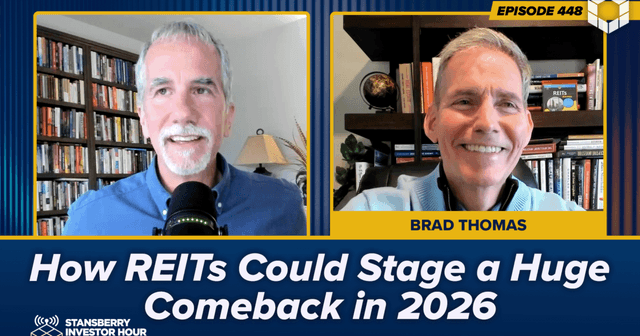

How REITs Could Stage a Huge Comeback in 2026
In This Episode
In this week's Stansberry Investor Hour, Dan welcomes Brad Thomas back to the show. Brad is an editor at our corporate affiliate Wide Moat Research.
Brad kicks things off by stating why he thinks now is a great time to invest in real estate investment trusts ("REITs"). He shares a chart of different asset classes going back to 2010 to show how many times REITs were a leading sector. He then discusses the Federal Reserve, interest rates, and why he isn't worried about their impact on REITs in the long term. Additionally, he talks about how the growing "silver tsunami" is going to create a surge in REITs...
According to AARP, there are nearly 10,000 Baby Boomers [who] cross the 65-year-old threshold every single day. And [the] economic implications of this shift are obvious. Older adults already account for more than half of global health care spending. The older we get, the more our bodies break down... We need treatments to keep going. America's Baby Boomers are either in or entering the most medically expensive years of their lives, and that trend should signal a boom for one corner of the real estate market: health care REITs.
Next, Brad details one company primed to meet the silver tsunami demand. It owns its own buildings and rents off the land while possessing a strong balance sheet. Brad then shares his thoughts on data-center REITs and his previous recommendations in that subsector. He also says that more REITs outside of data centers are increasing their investing in AI. But with energy bottlenecks and other factors, the one concern that investors could have is vacant data centers...
There's definitely a lot more competition in building these data centers, developing data centers. There are a lot of towns that don't want to see these data centers... What does a data center look like when it's vacant in a small town...? What do you do with that asset? What do you do with this piece of property when it's vacant?
Finally, Brad mentions a sector that's boring yet is stable and provides predictable dividends. He provides an example with one company that had a slowdown due to COVID-19 but is starting to come back from the rough times. And he emphasizes Wide Moat Research's goal of meeting with management teams to see what they do for investors...
Part of the thing that I think is really important for us at Wide Moat is to [see how] these management teams really understand the alignment of interest and what their strategy is and how they're going to generate returns for investors. So, I'll be meeting with [one] management team next week... That's a really critical part of our research here.
Click on the image below to watch the video interview with Brad right now. For the audio version, click "Listen" above.

(Additional past episodes are located here.)
This Week's Guest
Brad Thomas is an editor at our corporate affiliate Wide Moat Research. He's a value investor and adviser with more than three decades of investing experience – and a whole lot of lessons learned – under his belt. His focus is on cutting through the hype and noise and investing in reliable, consistent income-based strategies. That helped him become the most widely read analyst on Seeking Alpha, with more than 100,000 followers.
The author of three real estate investing books – including his latest, The Intelligent REIT Investor Guide – podcast host, and public speaker, Brad also teaches at New York University and guest lectures at Cornell University, Pennsylvania State University, and Georgetown University.
Dan Ferris: Hello and welcome to the Stansberry Investor Hour. I'm Dan Ferris. I'm the editor of Extreme Value and The Ferris Report, both published by Stansberry Research. And I'm hosting the show. My co-host Corey is off today. Our guest is my friend and [real estate investor trust ("REIT")] expert Brad Thomas from Wide Moat Research. Brad has been there and done that in real estate. He's been in the sector for decades. He knows it cold. He is a guy we definitely want to check in with if we want to know what's going on with REITs and – real estate investment trusts and real estate generally. So, let's do that. Let's do it right now. Let's talk with Brad Thomas. Let's do it right now.
Brad, always a pleasure to see you. Welcome back to the show.
Brad Thomas: Hey, it's good to see you, Dan. And I'm glad to be back. Really excited today.
Dan Ferris: Yeah, I didn't look up how long it's been, but too long is what I want to say. There's a lot happening in the world. I feel like I need to check in with folks like you more often, so I'm glad you're here. I guess it's hard, this is our first recording of 2026, so there's really only one place to start here, right? I mean, as we spoke before we hit the record button, REITs were not so great in 2025. And it really – you're the one guy I really want to be talking to at the beginning of 2026 about this because I have a contrarian kind of an instinct, so I want to – that's where I want to go if the performance wasn't great. But can you sort of – why didn't they perform so great? And look ahead for me and tell me if you see anything.
Brad Thomas: Yeah, well, Dan, we're probably close to the same age and we both have lived through various cycles and market cycles and recessions and course COVID-19. And so, it's – I think given all of this history – and of course I was a real estate developer for over 20 years before I got into this new career being a Wall Street writer, and I think this is a great opportunity for REITs today. And you're absolutely correct. In 2025 REITs underperformed. We were the worst-performing asset class, returning just 3.3%. And that includes dividends by the way. So, compared to the large caps at about 17%.
I wanted to show you this chart I'm going to put up on the screen here that illustrates the performance of all of the asset classes going all the way back to 2010 – 15 years, you can see. And first here, if you look at the upper left side of this chart, and you can see in 2010, REITs returns were the top performing asset class, returning about 28%. Now, that's of course doing large part to the drastic underperformance we had in 2008, 2009 during the global financial crisis. So, it was a bounce back, not a claw back.
Then, of course, after the crash in 2008, it's because the [Federal Reserve] immediately slashed interest rates to encourage economic activity. So, about December 2008, they had effectively had a – we had a zero interest rate. Now, as you can see here on this chart, again, this was the start of a prolonged period of ultra-low interest rates, where REITs tend to thrive when interest rates are down. So, investors of course piled in. So, you can see the results here. From 2010 to 2012, REITs returned an average of 18%. And they were the best-performing asset class again in 2014 and 2015. So, when the Fed began to raise interest rates in December 2015, of course it increased that cost of capital, so REITs were perceived to be less attractive.
Dan, I want to point out I use this word "perceive" because contrary to popular opinion commercial real estate businesses can still grow nicely in less opportune environments, raising their dividends while also maintaining balance sheets, strong balance sheets. So, when the Fed began to raise rates again in 2017, shares underperformed again. In 2019, REITs were – underperformed, or it was the worst-performing asset class. But, Dan guess what happened in COVID-19, during the period of COVID-19? How do you think REITs perform?
Dan Ferris: Well, I'm sure they crashed along with everything else in March, and then when rates went to zero maybe they kind of took off like a rocket ship. That's what I'm going to –
Brad Thomas: Well, take a look at this chart. You can, you can see again, 2020 RETIs where the worst-performing asset class again. So, returning around 4.7%. But in 2021, they bounced back to the euphoria, up 40%. So, you can see, this is like a zigzag roller coaster.
But one thing I want to notice here, and this is the opportunity that I'm really excited to talk with you about today, is when you see rates coming down you can see REITs move closer to become the number one or the number two best-performing asset class. I think this is the real opportunity set today that I want to tell you about because when you look at REIT performance, the peak-to-trough decline of 33% has happened, which brings a compelling opportunity for both –
33% has happened, which brings a compelling opportunity for both income investors but also for value investors. So, I think that's what I see as a very attractive setup today for REITs.
Dan Ferris: All right. I have one serious question about that, is that if we're counting on lower rates to really push the performance, we've had this thing happening lately where the Fed of course manipulates the short end of the curve, but the long end doesn't necessarily play ball with the short end the way it once did. And of course, the long end, that's where the REITs live. Everything is a long-term, basically, mortgage loan for them. What do you – does that bother you? Does that worry you at all?
Brad Thomas: It doesn't, Dan. As you know – and again, we're not agnostic in terms of our coverage of stocks, and we – I'm sure you and I come from the same school, that earnings drive dividend and dividends drive returns. And so, what we're seeing across the board – and again, looking at these, the health of these balance sheets, a lot of these REITs that we cover, they were around in 2008, '09, and '10. And they learned this valuable lesson to reduce debt and really focus on a circle of confidence and competence. And you're seeing a number of these REITs – most REITs in our coverage universe, they're pure play. They have targeted strategies aimed around certain property sectors. Their balance sheets are in much better shape. And so, we're seeing these fundamentals are strong as ever. So, we're seeing that sentiment down at an all-time low, but yet the fundamentals for the most part are very strong.
Now, the great thing, Dan, about REITs is you can – there's so much now to select from. It wasn't – even going back, say, 15 years, the chart I just showed you – back in 2010, we didn't have data center REITs. We didn't have cell tower REITs. We didn't have farming REITs. We didn't have cannabis REITs. So, now the great thing about investing in this very broad REIT universe, which by the way is – has its own place in the JIX. We're not part of financials anymore. It is a core asset class. That's another important thing to remember here. This is a core asset class.
And look at the performance over the last few years. So, there's a lot of different ways that you can play REITs, invest in REITs, but you've got to understand these different property sectors because it's not just about buying REITs; it's about finding those property sectors that have the best risk-adjusted returns. But you're right. But I do think overall the sentiment has been the big thing. The earnings are really what matter. And we're seeing evidence of that throughout – coming out of the pandemic, but also moving into 2026, '27. And again, with Trump in office, there are some really effective things he's done to accelerate demand within certain property sectors.
Dan Ferris: Yeah, I'm taking him real seriously. He's moving the needle on things. And if I had it my way, the government would not be interfering in the market in this fashion. But you know what, Brad? They haven't called me. I'm sitting here waiting for them to call me to tell them how to run the world and they just won't do it. I mean, the phone doesn't ring. So, I have to work with the world as it is.
And I'm thinking – in my newsletter, The Ferris Report, I'm really going to be all over the Genesis mission, which is the big Trump initiative that goes into all kinds of different areas, biotech and defense and minerals and mining and manufacturing and everything, semi-conductors, lots of different industries. There's lots to do here. There's a lot of work to do and I suspect a great deal of opportunity to be had. And the knock-on effects of what's going on elsewhere too in those industries, it's neat. It's pretty cool. So, what do you – when you look at what Trump is doing, given that you're the REIT guy, what do you see? What excites you about the intersection there?
Brad Thomas: Yeah. Well, of course, Dan, I'm a – as a real estate guy by DNA, I think supply and demand is critical as we analyze stocks, not only REITs, but all the other asset classes. And so, when you look at – one of the trends that I've really focused on, or our team is focused on is this so called silver tsunami. And Dan, as you know – and actually I've looked at some research. According to the AARP there are nearly 10,000 baby boomers across the 65-year-old threshold every single day. And that economic implications of this shift are obvious.
Older adults already account for more than half of global health care spending. The older we get, the more our bodies break down. And mine breaks down practically every single day, Dan. I don't know about you. But this means we need treatments to keep going. America's baby boomers are either in or entering the most medically expensive years of their lives. And that trend should signal a boom for one corner of the real estate market and health care REITs. And we saw a Welltower, which is a company within our coverage spectrum. The ticker symbols is WELL, W-E-L-L. They were up 50% last year.
And so, while REITs were the worst-performing asset class in 2025, if you would have bought Welltower, you'd have seen 50% returns. Now, we're not buying Welltower now. We think shares are trading like 40 times their price-to-AFFO, their earnings multiple. But one company we are buying and we do like is a company called Healthpeak. That ticker symbol's DOC, D-O-C, so that's easy to remember. They own medical office buildings, life science properties. You mentioned biotech. I fully believe there's going to be strong demand, continuous demand fueled by tremendous technology advantages within the life science space. And they also own senior housing. Now, earlier this week, I talked with the chairman of Healthpeak, John Thomas, and he was telling me about the spin.
So, they're spinning off – and we think this is another compelling opportunity, by the way. They're spinning off their senior housing business. It's about a $3 billion transaction spin. But one of the reasons that Healthpeak is trading so cheaply now is because of that life science exposure. Unlike REITs like Alexandria, ticker A-R-E, which many people are familiar with, they recently cut their dividend, Healthpeak didn't participate in that overbuilding, that new supply stream that came in coming out of COVID. So, they're a lot more disciplined in their development approach. They also maintain a really strong balance sheet and capital structure, their debt-to-earnings, they're over – EBITDA is about 5.3 times as of the third quarter, and they have about $2.7 billion dollars of liquidity.
Now, all investors, all dividend investors like to focus on the safety of that dividend. Healthpeak has a conservative payout ratio of around 72%, which suggests the company will be able to increase that dividend. When I spoke with the chairman this week about the spin, I did ask him if they were going to have to cut the dividend as it results to spinning off those $3 billion dollars of senior housing. He said absolutely not; they'll maintain that dividend. And I think that was a very wise move, by the way, for that spin. It's going to – because the shares are worth a lot more, 40 times Welltower, so you can see there's some value creation along that, along those lines.
Dan Ferris: OK. I have a couple quick technical questions.
Brad Thomas: Sure.
Dan Ferris: Well, one is just for our listeners. AFFO: adjusted funds from operations.
Brad Thomas: Yes.
Dan Ferris: Funds from operations is the sort of free cash flow of REITs, is that fair? I think that's how I think of it.
Brad Thomas: Yeah. Yeah, it is. It's the earnings multiple. And again, because REIT have real estate, we have depreciation, we have CapEx. There are some items that are GAAP metrics. So, FFO is a GAAP metric. AFFO is more of a subjective metric. But nonetheless, the AFFO was kind of that freest form of cash flow after taking out all the CapEx expenses to derive it at really the most meaningful form of free cash flow. And that's the number you want to use when you compare that to the dividend because that's going to give you the most accurate payout ratio. And so, now, again, there's several different ways to utilize AFFO. And by the way, in my book, REITs for Dummies I explain and break down all the components of FFO and AFFO. But that is –
Dan Ferris: All right, everybody. Read the book. Yeah. Read the book. Read Brad's book. OK, so that's the answer to that. Read the book is the answer to that question.
Brad Thomas: Yeah, there you go.
Dan Ferris: The other one was net debt to EBITDA five times. Did you say that?
Brad Thomas: Yes.
Dan Ferris: Because when I've seen ne debt to EBITDA five times in the corporations, the normal C corps traded, publicly traded corporations that I recommend, I go "Hmm, that seems high," because I like two or three usually. But you're cool with five? Five is good. This company has a good balance sheet, you're telling me.
Brad Thomas: Yeah, they do. I mean, they have their – I believe they're either BBB or BBB-plus. I think they're BBB-plus. So, certainly they've got some very strong credit ratings.
Dan Ferris: Investment grade. Yeah. Yeah, that is investment grade. All right. But I just – just as an analyst hearing is there something different about REITs that I should know that makes you more comfortable with five times EBITDA or net debt five times EBITDA? Or do we just differ in that? I mean –
Brad Thomas: Well, yeah. I mean, what I was referring to, I think, Dan, is – and again, I meant debt to earnings. That's before interest, tax, depreciation, and amortization.
Dan Ferris: OK. Never mind. Sorry. Never mind. Anyway, there's a nice technical digression that doesn't apply and you can all take notes and think about that. But let's get back to what you're talking about. Sorry.
Brad Thomas: Yeah. So, and again, in terms of the valuation of Healthpeak, I think this is – they've sold off dramatically. Again, that life science selloff, there's a lot of fear in the life science space, again, due to the overbuilding and vacancy rates. But again, shares are trading at 9.7 times, so below 10 times. Their normal multiple is around 16 times. So, again, look at Welltower trading at 44 times. Now, a little different property sector, senior housing versus life science and MOBs, or medical office buildings. But the dividend yield is really what's attractive here in terms of the valuation. Their yield's about 7.4%. So, we believe this company could deliver returns in excess of 25% on an annual basis when you take in part – of course, the dividend – the growth. The growth will not be as strong. And Welltower obviously is trading at 40 times because they've got double-digit, mid-double-digit – high-double-digit in fact growth, whereas Healthpeak is – you're not going to see that growth. Medical office buildings are just a fairly boring business, kind of like a net lease business model, because they are going to grow by 4% to 5% per year. But still, we think with the price appreciation opportunities, this is unfolding to be another really attractive opportunity.
Now, Dan, I want to pivot over – we're talking – I mentioned about silver tsunamis. Another company I like – again, not health care, but this is a company that is still riding that same aging population demand, is Equity Lifestyle. And I don't know if you're familiar with Equity Lifestyle, E-L-S.
Dan Ferris: Right. I've heard of it, yeah.
Brad Thomas: I got to meet with Sam Zell before he passed away. I was in Chicago –
Dan Ferris: Oh, no kidding. I'm jealous. That's awesome.
Brad Thomas: Yeah. Yeah. Yeah. Well, actually, he provided me a testimonial for my previous book, believe it or not, and when he passed away I actually dedicated the last book I wrote to him. So, I think a lot of Sam Zell. Very smart. Very smart investor. But he was involved with the startup of Equity Lifestyle. And they have 455 properties. They consist of manufactured housing properties, RV, resort properties, campgrounds, and marinas, mostly in North America.
And what I really like about Equity Lifestyle, most of those assets are in the Sunbelt markets, which are, of course, retirement destinations. Again, going back to that silver tsunami theme, 70% of their manufactured housing properties are age-qualified, which have residents of 55 and over. In fact, nearly 50% of those residents are age 70 or older. So, again, that's part of that silver tsunami trend.
This is also a play on affordability. It's not expensive to rent space in one of these properties. Equity Lifestyles, renters pay about 20% to 25% less per square foot than the average two-bedroom rental. So, Trump's focused on his affordable housing. Well, here you go. This is one of the most affordable property sectors. And many of these – Dan, I don't know if you're aware of this, but many of these parks, they're actually on ground leases, which is, I think, the safest asset class. So, the – they own the – the tenant in fact owns the building and they just rent the land. So –
Dan Ferris: Now that's a business.
Brad Thomas: It's a great business to be in. And so, Equity Lifestyle, again, like a lot of these REITs, they've sold off. And Equity Lifestyle, just like Healthpeak, has a very strong balance sheet. They've got a billion dollars of liquidity when you combine with their lines of credit and the ATMs that they have in place. So, we think that's going to be a tremendous opportunity. Again, could deliver some very strong returns here for investors in 2026, again, driven by this silver tsunami effect.
Dan Ferris: The silver tsunami. At first, I thought you – I was like "Is he going to be talking about silver mining?" No, you're talking about silver-haired people driving economic developments in the world. Yeah. OK. That's pretty cool.
Brad Thomas: Yeah.
Dan Ferris: You hear – when I hear somebody make demographic arguments over the years, I've been like "A billion people in China are going to buy refrigerators" sort of argument. I just throw them all in one bucket. I'm like "Hmm." But this is a good one. And it's – it's a good one – you know why it's good? Because it's not in the future. It's happening right now.
Brad Thomas: Exactly.
Dan Ferris: That's why that's why I buy it.
Brad Thomas: Well, Dan, and we're living it, man. We're – you and I are both living this.
Dan Ferris: Yeah, the idea – that's right. We have a little bit of skin in that game. So, I'm buying it, Brad. I'm buying it. And I may be literally buying it. I'll have to look at these.
So, yeah, that actually – that is the exact sort of thing that I would expect from you because there's a contrarian element here. It's great. One thing that's not a contrarian play right now, I would assume, is data center REITs. I have to ask you about this because it's sort of like – I feel like on the podcast we've got to talk about the stuff absolutely everyone is constantly hearing about every minute of every day. You never stop hearing about AI. You never stop hearing about data centers. So, I think it's doubly important actually to check in with people like you who are focused on some portion of the market relative to these things that we – these narratives that we can't get out of our head. Do you care about data center REITs? Do you own data center REITs? Do you recommend them? Are there some that you like, some that you hate? How do you feel about them?
Brad Thomas: Yeah. So, Dan, I guess you could say I'm an early mover in data center REIT coverage. I started covering data center REITs really when they started to form. We had – one of the first ones was Digital Realty, which we picked up coverage on just as they became a REIT. Then we picked up coverage in a company called CyrusOne, which was sold during 2020, I believe, to KKR and another institutional partner. We have Equinix and – which is a very large data center REIT. We've had other data center REITs that were existing, or were sold, or there's been some M&A in this space. There's a company called CoreSite, which was actually acquired through an M&A deal by American Tower. And then we had one called QTS based out of Atlanta that was acquired by Blackstone.
So, we think there's – and there's other REITs that are not necessarily pure play data center REIT companies. I mentioned American Tower. Iron Mountain is another example. Most everybody is familiar with Iron Mountain because of the trucks and the shredding and all of that. But the company has really evolved into a digitization, a data play. Obviously, paper is not as in high demand like it used to be. People are scanning it and putting it in the cloud. So, Iron Mountain has really adapted and we've watched the evolution of that company. We think that's a very great company that has a tremendous runway for growth as well.
So, the great thing about data center REITs is you're able to generate – these REITs are able to generate really higher growth than traditional REITs. So, the average REIT's going to grow by 4% to 5% a year, but the data center REITs – it is nice. And especially, again, all of that power of compounding adds up. But again, I think the data center REITs with this AI demand that we're watching right before us unfolding, we think this is a great area to be investing in, not only just the data center REITs. And we cover the energy space and utilities as well, so obviously you've got to have utilities for those data centers as well. So, we think kind of a combined infrastructure, all-in kind of infrastructure play is really what we're really focused on here at Wide Moat research because I think that – in terms of real estate, that's going to create some really attractive opportunities.
Now, I will say, Dan – I'm actually doing a research report on this now for Wide Moat research. I think that you're seeing a lot of REITs that are investing in NAI. In fact, most REITs should be, if they're not. Companies like – we cover Public Storage, for example, which is one of the leading self-storage landlords in the world. They're the – they've got the orange doors; you've seen them. And they've invested a tremendous amount into technology, which they utilize for site selection and sourcing sites, for managing their customers, for managing rents. They've got all types of technology where they can – they know in real time what the pricing power is really how – it comes down to in terms of storage, because these are month-to-month contracts – unlike a net lease REIT, which is a 15-year lease contract, the self-storage business is month-to-month. So, utilizing technology – again, this AI that they have within their business, they're able to grow their earnings consistently at a much more rapid rate and retain customers. So, I think you can really see AI expanding to all elements.
Now, one other thing I want to mention is logistics warehousing, because we're looking at the robotics and what goes inside these warehouses and all of the technology that's driving growth within the logistics and the REIT warehouse space. So, I think that's another area that you could seek to invest capital, not only data centers and the energy utilities, but also these warehouses. I think that's certainly a continual demand driver that we see unfolding in that sector.
Dan Ferris: All right. An early mover on data center REITs. How about that? If you say data center REITs to me, I just spit out Digital Realty and Equinix and I don't know anything else and I hardly even know anything about those two. So, it's, it's good to hear you talk about them.
I wonder overall if we could just, I don't know, just be a couple of old guys pontificating for a minute, I wonder about data center buildout overall because it's aggressive. It really is aggressive. And we all know energy is a serious bottleneck. The power grid is a bottleneck. They're going to have to build their own generation if they really want to keep this up. And I found another: Diesel is a bottleneck, or a potential one, a potential huge one because they all – 95% of them use diesel generators as backup power. And even in California, it's like 90%. In California. I mean, so I don't know. Do you have any thoughts about – I'm not even talking about whether or not data centers and AI is a bubble. I don't care about that anymore. What I really care about is the bottleneck of energy in data centers. And as a guy who was an early adopter in data center REITs, do you have a viewpoint about this? Do you think about it? Does it bother you? Does it not bother you.
Brad Thomas: Yeah, I think, first of all, there's definitely a lot more competition in building data centers, developing data centers. There's a lot of – they're coming to a lot of towns. There's a lot of towns that don't want to see these data centers. The jury's out as far as what is it going to – what does a data center look like when it's vacant in a small town? And we also cover the prison sector, by the way and – which is also an interesting space, by the way. Highly political, I might add. And – but the question is what do you – if you invest in a prison, what happens when the prison goes vacant? What do you do with that asset? And I have the same argument, by the way, with Topgolf. We cover the net lease space and there's a number of net lease rates that own Topgolfs. And I always think "Well, that's a great trend." Is it a fad? I don't know. I like Topgolf. But would you want to own a $40 million Topgolf when it's vacant and there's no – what do you put in there, a church? I don't know.
Dan Ferris: Yeah, it's a big – that's right. Yeah.
Brad Thomas: So, the question is what do you do with this piece of property, this data center when they're vacant? Now, what I'll say is – I mean, first of all, we covered an IPO recently last year called Fermi, which is kind of – Rick Perry is an investor. Governor Perry's an investor in this deal.
Dan Ferris: Love Rick. Great guy. Yeah.
Brad Thomas: Yeah. Yeah. And we recommended to avoid the company. Obviously, we avoid many IPOs for obvious reasons. And – but we recommended avoiding that. And of course, I'm – I think we made a good call there because shares are now down to maybe sub-$10. You would have lost a lot of money with that trade early on. I mean, and Fermi, there's a great example here. There's an IPO, a data center REIT, they have basically one property, a huge campus that they're building, but all they had was a blueprint. They had a piece of land that was a ground lease and a blueprint and they had investors just pile into a blueprint. They hadn't even – we won't even have the building up yet. And so, there's definitely a lot of –
Dan Ferris: And this was a REIT? They went public as a REIT?
Brad Thomas: Yes. Yes. Yeah.
Dan Ferris: A REIT with no property. I mean, that's a little weird.
Brad Thomas: It is. It is.
Dan Ferris: That's a red flag, folks.
Brad Thomas: Yeah. I had friends texting me, Dan, and they're like "Man, should we buy in? Should we buy in?" I forget the actual pricing, but it just – there was so much money that went into that. And then all of a sudden the euphoria cooled down and people realized where it is.
And so, yeah, I think you're going to see a lot of those – a lot of companies are going to get into the data center base – space. But one thing that I've – and this is not just in the data center REITs, but again, kind of looking at these REITs that we cover, I mean, these are large companies, Dan. They're not private entities. They have transparency. For the most part, they have very good management. You've got the governance in place. Obviously, the SEC, all the reporting, And one thing we're doing at Wide Moat Research, which – because you make a great point. And I'm trying to help educate investors and really our customer base on exactly – this CapEx element is really, I think, critical and – because we want to see how sustainable, first, is this – are these earning streams that are going online, and all of this demand with these hyperscalers that we're seeing today.
But exactly in terms of accounting, I think that's really critical, is drilling down to – for example, we know what – I mean, first of all, let's go back to the beginning of data centers. So, what happened in the data center space, and I think Digital Realty, I think, was the first entrant into the REIT space. But to qualify as a REIT, the company has to have 75% of its assets invested in real estate, or they don't have to even own it; they can lease it too. OK?
But the big thing that had to occur in the REIT space is these racking systems, OK, not the building but the racks had to be established as real estate – technically in legal terms, real estate to pass the IRS ruling, the private letter ruling, PLR, so that they could qualify as a REIT. And once that occurred and the IRS said, "Check the box," then all of a sudden you have the floodgate open of all of these – we had five or six different REITs.
Now, again, some of those have gone through M&A. We only have two pure plays now. Well, now we've got the Fermi one. Three. But I think we'll definitely have more data center REITs coming online. But that law is really the critical part of it. That's how Iron Mountain, by the way, if you look at Iron Mountain, they were a C corp for many, many years, and then they were able to get that private letter ruling because those racks where all those documents and all your tax returns and bank statements that are maybe in an Iron Mountain building somewhere, those racking systems also became part of the real estate, which allowed Iron Mountain to become REIT-qualified. So, there you go.
Dan Ferris: That is so weird. I never knew this. That is weird. What a weird kind of legal technical thing. I mean, the racks had to become part of the real estate. I mean, what were they, alien invaders before? I don't – were they tenants? I mean what – it's property. It's in a building.
Brad Thomas: When I took my first real estate class in college, when I looked at real estate I thought "OK, apartment complexes, shopping centers" And now – I mean, again, this is great for investors, by the way, because now we have – individual investors have access to all of this commercial real estate. Again, we've got farming now. We've got cell towers, data centers. I mean, we cover a company now, Dan, that's actually not a REIT yet. I think they will be. I'm actually meeting with their management team next week for Wide Moat research, the CEO. But they're in the jet hanger business. I mean, think about it. You get – you can invest in these hangers. And by the way, guess who's a tenant? Elon Musk, by the way. Nice rent check, by the way.
So, there's all types of ways to invest in real estate, is my point. And I think 2026 – again, with – again, rates coming down, it's certainly going to be a catalyst. But at the end of the day it comes down to supply and demand in real estate. And what we try to do at Wide Moat is look at those asset – those property sectors where we see the best opportunities unfolding with supply and demand. And I just mentioned, like I said, that silver tsunami, that is undeniable demand that we're seeing. You and I are living through this right now. So – and the same applies to the data center space. We're seeing this – all this hyperscaler demand.
Dan Ferris: Yeah, that's not in the future. It's happening.
Brad Thomas: Exactly. It's here. It's here.
Dan Ferris: It's here. Yeah. It's here in a huge, huge way. Nobody can ignore it. And it affects – it's literally like the internet. AI is like the internet. It affects every person and every business.
Brad Thomas: Yeah.
Dan Ferris: It's just – you can't get out of the way. Which it makes our job – in one way it tells us what to focus on because if you don't focus on it, you could make a big mistake. But it's a massive, massive, massive trend. And it's cool that you can get at it through real estate and through REITs, I think.
Brad Thomas: Yeah.
Dan Ferris: Yeah. So, you gave – let's – I feel like we should list like the tickers that you like, that you've mentioned. DOC is one. ELS is another one. Did we mention anything else that you like?
Brad Thomas: I like a lot. I know you don't have a lot of time, but –
Dan Ferris: That's OK.
Brad Thomas: – I will say there's one sector, and I think, actually, last show I talked about this sector, and I'll I mention one name or two. But the net lease space, I mentioned it's kind of a boring space. You're not going to get double-digit growth out of these freestanding properties. But again, that – this is a sector that is extremely fragmented. You've got them all up and down. Every town has a FedEx building, a Dollar General building, a Sherwin-Williams building, freestanding properties, casinos. And again, this whole net lease sector has really evolved into a much larger institutional asset class. And again, those shares have been punished. They've been whipsawed on 2025.
So, out of that carnage I think there's some really good net lease opportunities that are not only going to provide very – they're not only going to provide the stable and predictable dividend income – and by the way, 5% dividend roughly in that space on average – but you're going to get – so, you're going to get the growth – you get the 5% dividend, you get the 5% growth, so you've got 10%. OK. But then shares are down 10% to 15%. Companies like VICI. I'll throw that one out. We just wrote about VICI. V-I-C-I. Just wrote about it in our newsletter daily, Wide Moat Daily. And Las Vegas has sold off, there's been less demand, but look at that – the latest conference we had, the CES conference this week. I mean, look at all these conferences. Look at all the sports that's coming in this market. And we're not only covering the landlords like VICI that own and lease back these casinos – we're covering the gaming sector because we want to understand those demand dynamics as it relates to that submarket and that industry.
And so, I think VICI is definitely a name to look at. Again, they've sold off primarily because of the slowdown in Vegas, but Vegas is coming back. And if you want to bet on Vegas and a net lease player that has a really attractive dividend yield and upside, I think VICI's a great fit. And by the way, I'll be in New York next week, and I'm going to meet with the management team there at VICI as well, because that's part of the thing that I really think is important for us at Wide Moat, is to sit down with these management teams and really understand the alignment of interest and what their strategy is and how they're going to generate returns for investors. So, I'll be meeting with that management team next week as well.
Dan Ferris: You meet with a lot of management teams.
Brad Thomas: It's – I try. That's my goal. And not all. But I – next week will be a two-for-one because I've got VICI in New York and this jet business is right outside in White Plains, I think it is, or right outside of New York.
Dan Ferris: Yeah. That's cool that you can do that. I've done it in – with smaller companies, but when I write about Costco, that guy just is not going to have time for me. We write about Berkshire. [Warren Buffett's] a little busy for Dan. You know what I'm saying?
Brad Thomas: Oh, by the way, I will tell you this. I haven't set up the appointment, but I'd really like to try to meet with Bill Ackman. I was able to meet with him a couple months ago. And we're covering his companies. The whole Fannie Mae/Freddie Mac thing is really interesting to see kind of – we think that'll IPO probably next year. But not only the management teams, but I like these – I like to meet with these not necessarily billionaires, but certainly ultra-high net worth investors. I mean, that's another really critical part of our research here.
Dan Ferris: That's very cool. Yeah. You're an on-the-ground kind of a guy, aren't you?
Brad Thomas: I am. Well, Dan, I have five kids. I have two grandkids and I have two more coming. So, I have to work. And one of these days I'll go to six days a week, but unfortunately, I'm hitting seven days a week. But I love what I do and I love helping our customers. And that's really what drives me every single day.
Dan Ferris: All right, good to hear. I think we're actually ready to ask our final question, which is the same for every guest no matter what the topic. Even if it's a nonfinancial topic, I ask them this identical question. Everybody gets this identical question. And it is simply – it's for our listeners benefit. If you could just, Brad, provide them with one takeaway, with one thought that you'd like them to take away from this, what would that be? And if you've already said it, feel free to repeat it. That's fine. But what's that one thing you want them to take away from what you're telling us today?
Brad Thomas: Well, Dan, earlier in the show, I just started out and I showed you that chart going back to 2010. I didn't show you the chart going back to 2008, 2009. And it was ugly. It was ugly for REITs. I should have done that. But I lived through that. I lived through that mess. That Great Recession was awful. I was in the real estate business. I was unwinding a really bad partnership. And it just about put me under. I mean, and my kids were younger then. They were – I think I had one in diapers or just coming out of diapers and it was – those were some very tough periods and I had substantial losses in my business. A bad business partnership. And of course, the Great Recession. It really was difficult. And that led me to become what I am today, which is a writer, a Wall Street writer. I'm honored to be on your platform and part of the MarketWise company, but I've gone through losses. So, really my – what drives me is helping investors. Steer them away from those losses. And I can – I've drank that Kool-Aid. I've gone through it. I'm battle-tested. I've gone through recessions, great recessions, COVID. And again, I think that's really been important to me –
[Audio cuts off]
[End of Audio]
The Five Best Turnaround Stocks in 2026 to Buy Now
These Energy Stocks Are Still Cheap... Not for Long
This One Filing Can Tell You When to Buy or Sell Stocks

The Mag Seven Trade Is Breaking... Here's What Comes Next